Just like expectant parents may need to “baby proof” or “childproof” their homes before welcoming a newborn, would-be dementia caregivers might need to make safety (and other) changes in order to provide a functional and secure homecare environment.
Given the research we do for this channel, I am no stranger to surprising, sometimes controversial—and occasionally disgusting—claims regarding Alzheimer’s disease.
In a previous video, we explored how something as mundane as earwax buildup—or, more technically, cerumen impaction—could lead to hearing loss and, by extension, cognitive decline.
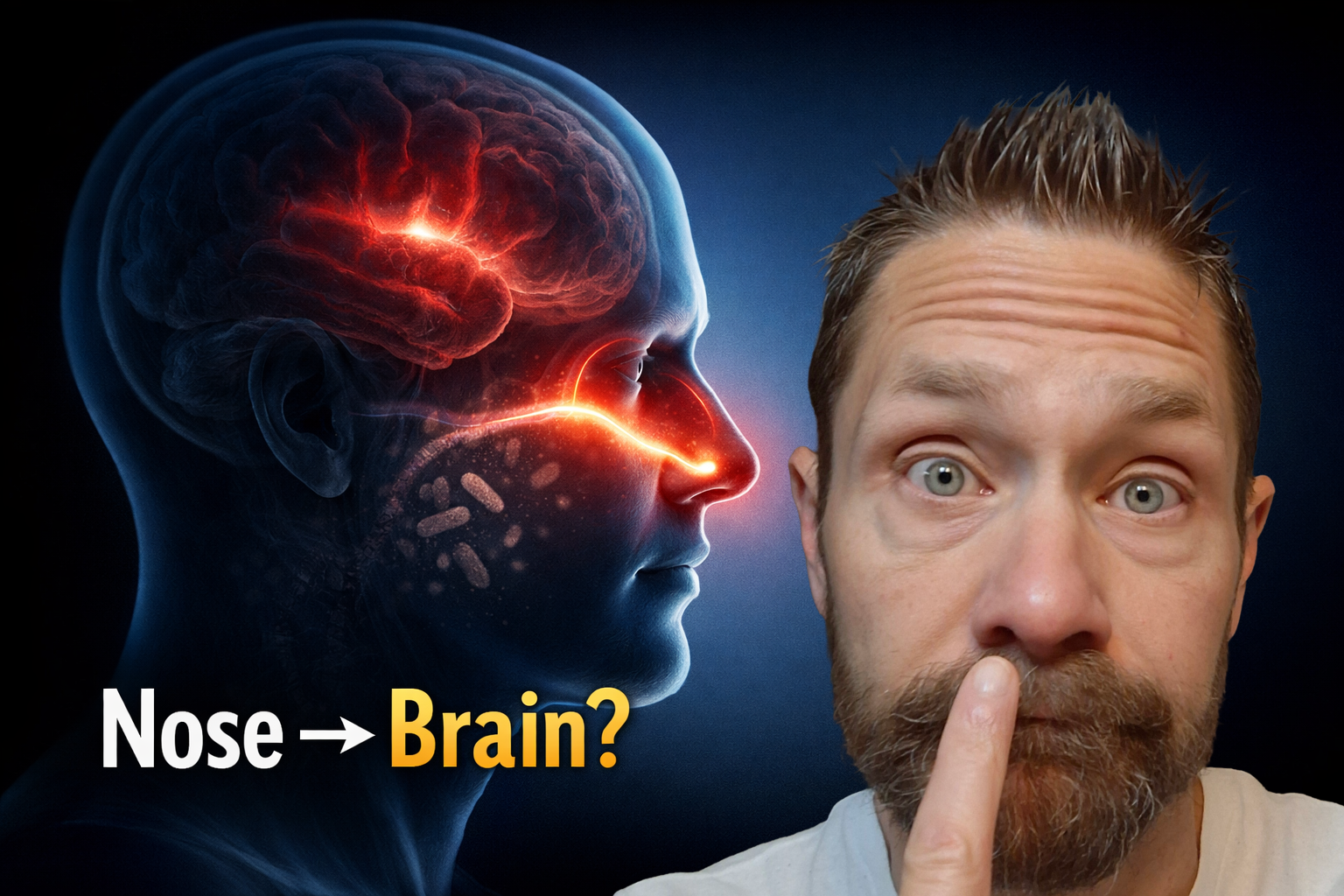
Today, we’re looking at a physical habit.
It’s often dismissed as a minor social faux pas—and was even the subject of jokes in an old Seinfeld episode. But recent research suggests this common behavior might create a pathway for certain pathogens to reach the brain.
We’re talking about nose-picking—and its potential link to late-onset dementia.
For the companion video, see here:
The Griffith University Study
A team of researchers at Griffith University in Australia published a 2022 study in the journal Scientific Reports. They focused on a bacterium called Chlamydia pneumoniae.
This common airborne bacterium—sometimes called the Taiwan Acute Respiratory Agent—is primarily known for causing bronchitis and pneumonia. However, it has also been detected in a significant number of human brains affected by late-onset dementia.
Using mouse models, the researchers tracked how this bacterium travels. What they found was striking: it can move along the olfactory nerve—from the nasal cavity directly into the brain.
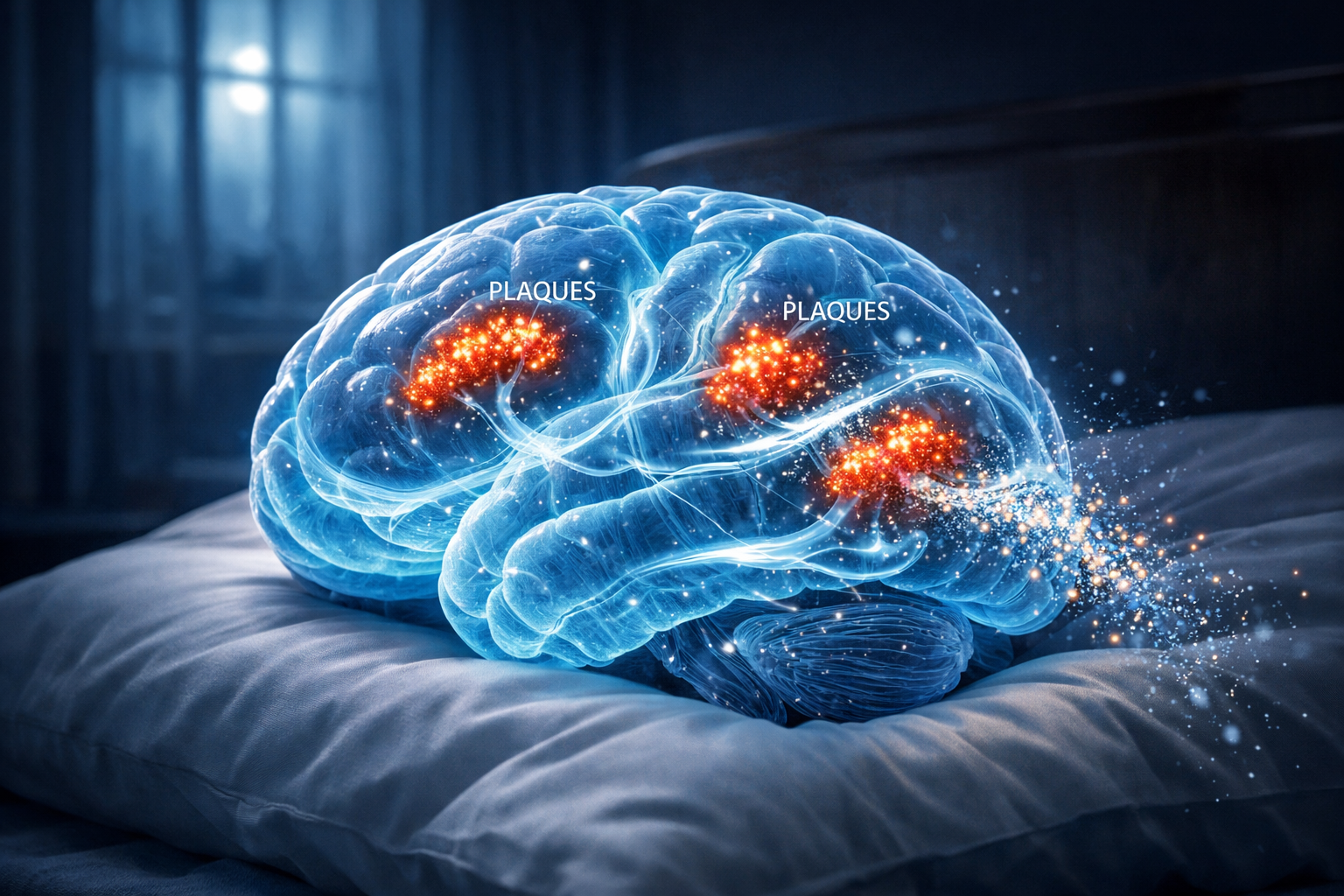
In these models, infection reached the central nervous system within 24 to 72 hours. Once inside, it triggered amyloid-beta deposition—the same protein associated with Alzheimer’s plaques.
One interpretation is that amyloid-beta may function as part of the brain’s immune response to infection. However, if that infection becomes chronic or repeatedly facilitated—potentially through damage to the nasal lining—this process could contribute to neurodegeneration.
In short: this research suggests that certain behaviors might make it easier for pathogens to access the brain.
Connection: The Earwax Analogy
You may remember from our earwax discussion that conductive hearing loss involves a physical obstruction—something like earwax blocking sound transmission.
In a similar way, the nasal epithelium acts as both a physical and immunological barrier.
The Griffith University study found that when this barrier was damaged, infections in the mice became significantly more severe.
Think of the nasal lining as a security checkpoint: if it’s intact, most threats are stopped. If it’s compromised, things can slip through.
Just as we cautioned against inserting objects into the ear canal, scientists now warn that picking—or plucking nose hairs—can damage this delicate lining. That damage may give pathogens a clearer route to the brain.
Why This Matters
As geriatrician Maria Carney noted in our earwax discussion, “most people don’t even realize that they have an issue.”
That lack of awareness is a recurring theme in both Alzheimer’s prevention and detection.
While nose-picking is often associated with children, it remains common in adults. In fact, one study found that about 91% of people admit to it.
I’m curious how that compares with this audience—so I’ve put up an anonymous poll if you’d like to weigh in.
As many viewers know, age alone—especially over 65—significantly increases Alzheimer’s risk.
If we add environmental exposures, such as introducing pathogens through repeated nasal damage, this could represent an additional, potentially modifiable risk factor.
Caveats and Disclaimers
To be clear: this is early-stage research conducted in mice. We do not yet have direct evidence that this pathway operates the same way in humans.
Human trials would be needed to confirm whether a similar mechanism is at work.
And of course, Alzheimer’s disease likely involves multiple contributing factors—including acetylcholine loss, plaque formation through other mechanisms, neurofibrillary tangles, and nutritional or metabolic influences.
So yes—this hypothesis may sound farfetched.
But it is being seriously explored, and it may be worth paying attention to.
Practical Advice and Conclusion
One of the core goals of the Alzheimer’s Proof project is prevention. And unfortunately, there is no single solution—no magic bullet.
What we can do is try to stack the odds in our favor.
Protect the Barrier
Avoid plucking nose hairs and minimize behaviors that could damage the nasal lining. Chronic irritation may increase vulnerability.
Use Safer Alternatives
If needed, consider electric trimmers for grooming. For congestion, saline sprays or nasal irrigation may help. If using a neti pot, always use distilled or properly purified water.
Keep It Clean
If you must manually clear your nose, ensure your hands are clean—before and after. Also keep fingernails trimmed and smooth to reduce the risk of micro-injury.
Stay Aware
Consult a healthcare provider if you experience persistent irritation, bleeding, or signs of infection.
The key takeaway here isn’t panic—it’s awareness.
Small habits, repeated over time, can shape long-term brain health.
And if reducing Alzheimer’s risk comes down—even in part—to eliminating preventable factors, then even small changes may be worth considering.
Anu Chacko, Ali Delbaz, Heidi Walkden, Souptik Basu, Charles W. Armitage, Tanja Eindorf, Logan K. Trim, Edith Miller, Nicholas P. West, James A. St John, Kenneth W. Beagley, and Jenny A. K. Ekberg, “Chlamydia pneumoniae can infect the central nervous system via the olfactory and trigeminal nerves and contributes to Alzheimer’s disease risk,” Scientific Reports, vol. 12, no. 2759, February 17, 2022, <https://www.nature.com/articles/s41598-022-06749-9>.
What if a simple sleeping pill could help the brain wash away the very proteins linked to Alzheimer’s disease? A surprising new study suggests that an already FDA-approved insomnia medication may do exactly that.
Researchers have found that a common, Food-and-Drug-Administration-approved sleeping pill might actually reduce the buildup of toxic proteins linked to Alzheimer’s disease.
Today, we’re diving into the reportage of the science behind this discovery. And we’ll discuss a bit about what it could mean for the future of dementia prevention.
The Study
First thing’s first: The study we’re concerned with was written up in an article titled “Suvorexant Acutely Decreases Tau Phosphorylation and Aβ in the Human CNS,” which was published online in the March, 2023 edition of the scientific journal Annals of Neurology. And it was printed in a hard-copy version in July of the same year.
To understand the study, we first need to understand how the brain ‘cleans’ itself (quote, unquote) during sleep.
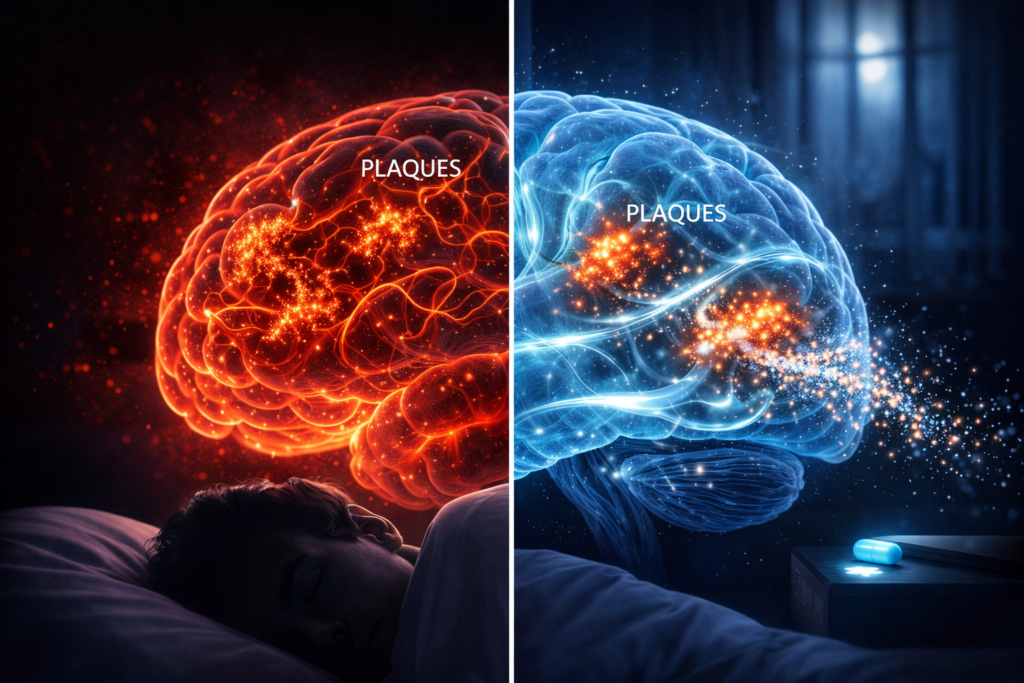
While we sleep, our brain uses something called the “glymphatic system.” Think of it like a biological dishwasher. It flushes out metabolic waste that builds up while we’re awake.
Two of the most dangerous types of “trash” cleared out by this glymphatic system are amyloid-beta and tau proteins.
Of course, viewers of this channel — not to mention anyone with a basic familiarity of Alzheimer’s — probably won’t fail to recognize these words.
After all, it’s these proteins that, when not cleared effectively, clump together into the notorious “plaques and tangles” that constitute the hallmarks of Alzheimer’s disease.
This is one reason why chronic sleep deprivation is often cited as a major risk factor — alongside advanced age, of course — for cognitive decline.
Suvorexant
Enter a drug called suvorexant, known by the brand name “Belsomra.”
It’s a type of drug known as an “orexin-receptor antagonist.” Oversimplifying, orexin is a molecule in the brain that keeps us awake and alert.
The idea is that, by blocking orexin, the drug suvorexant may encourage the brain to transition into sleep.
Researchers at Washington University School of Medicine in St. Louis, Missouri wanted to see if using this specific drug to “promote” or “enhance” sleep could help to lower the levels of the aforementioned toxic proteins.
To this end, and as scientific studies typically do, they took a group of thirty-eight healthy volunteers, aged 45 to 65, and gave them either a dose of suvorexant or a placebo before bedtime. Researchers then monitored the participants’ cerebrospinal fluid over the next 36 hours.
What Happened?
To hear them tell it, the results were striking.
In the subset of participants who took the higher-than-usually-prescribed dose of suvorexant, levels of amyloid-beta dropped by 10 to 20 percent, compared to the placebo group.
Even more significantly, the same group saw a drop in “phosphorylated tau” — a form of the tau protein that is particularly closely linked to brain-cell death and Alzheimer’s- disease progression.
What makes this exciting is that it wasn’t just “better sleep” clearing the brain (in some vague sense); it was a specific intervention that seemed to target the very precursors of Alzheimer’s pathology.
Caveats
However, before we get too ahead of ourselves, there are some major caveats.
This was a very small study, and it only lasted for two nights. Therefore, researchers cannot yet say if taking this medication, long-term, will actually “prevent” dementia, or if the protein levels will stay low once the medication is stopped.
The researchers themselves prefer to refer to this as something more like a “proof-of-concept.”
Of course, we would want to see much longer trials to decide if the observed reduction in proteins actually translates into a predictable — and reliable — reduction in cognitive decline.
That said, this study confirms that the intersection of sleep medicine and neurology is one of the most promising frontiers in medicine. And it suggests that we might eventually treat sleep not just as a lifestyle habit, but as a clinically significant tool that may help us to maintain brain health as we age.If you’re interested in the full details of the study, click for the ScienceAlert article or for the original paper. We hope you rest a little easier tonight!
The easy – and probably unhelpful – answer is: “Sure, it’s possible.” – said, of course, with suitable emphasis on the final word!
After all, anything is supposed to be possible. Right?
But what we’re really asking is: Can I manage it? Will it work in my situation?
And the frustrating reality is, I don’t know.
What I can do is speak from my own experience and research.
But after it’s all said and done, you’ll have to look at this picture, talk it over with family and trusted advisers, and decide whether it would be feasible and realistic for you.
Perhaps the least useless thing I can do is to try to paint a picture of what solo caretaking might look like in the hope that it will give you a framework for your own decision making.
So, strap in, and we’ll start to think through the question: Can you be a caretaker all by yourself?
Preface
I’ll be speaking broadly. I’ll talk about a way solo caretaking could look, drawn from when I was the at-home caregiver for my dad, who died from Alzheimer’s Disease in 2016. I started caring for him in 2008. But we’ll also talk about caregiving variations, based on my research.
The main thing I want to do is to provide you with a blueprint for having a conversation. You will want to talk about possible caregiving scenarios – and pitfalls – with family, friends, and trusted advisers. So, my hope and expectation is that you’ll take what you find useful and leave the rest.
As an “assist,” I’ve prepared a step-by-step guide that you can feel free to download. It’s possible that you can simply Google “Alzheimer’s Proof Caretaker’s Guide.”
But, search engines can be a bit dicey sometimes. So, you can always just point your web browser to AlzheimersProof.com and navigate to it that way.
Introduction
This video was prompted by a viewer-submitted question. As I reflected on the viewer’s situation, one thing I realized is that it is extraordinarily difficult – bordering on being practically impossible – to be entirely solo as a caretaker.
As we move along, it’ll become apparent why I say this. But, what I sincerely hope is that you may also discover, upon reflection, that you’re not actually all by yourself. Or, at least, if you are genuinely alone, then I hope you may come to a deeper understanding of the challenges that lay ahead of you. Not to compound your worries! But simply to enable you to better plan for, and adapt to, circumstances as they arise.
Caretaking Rôle vs. Household Composition
First thing’s first. We should try to clarify what we’re talking about. You’d think that “solo caregiver” is fairly self-explanatory. But I think there are subtleties that need to be made explicit.
What does it mean to be “solo”? There are at least two senses.
‘Solo’ in a Caretaking Sense
Firstly, there’s a caretaking sense. By “caretaking,” I mean assisting your loved one with the Activities of Daily Living (ADLs) – which I explain in a dedicated video – or supervising a cognitively impaired individual, or both.
Just for reference, the basic “ADLs” are: bathing, dressing, eating, maintaining continence, toileting, and transferring (e.g., in and out of bed).
Under the category of “caretaking,” we can further distinguish a primary caretaker from a solo caretaker. Taking the latter first, if you’re a solo caregiver – in a strong sense – then you are the only game in town (or the only player, as it were). It’s entirely and totally up to you – and absolutely no one else – to implement every aspect of your loved one’s care plan.
If you’re a primary caretaker, by contrast, then you have some people in relieving or supportive roles – even if only minimally. Consider a few examples.
Let’s say you have four siblings. One of your siblings drives mom to the doctor’s office. Another buys and delivers her diet-specific groceries and medicine. A third takes her to church on Sunday and spends the day with her. And a fourth can usually be relied upon to fill in for you if you have something come up.
Even so, mom lives in your house. You administer her medicines, prepare her meals, and otherwise tend to her daily needs. You watch her for the majority of the week. The bulk of caretaking duties fall upon you. We might say that you are mom’s primary caretaker.
On the other hand, suppose three of your four siblings live out of state. The other one declines or refuses to help you with any facet of mom’s care. Here, you’re more of a solo caretaker.
Granted, there are cases that are harder to classify. More on that in a moment.
But… it’s not as important to classify the cases as it is simply to recognize that there are different levels of expected responsibility falling on you in each case.
Questions
One of the most pressing questions is: Which case is – or would be – closest to your situation?
Can you expect help with the actual caretaking responsibilities?
At this point, I’m thinking about unpaid help: assistance you’d get from family and (possibly) friends. We’ll consider the role of professionals in a few minutes.
If you’re closer to a primary caretaker, then your questions are things like the following.
How dependable are the secondary caregivers?
Do you have someone who can step in for you in an emergency?
When you get sick, for example, is someone willing to come into your place?
Bear in mind that an Alzheimer’s sufferer may have difficulty adjusting to a new environment. Often, they have enough trouble getting around a familiar place. If the place is comparatively strange, they can be especially difficult to manage.
Do you have a family member willing to be around you when you might be contagious?
Will someone take your loved one to their place for a week?
Remember that the care environment may need to be safeguarded and secured in various ways. I’ve spoken in other videos about many aspects of this. You may need to install childproof locks on cabinets (to prevent your loved one from accessing dangerous chemicals or objects), change thumb-turn locks to double-keyed deadbolts (to reduce the risk of “elopement,” which is the caregiver’s term for when your loved one wanders away from the care environment), install closed-circuit cameras (to monitor them while you do other, necessary work), etc.
Even if you do have a family member who is willing to take dad for a week, it may be necessary for them to prepare their home for this eventuality well in advance.
And if you have no one, how will you function as a caretaker if you are not feeling 100%? What if you become disabled? Etc.
For that matter, how will you sleep? Many of you may realize that Alzheimer’s, and other forms of cognitive impairment and dementia, often interrupt normal sleeping patterns. Usually, this results in an insomnia-type situation at night. Your loved one may have difficulty falling – and remaining – asleep. Sufferers who wake up in the middle of the night may wander. And, unless their environment is entirely free of potential hazards, this nighttime wandering can’t be ignored.
Related questions include: How will you cook or otherwise prepare meals? Similar problems with wandering may appear during the day. If you need time in the kitchen, it may be possible to entice your loved one to join you – possibly by assigning them an easily accomplished or harmless task. But if they refuse to cooperate, or if they start to walk away, you’ll need to make sure they’re not getting into anything dangerous. And that can be easier said than done – especially if the timer’s going off and that dish in the oven is about to burn.
Now… some of these problems lead into another topic.
‘Solo’ in a Housekeeping Sense
Remember I said that there were two relevant senses of the word “solo.” The first was the caretaking sense. The second sense is related – and possibly overlapping.
And that’s the general question of whether you’re alone in your household. Apart from your afflicted loved one, are you literally the only other person in the home?
From this standpoint, we’re talking about whether you’re single, married, or otherwise “partnered”; whether you have kids; whether you have a roommate; or even, in some cases, whether there’s another aging adult that you care for already.
The basic questions, here, are: Are you being helped in running the household? And do you have other people – besides your afflicted loved one – for whom you are responsible?
I want to keep the phrase “running the household” a little vague. After all, this is not a channel about good housekeeping. But, just so we’re on roughly the same page, I have in mind anything – and everything – that goes into making sure the house isn’t condemned and the people inside it don’t starve. Doing chores, paying bills, performing maintenance, and …whatever else.
There are too many household variations to list them all. But we can gesture toward four (4) broad types, under two overarching factors: whether the other people are helping you, or if they’re needing help from you.
Of course, there’s a sense in which any group of people thrown together under the same roof will sometimes help one another and sometimes need help from one another.
But, for this exercise, what you want to ask yourself is: Are the other people in the household helping you in a consistent and meaningful way? Relatedly, you want to ask: Are the other people in the house needing substantial help from you on a regular basis?
We’re going to assume simple “yes” and “no” answers can be given. Real-life cases may involve “maybe” and “sometimes” answers. But… this uncertainty may help you decide what to do.
After all, if your household is already a “question mark” – before you bring in an Alzheimer’s-afflicted loved one – then you might have serious concerns about the viability of a plan that complicates your living situation further.
Ignoring those complexities for the time being, we can arrange the following possible answers.
One case is where you both give help to – and can expect help from – the people in your house. We might think, here, of two married or “partnered” people, for example.
Another is where you provide help, but can’t expect or rely on any in return. An example of this would be a case where you also have young children in the house.
A third is where you don’t really need to provide help, but you still get help. Maybe it’s your house, but one of your grown children lives with you. They pay their own way, as it were, but also do the dishes, maintain your car, mow the grass, etc.
Finally, we can imagine a case where you don’t need to provide much help, but you don’t get much back either. Perhaps you have teenagers. Maybe they’re in college and working part time. They’re starting to pay for necessities and you don’t have to do much for them day to day. But they’re not around much. And they aren’t really contributing to the household.
Some of this will dovetail with financial considerations, which I will say something about in a moment. But, for the time being, and at the risk of harping on the obvious, we can expect that it would be much easier to take on caregiving responsibilities in a household where you’re getting help than one where you’re not getting help.
Likewise, it would be harder to be a caretaker for someone with dementia if you’re also having to provide help to other people already (for example, children).
Still, for all that, it may be possible to add an Alzheimer’s-afflicted loved one into any of the four scenarios. And this is because there are so many factors at play.
For instance, it would make a huge difference if your afflicted loved one presently is in an early-stage – or has a mild form – of dementia as opposed to something more severe.
‘Early’ vs ‘Middle’ vs ‘Late’ Stages
I don’t want this to be a video about Alzheimer’s various stages. I’ve gotten into that topic before – and it may be good to do so again in the future.
At the same time, we can’t avoid touching on the subject, here. But my remarks will be cursory and shouldn’t be taken as a detailed accounting of the progression of dementia.
What I want to highlight is that caretaking challenges are not static. They can and do change – sometimes dramatically, frequently, and unpredictably.
Caveats notwithstanding, we can say that so-called “Early-Stage” Alzheimer’s is characterized by mild difficulties. Memory and reasoning are beginning to be impaired. But this impairment may go unnoticed – even by family and trained physicians.
Possible “comorbidities” aside, your loved one may be able to maintain a large amount of independence. For example, they might be able to cook for themselves, handle basic finances, maintain good hygiene, etc. They might even still be able to drive. Though, this poses special problems and carries risks, as I discuss elsewhere.
From a caregiving perspective, it may not pose insurmountable or even especially difficult challenges to take in a loved one who is in an early stage of cognitive decline. In other words, caregiving – even solo – could potentially be sustained throughout the early stage of dementia.
That said, there are important qualifications. Firstly, given the subtlety of the symptoms, Alzheimer’s may not be diagnosed in its earliest stage. So, families may not be presented with the question of home care until after the dementia becomes more advanced.
I didn’t come in until my dad – by all accounts – was already in Middle-Stage Alzheimer’s.
Secondly, given the current state of the medicine – and enough time – the disease will (unfortunately) progress. This has numerous consequences. Chief among them, for this discussion is that, even if you are able to be a solo caretaker for a while – while symptoms are mild – you have to understand that symptoms will not be mild forever.
If you have a good reason for suspecting that your loved one’s dementia will not become more complicated, that’s one thing. For example, let’s say that your mom is simultaneously (and tragically) diagnosed both with Early-Stage Alzheimer’s and some form of advanced, inoperable cancer. Suppose that her physicians expect her death within 12 to 24 months and they think it likely that she’d still be suffering from only mild dementia during that interval. In that specific case, you’d have good medical reasons for worrying less about how to handle advanced Alzheimer’s than about how best to deliver so-called “palliative care.”
Even so, you may feel more comfortable with a backup plan. After all, the exact progression of the cancer and the dementia are, to some extent, left to the educated guesswork of the doctors. And they are not all-knowing or inerrant.
One final word, here. If Alzheimer’s (or some other dementia) is recognized in an early stage, it may provide a prime opportunity to involve the afflicted loved one in the development of a sustainable, long-range plan for their care. If you simply take them in – and figure you’ll deal with any worsening of their condition later – you may foreclose on that possibility.
Not only this, but if they do live long enough for the dementia to progress, then caregiving will become more complicated. And that is what you can expect by “Middle Stage.”
It’s arguable that Middle Stage is the most difficult, from the standpoint of caregiving in general, and at-home caregiving in particular. Be that as it may, Middle Stage is characterized by a worsening of the pertinent condition. You’ll be dealing with a person who may still be mobile, but who is no longer reliable in terms of decision-making, memory, reasoning, etc.
To put it bluntly: It can be a bit like dealing with a child who has the physical abilities of an adult.
Middle Stage is also often the longest stage. Possibly this is due to the fact that Early Stage may not be detected immediately. Bear in mind that the beginning of “Middle Stage” may not be much worse than the end of “Early Stage.” This might point to the clumsiness or inadequacy of the three-stage view. But my point is that the relevant degeneration and transition can be gradual. The home situation could be fine and manageable until… it’s not.
And – especially if you’re all by yourself – you need to have some awareness of this progression so you can plan accordingly. After all, if it became necessary for you to look into nursing homes, it’s not clear how you would be able to manage visiting and applying to facilities while you’re buried in daily caretaking tasks. And nursing homes almost always have waiting lists.
And while the progression of dementia is somewhat predictable, there are numerous variations.
For instance, Early Stage is usually said to last 1 to 2 years. Fair enough. But you should know that, occasionally, people report a precipitous decline in their loved-one’s cognitive function.
This might occur after a major surgery, for example. My dad took a significant turn for the worse following a triple bypass and a colectomy (spaced out by several months). I’ve seen comments where other people have shared similar stories. It may happen that your loved one is compliant or reasonable one day; then – almost suddenly – they’re obstinate or uncontrollable.
If you can make it all the way to “Late Stage,” you might find that a lot of the Middle-Stage difficulties have subsided. For example, your loved one’s mobility will be drastically diminished. And at a certain point, they will have a near-total impoverishment of their communication ability.
The huge caveat, here, is that Late Stage comes with brand new difficulties. Dealing with a bed- or wheelchair bound person is by no means effortless. They have to be bathed or wiped, changed, fed, hydrated, turned to prevent bed sores. Etc.
When you imagine having to lift an immobile person and help them transfer, you may see why this stage can be extremely physically demanding.
And speaking of those challenges, let’s talk about another set of considerations.
Able-Bodied vs Disabled
Let’s go back to the beginning of the home-care-decision process. Whether the cognitively impaired adult is able-bodied will also matter. Although, this consideration cuts in two directions.
If your loved one has mild-cognitive impairment, then – all other things being equal – it would probably be easier to care for them if they were able-bodied rather than disabled. As stated, many early-stage Alzheimer’s sufferers can perform a lot of daily activities on their own. And while they will need some measure of monitoring and reminding, these kinds of assistance may be “low-impact” and might be manageable by a caretaker who has many other responsibilities.
On the other hand, if your loved one has more severe dementia, then – somewhat paradoxically – it might be easier to care for them (overall) if they were also physically disabled. This sounds bad, but it’s to say that an able-bodied person with significant dementia may be an elopement risk (meaning that they have a tendency to leave the safety of the care environment without the knowledge of the caretaker); or they may otherwise require constant supervision.
I’ve told many stories – in other videos – of times that my dad created messes or safety hazards (whether for himself, for others, or both) in virtue of the fact that he was still ambulatory and mobile, but had lost his ability to recognize perils or to make good decisions.
That said, a severely impaired person who is also disabled may be at increased risk for other things – such as falling. They might fall out of bed, out of a chair or wheelchair, or – God forbid – down a flight of stairs or off the front porch.
To make all this even more complicated, it’s also predictable that – again, all things being equal – a physically disabled person would be more difficult to care for than one who is able-bodied. This is due to the obvious point that a person who is physically disabled will require help getting around, whether to the bath, shower, or toilet; in and out of chairs or bed; or whatever.
Support Network
You also need to consider your – or your loved one’s – support network. And, here, let’s further develop the point – made earlier – that some cases are difficult to classify.
For example, let’s say you’re caring for mom or dad in your home, but that you have siblings who live in the same city. Suppose that they don’t usually assume caretaking responsibilities.
Still, if they could or would assume some responsibilities in the event that you had a personal emergency, you would want to know this – and get that commitment – in advance of needing it.
Is this a case where you’re a primary caregiving, or solo? Once again, and obviously, it doesn’t really matter what you call it. What matters is what help you can rely upon!
I am working on a separate video on talking and planning with family. The best practice is to have hard conversations before emergencies arise. Try to agree on a workable plan in advance.
See, again, the “Caretaking Guide” at AlzheimersProof.com.
Paid vs Unpaid Support
Family can be – and often is – a valuable resource. However, it has its limitations.
What happens if your sister is out of town when you fall ill? She promised to help in the case of an emergency, but she’s just not around.
In such cases, you may need to augment your family network by paying for professional services. So, let’s round out our discussion by picking up the thread I laid down earlier.
There are numerous types of paid services. There may be home-care providers in your area. Some of these may require applications and approvals in advance. This is especially likely if your loved one requires skilled-nursing care, or if you will be – wholly or partially – relying on long-term-care insurance, medicaid, or medicare.
I have a few videos sketching the basics of these. If you would be interested in more, please leave me a comment.
Of course, other options might include changing the care environment altogether. On this wavelength, there are Assisted-Living Facilities and Nursing Homes.
A somewhat middle-of-the-road option would be an Adult Daycare. This is a facility you might be able to utilize alongside home care. For example, maybe you take your loved one to a nine-to-five daycare program Mondays, Wednesdays, and Fridays, but care for them at home the remainder of the week.
A final recourse (still thinking about maintaining homecare) is called Respite Care. Respite Care is designed to give the primary caregiving a short break. But, if the respite provider comes to the home, this may only be for a day or so. If you take your loved one to a respite facility, the respite interval may be a week at most.
For some of the differences in care environments, see my dedicated video. Admittedly, it’s an older video. It might be time to remake it. Feel free to share your opinion in the comments.
Nursing Home
The thrust of this presentation is the feasibility of solo, at-home caregiving. But, what if you determine that it’s simply not feasible?
We should say, emphatically, that it’s not necessary to look at it as an either-or situation.
What I mean is, you shouldn’t think that either you care for your loved one in the home, or else you’re just not involved at all.
When my family made the decision to get my dad admitted to a nursing home, we saw – up close – the level of involvement that he and other patients received from the families.
And it was definitely a spectrum. On the tragic end were those people who received no visits from loved ones. Whether this was because they had no living relatives or because their relatives were unable or unwilling to come, I can’t say. And it probably depended on the case.
In the middle were those people who received regular visits from family members. Maybe it was the same day every week, or always on weekends, or whatever. But these patients had family members who remained involved in their lives.
On the other extreme, there were family members who – barring emergencies and illnesses – came to the nursing home every single day. These devoted folks – whether children, spouses, or whatever – maintained their role as caretakers, despite the change of care environments.
And here’s the crux. You may not be able to accommodate your loved one in your home (or in their home) all by yourself. But you could potentially still be involved as a caregiver – even daily.
I say “potentially,” because (as always) there are complications. For example, it would be an obstacle to daily visits if you had to make a four-hour drive to get to the nursing home. Obviously, all the income-specific considerations are still pertinent, here.
And there are ancillary factors as well. Unless you trust the staff implicitly, or you’re on site frequently, it’s a good idea to vary the days and times of your visits. I will have to get into more detail in another video.
But, in the same vicinity, nursing homes are often understaffed. What staff there is, may be overworked. This may lead to a situation – usually unspoken – where the staff depend upon you to deliver basic care to your loved one. And, well… there’s no delicate way to say this, but: You pay the same for the nursing home whether you are performing caretaking duties or the staff is.
It may come down to the question of whether it matters more to you that your loved one is properly cared for, or whether you get what you (or someone) is paying for.
Financial Considerations
Of course, professional home care, Adult Daycare, Respite Care and the like are not free services. Daycare and homecare can cost several thousands of dollars every month. And if you admit your loved one into a nursing home, the average expected monthly costs start at $4,000.
You or your loved one might qualify – or be able to qualify – for Medicaid. But you should know that not all nursing homes accept Medicaid. Of those they do accept Medicaid, they may not accept it for every available bed in the facility. That is, Medicaid beds may be in short supply.
So the prospect of having – or electing – to pay for care (of any kind) leads immediately into a discussion of finances. …For which – once again – I have dedicated videos.
But… At the most basic level, the question is: What is your financial situation? Among the prominent “sub” questions, here, would be: What is your source of income?
We’d be at it all day if I tried to list all the possible combinations. So, let’s just make a few obvious, summary remarks. If you have to leave the house to go to a 9-to-5 job, then assuming caretaking responsibilities may not be sustainable for you in the long run.
Things might be fine as long as your loved one has mild impairment, is in an early stage, or does not require constant physical assistance or supervision.
But what happens when the dementia advances and becomes more severe? What happens if a fall around the house confines them to a wheelchair? Would you be around them enough every day to notice the sometimes-subtle signs of worsening dementia?
Financially speaking: Could you manage to keep your current job and still be a caretaker?
If your income depends on you commuting to a business, then necessary in-home caregiving will have to be provided by someone else when the time for that comes. Either that or you will have to change your job, take an extended “leave,” or utilize some care facility. As mentioned, Adult Daycare could come into play.
But, what would you do if your loved one is ill and can’t be taken to daycare? Or, what happens if (or when) their dementia advances and they become hard to control or they become ineligible for daycare? Or, what would you do if, as my dad did, your loved one flat refuses to go?
You may be able to cover limited periods of time with paid time off or family medical leave. But at a certain point, your employer may become less understanding. Or corporate policies might demand your termination – regardless of the good will of your immediate supervisor.
If your job is more flexible, or if you work from home, you might have an easier time in some respects. However, even here: How will you ensure that you can devote the necessary time to your job? How will you make sure you have a sufficiently quiet environment in which to work?
It’s not always as simple as giving your loved one an arts-and-crafts project, or hoping they find something to do for a couple hours. What if they become agitated? Would you notice if they wandered off? Do you have some way of monitoring them? – All questions for “9-to-5’ers.”
Finally, a problem may arise more broadly for anyone thinking of taking an extended leave or quitting their current job to be a caretaker. If you’re not actively employed, you might find that some of your benefits – such as your health insurance – will be canceled or suspended. And if you ever found it necessary to rejoin the workforce or to try to get your previous job back, you might find that the position has been eliminated or filled. You might lose seniority. If you have access to a pension, its calculation might be negatively affected by the “lost” years.
There are cases where income may not be an issue for you. One might be if your partner or spouse is the primary breadwinner. Assuming they’re on board with the decision to take in your loved one, then – the idea is – you’d continue relying on their income. No changes. In theory.
Of course, you’ll want to consider whether home care would negatively – and predictably – affect your spouse’s ability to earn a living. If your partner works from home but mom or dad’s raucousness keeps your partner from being able to uphold their job obligations, then things could get messy. What if your loved one has chronic insomnia and their nightly wanderings disturb the whole household? Would your spouse find it difficult to get to the office on time?
Even if things started off “okay,” you’ll want to ask: What happens if the home care starts to interfere with the day job? Will you err on the side of continuing care? Or preserving the job?
These are all genuinely difficult questions.
Other cases of stable income might be ones in which you are able to live off a truly passive income stream – such as guaranteed pensions, royalties, or trust funds.
However, not all “passive income streams” are equal. Some may require periodic tending. Could devote enough time to this maintenance if you were also an at-home caretaker?
Probably the most common case where you may have quasi-dependable income is if you’re fully (not “partly”) retired, and you have unfettered access to all relevant funds (including distributions from 401ks, IRAs, Roth IRAs, dividends, and Social Security).
These can have complications of their own. And it’s beyond the scope of this video to tease out every aspect of relevance. But, if you’re not at least 59 ½, then you likely do not have unrestricted access to retirement funds. And if you’re not at least 62, then you wouldn’t be able to collect Social Security – assuming you’ve qualified for SSA retirement benefits.
Even if you can withdraw money from retirement funds without penalty, you still have to keep an eye on your tax situation. And if distributions from your retirement account depend at all on market performance, then the next economic downturn could upend your ship.
Eventually, if you’re not already doing so, you’ll be forced to take money out of qualified retirement plan accounts by way of the so-called “Required Minimum Distribution.”
The point is that even if you think your finances are “taken care of,” it may not be best thought of as a case of “set it and forget it.”
If you’re living off government assistance, you’ll want to be careful about altering the number of people in the household. Sometimes this can jeopardize your eligibility for some programs.
I can’t and won’t speak to this in any detail, here. Except, I will say that you should consult with experts before finalizing or implementing any changes. And you can see some of my other videos for basic overviews of some relevant programs like Medicaid and Medicare.
It’s worth pointing out that there are a few programs under which you might qualify for government subsidies as a family caretaker. I believe that Medicaid has such a program, sometimes falling under the umbrella of “Consumer Direction.”
Once again, it’s beyond the present scope to detail such a program.
And, of course, eligibility for government programs isn’t the only concern. The amount of assistance you qualify for may change depending on your household’s total financial picture. In some cases, if you change the makeup of the household, you’ll also change that picture.
Obviously, the amount of income is also important for you to reflect on, regardless of its source.
A question would be: Is your current income level sufficient to pay for home-care services – on top of the other, usual household expenses? If not, then it will probably need to be augmented.
Now you might think that if you’re living – or thinking about living – in the same house as your afflicted loved one, then you would have access to their income as well as your own.
And sometimes this is true. But, there are complexities.
I don’t want to make this a video about the relevant ins and outs. However, I could do so if there’s interest. I’m simply trying to bring to the surface issues that may be of relevance.
In that vein, let me just gesture toward some big considerations. As mentioned a moment ago…
Firstly, if your loved one’s income partly consists of government assistance, and is predicated on their living situation, then changing the situation could change the level of assistance. (Boldface, italicize, and underline the word “could.”)
Secondly, be aware that most financial institutions – for example, banks, brokerages, insurance companies, investment houses, retirement-management firms, etc. – are on the lookout for anything that smacks of elder abuse.
If dad’s social-security check suddenly starts getting deposited into daughter’s account; or if mom’s financial adviser or life-insurance agent gets an out-of-the-blue request to “cash out” this or that account or policy; you will probably have to answer some questions before your request or transaction is executed.
This isn’t to say that you’re trying to do anything questionable! Nor is it to say that these kinds of financial requests can’t be honored. But you should be aware that there are levels of legislative protection that have been built into financial regulations over recent decades. And these result in legal “hoops” that sometimes have to be cleared before you can “pool” resources.
Best-case scenario? You’re able to involve your loved one in making all necessary – or desired – changes before their legal or mental competence is undermined (or even called into question).
This might include cashing out or closing some types of account, filling out beneficiary-designation forms, giving you durable or “springing” powers of attorney, opening joint accounts, transferring control or ownership of a financial holding or instrument, and so on.
Once your loved one loses his or her ability to make sound financial decisions, then many – even most (or all!) – of the necessary financial moves you would need to make wouldn’t be advisable (or realizable) without outside authorization. The chief avenue for this would be a conservatorship hearing in a court of proper jurisdiction.
However, appointment as conservator will almost certainly carry restrictions and require reporting to the court. At a basic level, this means that separate bank accounts will have to be maintained, funds shouldn’t be “comingled,” assets can’t be disposed of without court approval, etc. Additionally, conservatorship generally terminates upon the death of the person who was subject to it – so… your loved one. (The subject would be called a “conservatee” or “ward.”)
If your loved one is still able – right now – to converse, decide, and think lucidly on these matters, then you could look into trying to arrange the asset picture in advance of any worsening of their condition. For example, if it is their wish that their financial resources be pooled with yours or otherwise used at your discretion then there is not a moment to lose.
Extremely important caveat! If your loved one is no longer legally or mentally competent, then they are unable to consent to changes to their financial situation. You might face serious – even criminal – consequences even if your loved one’s competency is questionable. All this is beyond me. You’d be wise to consult with legal and medical professionals to ensure that everything is above board. Just to be clear: What I’m saying is for general informational purposes only and should not be construed as any kind of advice.
Suffice it to say… You still do need to be careful with any consolidating moves.
Another point, here. If it’s even possible (that is, conceivable) that your loved one would eventually need Medicaid to help pay for the cost of care, then you have to take great care when assigning, disposing of, gifting, pooling, retitling, selling, or otherwise transferring assets. Because, once again, there are severe repercussions for not following Medicaid’s requirements to a “T.” It took me three dedicated videos just to scratch the surface of Medicaid-related issues.
A Word on Emotions
I’ve been ignoring emotional factors because these are sometimes especially difficult to describe or quantify – partly because they are so bound up with who we are as unique individuals. But, they’re no less an important part of our lives.
You need to consider the emotional impact on – and emotional makeup of – everyone involved.
On the one hand, this means your loved one’s emotions. A diagnosis of dementia would be depressing to anyone with the wherewithal to understand it. It can also be bound up with or give rise to anger, hostility, and resentment.
Alzheimer’s is a mysterious disease. The effects that it can have on emotions are sometimes as puzzling as they are devastating. There is no formula that I am aware of that will predict exactly what you’ll get.
Before his decline, my dad was friendly, likable, and somewhat extroverted. He was also easygoing and, to a large extent, unflappable.
As his cognitive faculties eroded, he became aggressive, belligerent, and combative – with everyone around him. It’s not exactly clear how to understand what occurred.
Did the dementia – so to speak – cause his emotions to “invert”? Did it cause an awakening and overemphasis of dormant negativity? Or did it destroy who he was and, in effect, leave us with someone new?
The other side of the coin, in a solo-caretaking situation, is your emotional tendencies.
If you are mellow and don’t get your feathers ruffled easily, you might be able to take caretaking challenges in stride. On the other hand, if you’re irritable and impatient – like I can be, for sure – then you’re in for an especially tough time.
These considerations need not be determinative or final. Alzheimer’s is always a wild card. And we’re often capable of rising to a challenge. So don’t sell yourself short. Don’t “ostrich” either.
For those who are interested, I dive more into emotional factors in the companion video “Is It Hard to Be a Caretaker?”
Summary Remarks
Okay… this has been a long and bumpy road. Let’s try to take stock.
We started by thinking about what it means to be a “solo” caretaker. We distinguished being a primary caregiver, where others – whether family members or professionals – assist you in backup, respite, and various secondary roles; and being truly solo, where you’re literally handling all caretaking duties by yourself.
But we also noticed that being a solo caretaker doesn’t necessarily mean you’re alone in your home – not counting your afflicted loved one, of course.
It’s difficult to be a caretaker at any level of involvement. It could be a challenge to take dad or grandma for the afternoon, let alone invite them into your house 24/7/365.
If you’re truly going it alone – both as a care provider and as a homemaker – then you’re in for major difficulties. Assuming you have your financial bases covered, however, and you just have to focus on caretaking, I don’t want to say it’s impossible.
Still, you’ll need to have a plan for necessities like cooking, sleeping, and showering – just for yourself. And you’ll probably want to have some sort of lifeline in place if (for instance) you fall ill or become injured. This highlights the need for a viable short-term back-up plan.
This includes numbers for prospective, in-home professional caregivers, Adult Daycares, etc.
Looking farther into the future, you’ll want to have a plan – even if only provisional – for finding a nursing home should that route become unavoidable. This is part of a long-term backup plan.
If you’re more in the primary-caretaker camp, then some pressure might be off of you. But, even so, emotional, medical, and other factors might arise that make it infeasible (or ill-advised) to continue with in-home care.
Additionally, worsening of your loved one’s dementia is, for all intents and purposes, inescapable. Though, of course, it’s possible that a comorbidity might arise and further complicate an already complex situation.
Regardless of your circumstances, you’ll almost certainly run into a situation – probably many – where you’ll need or want professional advice. This could be legal, medical, nutritional, psychological, whatever. You’d be well-served by trying to develop a network of connnexions before your need for expert guidance becomes urgent.
Okay. As difficult as it was to make this video, the really hard part is up to you. You have to reflect on these factors and make the decision. Then you have to put that choice into effect.
Please understand that the Alzheimer’s Proof project – both this channel and the associated website – were designed and intended to help you.
I hope you can turn to some of my resources and find some assistance and value in them.
Finally, let me remind you that I have a second video – written in tandem with this one – which you might find a useful supplement. And don’t forget to check out and download the free workbook that I prepared to walk you through reflecting and choosing a path for your family.
If you’d like to ask follow-ups to me, personally, you can type your comments below or email me at AlzheimersProof@gmail.com.
For legal reasons, I cannot give specific advice. But if there are general concerns, I may be able to speak to them in a future presentation.
Please know that I wish you all the best in this confusing and painful process. Thank you for watching.
One of the major challenges in caring for someone who has Alzheimer’s Disease, or some other form of dementia, is that they are often prone to “elopement.” Of course, in the context of long-term care, elopement has nothing to do with illicit or surreptitious marriage. It has to do with a cognitively impaired person leaving the safety of the care environment without supervision.
This problem can be extremely vexing for the caregiver and perilous for the Alzheimer’s sufferer. I know this firsthand. On one memorable occasion, my dad was returned to his home by a police officer after he had been found wandering along a busy road in our city. During a snowstorm.
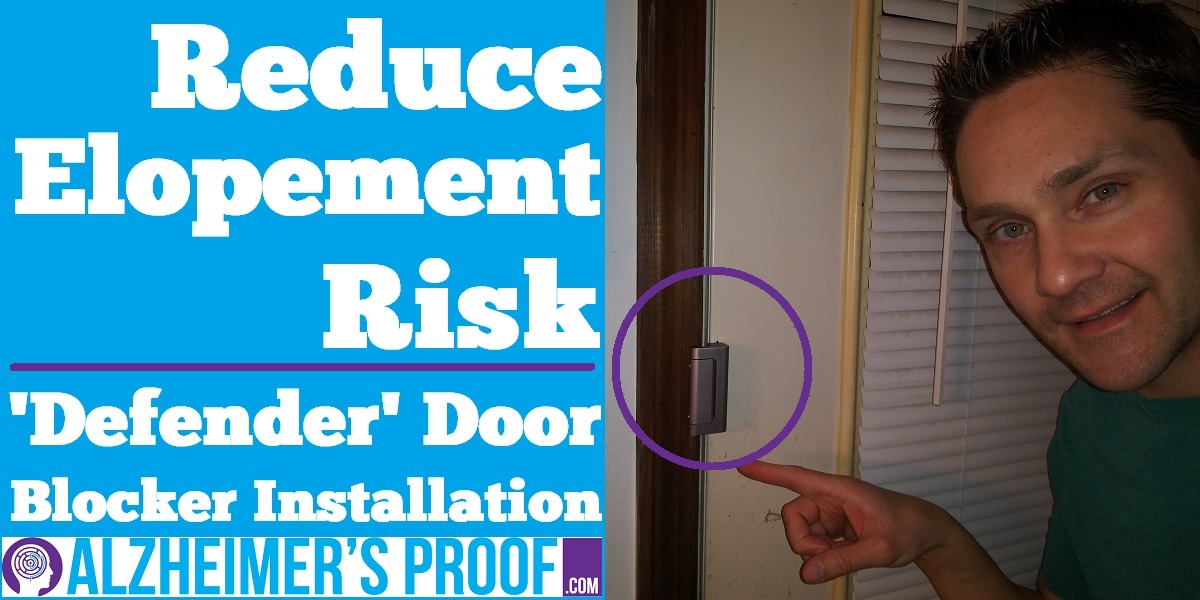
However, I was able to hinder my dad from wandering with an ingenious little gadget. In this article, I’m going to explain how to install that device – a door blocker called the “Defender.”[1] I have installed several of these blockers: one in an apartment, and a couple of them in a townhouse. I absolutely love these products. And I think that you might, too.
Introduction
What’s the Function of the ‘Defender’?
Knowing your loved one can open doors and leave the care environment without you or a caretaker in tow – or even realizing your charge is gone – is a terrifying proposition. Memory and reasoning deficits raise the possibility that he or she could become disoriented and lost, or even injured or worse.
From the perspective of long-term home care, then, the main benefit of these locks is to prevent your loved one from eloping. The devices are inexpensive, and the contemplated modification may be performed relatively easily.
This sort of change is part of what I mean by “Alzheimer’s proofing” your home environment. (This is a concept that I describe more fully HERE.) Under this way of using the phrase, it is a close cousin to childproofing a house as expectant parents would do in preparation for the arrival of a newborn.
Devices Double as Theft Deterrents
These door blockers can deter Alzheimer’s sufferers, or other cognitively disabled persons, from opening exit doors, leaving the care environment, and potentially putting themselves in harm’s way.
But it is worth noting that this particular use – keeping someone inside the house – is a bit of a departure from the product’s stated purpose.
This style of door lock has been designed and marketed as a security device and theft deterrent. When properly installed on an entrance door, the lock helps to prevent forcible entry into a house. It essentially fortifies the door so that even if a thief has jimmied it, or defeated its deadbolt and locking mechanisms, the door blocker will enable the door to remain in a closed position.
So, beyond the standpoint of Alzheimer’s proofing, it will add another layer of security to your home.
Can Your Alzheimer’s-Afflicted Loved One Defeat the Blocker?
As stated, the Defender is intended to be set into a locked position inside the home in order to reduce the probability of forcible entry should an intruder attempt to gain access to the interior of your house.
Given this, it has been designed to be locked and unlocked by normal-functioning adults. Therefore, it is possible for a cognitively impaired person to operate the latch. However, to do so he or she would have to have a number of cognitive and physical abilities. A rough-and-ready enumeration of these might look the following.
Cognitive Abilities Plausibly Needed to Defeat the Blocker:
The ability to notice the device
The capability to identify its function
The capacity to understand or the resourcefulness to determine the correct way to unlock it once
The motor skill and dexterity required to execute the unlocking action
The memory power to remember how to defeat it on subsequent encounters
I’m certainly no medical or psychological expert. But, the likelihood that a cognitively impaired individual would possess this collection of abilities seems to me to be somewhat low. More guardedly, I suppose that I would venture the opinion that the probability is low at least once your loved is sufficiently advanced in his or her dementia to be a serious elopement risk.
Often, if it is positioned high enough on the door – or if it is camouflaged – your loved one may not even recognize that the door blocker has been installed. Of course, this is because Alzheimer’s tends to diminish perception. In the case of my dad, for instance, I don’t believe he noticed that the thing was even there.
Additionally, a high-up position might hinder the door-opening ability of a senior adult in general – quite apart from any dementia – for example if he or she has joint or mobility issues.
Moreover, the door blocker requires an additional motion, outside of those used to open doors in the usual way, that may frustrate a person with a cognitive deficit and prevent them from eloping from the home.
WARNING!
I should, however, inject an important word of caution.
These door blockers may hinder your and your loved one’s abilities to exit the house in the event of a fire or other emergency. If you’re going to use these products as a deterrent to help prevent elopement of a loved one from the residence, you may want to ensure the blocker is activated only during the time periods where your loved one is at the highest risk of vacating the premises without you noticing.
Of course, from a theft-deterrence perspective, it is appealing to have the latch activated throughout the night or during whatever intervals occupants of the house wish to lower the likelihood of intrusion.[2]
Disclaimer:
I cannot advise you as to the appropriateness of any particular course of action for your application. Furthermore, I cannot be sure, and do not warrant, that the device will be effective for you – for any purpose whatsoever. This information is presented as-is, for general or entertainment purposes only. Whatever use you put this information to is entirely your own responsibility. No one at or affiliated or associated with AlzheimersProof.com assumes any liability for how you may implement or not implement any of the ideas described in on this website or in any companion videos.
Be aware of where and under what circumstances you are installing these blockers. The upshot is that I am certainly not guaranteeing that these devices or installation methods will be successful or safe for your individual or family situation.
I can only state that these blockers were a tremendous help for me and my family when caring for my Alzheimer’s-afflicted dad.
My Installation Procedure
‘Unboxing’ & Collecting Required Tools
‘Defender’ Installation Instructions
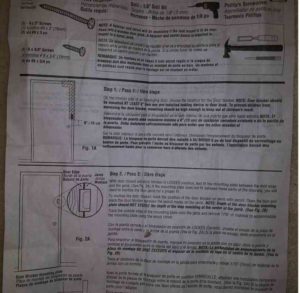
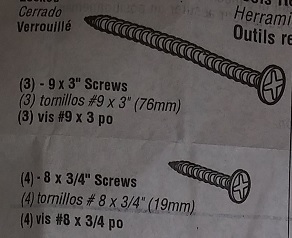
Upon opening the Defender’s packaging, you will find several items. These include:
The door blocker device itself;
Instructions;
3 large wood screws;
4 smaller metal screws;
Tools
The main tools needed include:
A drill (this could be theoretically be corded or cordless; mine was the latter)
1/8-inch drill bit
Philip’s screwdriver
Optional (& Possibly Necessary) Tools
Wood chisel (if there is insufficient space in between the door and door jamb to accommodate the blocker)
Hammer (to use the chisel, if one is needed)
Center Punch (to tap a small “pilot” for the drill bit)
Tape Measure (to assist in positioning the blocker on the door with respect to the other locking hardware – such as doorknobs and deadbolts)
Safety Equipment
Safety goggles
Positioning the Blocker
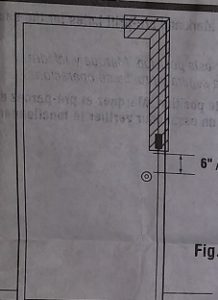
You may want to begin by determining where you want to place the Defender door blocker. The instructions suggest that it be installed at least 6 inches above the door handle and deadbolt.
As suggested above, it may be beneficial to install this blocker a bit higher than this. In fact, there is an “L-shaped” area on the door within which the manufacturer recommends placing the Defender.
Inverted ‘L’-Shaped Install Location
While determining where to install the blocker, place the blocker in the locked position. While in this fully closed position, slide the plate between the door frame and door with the black pad against the door.
This will allow you to get a good look at everything, and to reposition the blocker is desired or necessary.
**Be mindful of any electrical outlets nearby as there may be wiring within the walls near where you may be drilling. Additionally, look at surrounding door hardware, molding, key hooks, or other things that might interfere with your ability to operate the blocker and allow it to swing fully from locked to unlocked positions, and back again.
Actual Installation Steps
Step One
Once you have determined where you want to place the door blocker, use a pencil to mark the placement of the center screw within the door frame.
Step Two
Use your drill and 1/8-inch drill bit to make a hole where the center screw will be placed.
Step Three
Place the door blocker plate back against the door frame, allowing the recently drilled hole drilled to be visible in the center-hole of the plate.
Step Four
Drive the center screw into the door frame allowing the blocker plate to be provisionally positioned. The center hole is oval shaped and allows for the back-and-forth movement of the device in order to ensure that it is tight enough against the door to perform its function, but not so tight that it prevents you from latching and unlatching it.
Step Five
Test for the appropriate and desired fit. Before fully securing the door blocker, close the door and test the blocker in the locked position to ensure the placement is optimal. If the lock is difficult to engage or disengage, the placement of the plate may need to be adjusted slightly for proper operation of the device. In this case, you would simply loosen (but not remove) the center screw, move the blocker, and re-tighten the screw.
Step Six
Once the positioning has been established, ensure that the center screw is fully tightened – but not over-torqued. (You don’t want to strip the head or threads.)
Longer Wood Screws & Shorter Metal Screws
Then, drive in the remaining three (3) screws – large screws for a wooden door frame; small screws for metal – into the remaining holes present on the door blocker plate to firmly secure the blocker.
Congratulations!
Your Defender door blocker has now been successfully installed!
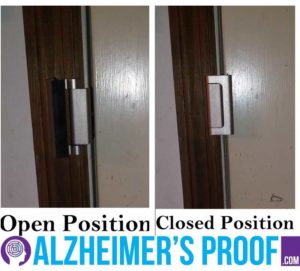
‘Defender’ in Position
If you need an additional assist, or a bit more in the way of visual aids, never fear. For a demonstration of the operation of the lock, or for a video tutorial on the installation procedure, please view my companion YouTube video: Alzheimer’s Elopement & Access Control: Install the Defender Door Lock.
Thank you for reading! I wish you all the best trying to deal with elopement risk.
Notes:
[1] The “Defender” appears to me to be an off-brand version of a different door blocker known as the “Door Guardian.” I also have the Door Guardian and will walk through its – nearly identical – installation procedure in a subsequent post.
[2] Note that there is no “key” and that the device is not designed to be unlocked from the outside. It is supposed to be activated and deactivated from within the area being secured.
Alzheimer’s is a degenerative brain disease that causes diminution of cognitive abilities, including memory, perception, and reasoning. As of this writing, Alzheimer’s Disease afflicts between 5.5 and 5.8 million people in the United States and between 44 and 47 million people in the world. It’s possible causes – discussed HERE – are not well understood. (There are widely mentioned RISK FACTORS.)
Various researchers, however, have suspected that at least some of the blame for Alzheimer’s can be placed on controllable things like diet/nutrition and exercise – both mental and physical. The general idea is that if you don’t “use it” (i.e., your brain), you might “lose it”![1] To that end, several sources have posited a slew of activities that are geared toward keeping you cerebrally fit. I’’ take a sort of “cocktail” or “grab-bag” approach.
Here is my list of the top twelve ways you might be able exercise your brain to prevent Alzheimer’s Disease. (See “Caveats,” below.)
Board and Card Games
An article in the British newspaper Independent related that “playing board games …could help” with mental decline – perhaps to an even greater extent than working crossword puzzles (about which, more in a moment).[2]
According to the results of one study that looked at brain scans: “Middle-aged people who [are] avid game players …[tend] to have bigger brains than people who [do] not play games…”.[3]
These more massive brains can confer a big advantage. Some people refer to this as “cognitive reserve.”[4]
Brain Teasers
“Brain teasers” are a type of game, usually consisting of problems, riddles, and the like of that that are solved usually for amusement. But what if they could serve a more useful purpose?
Numerous news outlets have reported on the possibility that various brain teasers, mathematics puzzles, and mysteries might help to enhance your cognitive health.
In the article “How to Outsmart Alzheimer’s,” Wall Street Journal columnist Amy Marcus reported that “quizzes and other cognitive challenges” might push back the onset of Alzheimer’s – “perhaps indefinitely.”[5]
So, reach for those puzzles and put your mind to work!
Chess
Chess is a two-player strategy game that has been around for hundreds of years. It’s played on a board composed of 64 squares of alternating colors. In total, there are 16 pieces per side (32 in all): eight pawns, 2 knights, 2 bishops, 2 rooks, 1 queen, and 1 king. Each type of piece has different rules governing its legal moves. The overall objective of the game is to “corner” (or “checkmate”) the opponent’s king in such a way as to leave it with no counterattack or means of escape.
Chess can be a very involved game with lots of subtlety and variety. It has competitive and social aspects (on the further benefit of which, see further on). But, on the other hand, it can be played over the internet without you (or your loved one) having to leave home.
Once again, some researchers suggest that “playing chess helps stave off the development of dementia.”[6] In fact, one study showed that playing chess “resulted in an almost 30% reduction in” dementia risk.[7]
Checkers
A two-player game, checkers is similar in some respects to the aforementioned chess. For instance, the board consists of 64 alternately colored – or “checkered” – squares.
Checkers is, however, played with 12 pieces per side instead of 16. Each piece is the same at the beginning of the game: simply a small, circular disk. The object of checkers is to “capture” or remove all (or at least most) of your opponent’s pieces or to leave him or her without any legal moves.
Although checkers has less variety in terms of pieces and moves, it is plenty rich in terms of move combinations and traps.
“Studies show games like checkers can boost your brain strength.”[8]
Crosswords
Admit it: Here’s the one you’ve probably been waiting for!
Simply put, a “crossword” is a kind of word puzzle. It is usually presented as a sort of grid with a combination of “empty” boxes and shaded boxes. The object of a crossword is to answer questions or use clues to fill in the empty boxes with words. Often, the words crisscross and interconnect in interesting ways – usually by sharing letters – which accounts for the name of this puzzle type.
Some investigations have suggested that working crosswords can boost mental ability and function.
Whether these activities affect age- or Alzheimer’s-related cognitive decline is an open question.
However, the National Center for Biotechnology Information, part of the National Institute of Health, published a study revealing that doing crossword puzzles delayed cognitive impairment – specifically, memory decline – by an average of two and a half years.[9]
Language
There’s a joke that goes something like this.
Question: What do you call a person who speaks three languages? Answer: Trilingual. Question: What do you call a person who speaks two languages? Answer: Bilingual. Question: What do you can a person who speaks only one language? Answer: American!
A quick Google search suggests that around 80-85% of Americans are monolingual.[10] Similar percentages apply in Canada. And the United States and Canada have some of the highest rates of Alzheimer’s Disease. For instance, it is the sixth leading cause of death in this country.
This is compared to approximately 45% of Europeans who are monolingual.[11]
Some research suggests that being bilingual can delay the onset of dementia.[12] For example, a 2013 article from CBS News is titled “Learning Another Language May Help Delay Dementia.”[13]
The article reported on a scientific study of various subpopulations in India. The suggestion was that speaking another language can push Alzheimer’s onset back an average of four to six years.
However, a key word is delay. Many people Belgium and Iceland are multilingual. However, both of those countries are in the top ten of nations with high percentages of Alzheimer’s dementia – according to WorldAtlas.com
In fact, Finland is the nation with the highest affliction rate. And a preponderance of the population appears to be bilingual to one degree or other.
Still, it seems reasonable to talk about a “protective effect of bilingualism.”[14]
Music
I have written a bit about how musical therapy can be a helpful intervention to explore when it comes to treating Alzheimer’s sufferers. (See my article “Can Music Calm an Alzheimer’s Patient?”)
A few studies have also led investigators to conclude that things like “playing musical instruments” can be better than working crossword puzzles or doing Sudoku. In fact, some suggest that this can “significantly reduce” a person’s risk.[15]
But for a more complete look at risk factors, see my video dedicated to that topic.
Puzzles
For those who weren’t introduced to these as children, jigsaw puzzles are basically jumbles of irregularly cut pieces (originally of wood, but now largely cardboard or plastic) that must be assembled in the correct order to reveal a pattern or picture. Pieces range in size from large (for small children or Alzheimer’s sufferers) to small (for people of normal to high cognitive function who may be looking for a challenge).
This deep into the article, you can probably predict what I’ll say next. “[J]igsaw puzzles …can help keep the mind active and a little sharper.”[16] (There are numerous kinds available. For my suggestions, see HERE.)
Reading
Some researchers believe that simply reading (books, magazines, etc.) frequently can have a protective and supportive effect on our brains. This could honestly be as mundane as picking up the daily newspaper. Or, for people who are more electronically inclined, visiting your favorite news website.[17]
If you walk to your local library, you could add a bit of exercise into the mix as well!
Social Interaction
According to a report from National Public Radio: “social interaction may be a better form of mental exercise than brain training,” where “brain training” refers to exercises designed to enhance processing speed and promote reasoning.[18]
Just “being around” other people can be of great benefit to Alzheimer’s sufferers.
Still, it is well to recall that causal direction is difficult to establish. Is it that social withdrawal leads to Alzheimer’s, or that Alzheimer’s leads to social withdrawal?
Sudoku
Here’s another – and more arithmetical – sort of puzzle: Sudoku. This Europe-originated puzzle with the Japanese name is essentially a reworked “magic square” in which numbers are inserted into a 9×9 grid. The object of the number game is to fill paper so that every column, row, and embedded 3×3 grid contains all numerals from 1 to 9.
One scientist stated: “…doing Sudoku isn’t probably going …to prevent you from developing Alzheimer’s disease” by itself.[19] Still, there’s little doubt from many investigators that “regular use of word and number puzzles” – like Sudoku – “helps keep our brains working better for longer.”[20] At least one scientific “study has identified a close relationship between frequency of number‐puzzle use and the quality of cognitive function in adults aged 50 to 93 years old.”[21]
If numbers are in your wheelhouse, give it a shot. If letters are more your thing, feel free to see our section on “crosswords,” above!
Working
You read that correctly. We’re talking about going to work.
Before you complain about your job, consider that, for many people, their job provides their “daily cognitive training.”[22]
This is to say that just going to work can have some neural-protective value.
Many jobs are going to present workers with daily brain challenges. These may include having data to enter, information to process, items to remember, things to multi-task, questions to answers, and so on.[23]
Now, if your nine-to-five has you on the verge of a panic-induced coronary, then you might want to seek stimulation elsewhere. But if your day job isn’t overly stressful or soul-sucking, then realize that it might be giving your brain an assist.
Caveats
When it comes to Alzheimer’s prevention, there are three divergent perspectives on the efficacy of mental exercise. These are as follows. (1) Mental exercise is possibly helpful. (2) Mental exercise is likely neither helpful not harmful. (3) Mental exercise is potentially harmful.
Objections
The third position – that mental can be potentially harmful – suggests a few objections to the strategies outlined above.
False Hope?
Firstly, some investigators worry that these considerations might give a person “false hope.” The idea, here, is – presumably – that someone might form beliefs such as that doing crossword puzzles has the power to confer some sort of magical protection against dementia, or that doing them could even reverse the disease. Sadly, these don’t seem to be the case.
But it seems to me that the solution is to have realistic expectations, rather than abandoning the idea of doing mental exercises.
Ineffective?
Secondly, and relatedly, some people object that these interventions are just plain ineffective. For example, in some studies – like regarding bilingualism – participants ended up getting Alzheimer’s anyway.
But this shouldn’t mean that the interventions are without value. It may be that we have to clarify what we mean by “effective.” If “effective” has to mean 100% protection against Alzheimer’s, then we might have to confess these interventions to be “ineffective.” But could mental exercises be “effective” at delaying Alzheimer’s?
Delaying onset of a disease seems valuable in and of itself. For example, if you can maintain a higher quality of life longer, wouldn’t you want to do it?
So, maybe playing checkers or working won’t guarantee that I never get Alzheimer’s. But if they (and other things) can help me to push onset back 2 years, 4 years, 6 years… it’s worth it to me.[24]
However, some people mention another facet of this objection. To put it directly, it’s possible that “incipient” or as-of-yet undetected dementia might prompt people to withdraw from social situations and to cease engaging in mentally stimulating activities.
On this picture, it’s not so much that you should exercise your brain to ward off Alzheimer’s. It’s more that once you reduce your level of mental engagement, it’s likely that you have Alzheimer’s – latently – already.
Of course, it is true that I don’t have any special insight into the mechanics or direction of the causation – if any – between mental exercise and dementia. It could be that dementia causes a lack of mental exercise; it could be that a lack of brain engagement causes dementia; it could be that they both have a third, presently unknown cause; or it could be that they are causally unrelated.
Still… only one of those possibilities suggests any direct way for me to influence my mental health positively. In the absence of some impelling reason for me to think that brain exercise isn’t at least possibly beneficial to me, I’ll continue to operate as though it might.
Counterproductive?
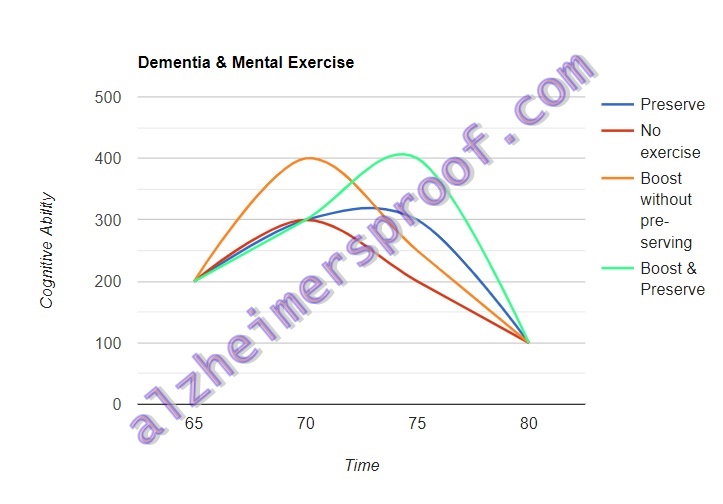
Thirdly, some commentators have spoken (or written) in such a way as to suggest that brain exercises could actually be harmful! A few titles make statements such as that mental training can “speed up dementia.” A few acknowledge that mental stimulation might buy time, but that it also accelerates decline once it begins.
There are a few things to be said.
Number one, insofar as these statements make it seem as if someone could be worse off for having exercised their brains, these summaries are a bit misleading. The “acceleration” of the decline can be explained as a simple matter of mathematics, provided only that the dementia is at least partially a matter of biology or physiology.
What I mean is this. Mental exercises almost certainly help boost or preserve cognitive function. But Alzheimer’s involves literal, physical damage to the brain. So, ultimately, mental exercises cannot undo physical damage.
However, through things such as by increasing “cognitive reserve,” they may be able to stave off the noticeable effects of the condition. But this means that once the effects of the condition do become noticeable, the disease may be “compressed,” and the decline may appear to be more rapid or steeper than it would have been otherwise.
Mathematically, this means that the decline is “quicker” either in that it happens over a shorter time, or that it occurs from a higher “starting point” – or both. This can be seen fairly readily from a simple curved-line graph.
In the graph, I show four different trajectories, all ending at age 80.
Red line: no exercise
The red line represents a person who doesn’t exercise at all, and whose decline begins at age 70. The decline concludes at age 80 – as it will for each of the four imagined scenarios.
Blue line: exercise preserves brain function
The blue line represents a person whose exercise preserves their cognitive function an extra five years. So, their decline begins at age 75. It still concludes at age 80.
Orange line: exercise increases, but doesn’t preserve
The orange line represents a person for whom exercise gives their brain function a boost. I didn’t also assume that this boost bought them any additional time. So, you see their decline begins at the same point as the person who doesn’t exercise at all: age 70. This is the person who has a “higher starting point.” The decline also ends at age 80.
Green line: exercise increased brain function
Finally, the green line represents the person for whom exercise both gives a boost to brain function and preserves it. Obviously, this is the best-case scenario. Since the brain function is boosted, the starting point is higher. Since it is preserved, I have their decline begin at age 75. Like everyone else, it stops at age 80.
Analysis
In this toy model, I have envisioned four scenarios, representing four possible combinations. (1) No boost to brain function and no preservation of brain function;[25] (2) preservation of brain function with no boost; (3) no preservation of function, but some boost; and (4) both preservation and boost.
In each of the four cases, we’re looking at people between the ages of 65 and 80. I have assigned arbitrary “brain-function points” between 100 and 400.[26] Furthermore, I have supposed that people start to decline beginning at age 70 or 75, depending on whether there is preservation or not.[27]
(You could either see these as representing four different, but relevantly similar, people. Or you could see it as representing four different possible trajectories for one and the same person. I prefer the latter.)
The four resulting combinations are as follows.
No boost, no preservation
The red line depicts a person who doesn’t engage in any mental exercise at all. The decline begins at level “300” (just an arbitrary number) and ends at level “100.” This is a difference of 200 points. It takes ten years, which means that they lose twenty points a year.
No boost, preservation
The blue line buys the person an extra five years of preservation. Since they hit the same level – level “100” – at the end, their decline occurs twice as fast as for the person who didn’t exercise. They drop 40 points per year, which is twice the rate of decline. This is because the same amount of decline (as occurred with red) is compressed into half the time.
Boost, no preservation
The orange line shows a person with a bit of a boost (getting them to 400), but no extra time before decline begins. They start higher, but end in the same place, dropping 300 points in ten years. This yields a rate of 30 points per year. The amount of decline (compared with red) is 1.5 times greater (150%) but is stretched over the same length of time (as red).
Boost, preservation
The green line shows a person with both boost and preservation. This person bought an extra five years before visible decline. But they also have the extra “100 points” of function. So, their decline starts at a later age (compared to red) – age 75 – and from a higher starting point (again, compared with red) – 400 points. Since they decline 300 points over five years, their rate of decline is 60 points per year.
Conclusion
That we see “higher rates” of decline in the exercisers is due to either (or both) of two factors.
Factor 1: The decline happens over a shorter span of time (as with blue and green); or…
Factor 2: The decline happens from a higher starting point (as with orange and green).
I said earlier that the explanation for the higher decline rates was mathematical. When a predetermined amount of decline happens over a shorter time frame, the rate of decline is increased. This is mathematical in this sense. Take some number, n. n divided by 5 is going to be bigger than n divided by 10.
Moreover, when a predetermined endpoint of decline is reached from a higher beginning point, the slope of the line representing that decline is steeper.[28] This is also mathematical, since the slope of a line is merely a value (m) in the equation representing that line. So, if the cognitive “drop off” is steeper, all we’re saying is that the value of slope (m) for that drop off is a bigger number than it is if the drop off were not as steep.
At the end of the day, for me, I would rather have my cognitive function preserved for as long as possible – and boosted as high as possible – even if I experience an eventual decline.[29]
Curiously, you could even argue that having a “quicker” or “higher” rate of decline is preferable to a slower rate in that it likely saves caretaker energy as well as money devoted to care!
Training Is Parochial
Fourthly, you may read that certain forms of “brain training” are very limited in terms of what they accomplish. Even where certain mental exercises may be worthwhile, their impact may be restricted. To put it another way, specific benefits may not generalize to other areas of your daily or mental life.
For example, reading books may help boost your processing speed, but maybe doesn’t help enhance your memory. (It’s just an illustration; I don’t know whether it does or doesn’t.)
Somewhere I read a researcher giving the following analogy. Some brain exercises can be likened to working out physically by doing only one or two exercises. These exercises – like bicep curls – may strengthen a single muscle (the biceps), but they are unlikely to impact the overall health of the body much.
A few things may be said in reply. Number one, you can make the case that doing a few exercises is better than doing none. A person who does biceps curls may not be as fit or healthy as a person who trains his or her whole body. But he or she may well be more fit or healthy than he or she would be if they did nothing at all.
Number two, whether a given exercise has broad or narrow impact may depend on the sort of exercise being done. In physical training, there are differences between compound and isolation exercises. It’s one thing to do bicep curls or grip strengtheners all day long. It’s another to do deadlifts or squats. The former may only affect one or two muscles; the latter might well affect the entire body. It is doubtful that we know enough about “brain training” to really understand the broader impact of a lot of the mental exercises discussed here. For example, is playing chess more than doing bicep curls, or more like doing squats? I’m not sure. And I’m not sure that anyone else is sure, either!
Blame the Victim?
Yet another objection, fifthly, is that talking about mental exercise may lead to sufferers being “blamed” for their Alzheimer’s. The idea here is that some people might conclude that if John Doe has dementia, then he must have been mentally inactive or lazy.
Sometimes you may read comparisons to smoking. People who smoke are at higher risk of lung cancer. So, if a smoker gets lung cancer, then he or she assumes some of the responsibility for that condition.
By way of response, I should first remind readers that Alzheimer’s risk almost certainly has a – probably a significant – genetic component. (See my video about risk factors HERE; or read the article on the same topic HERE.) To put it differently, some people are simply more at risk than others of developing it.
Having said that, I will simply repeat what I have mentioned many times in my written and video-graphic work: I am trying to stack the odds in my favor. I realize that if I smoke, I’ll be at increased risk for lung cancer. Although the data may not be as clear cut for the relationship between mental exercise and dementia, I’ll say that for me personally I’d rather exercise, and have it avail me nothing, than not exercise and have it turn out that it would have helped me.
If other people value other things over exercising, then I would suggest that it is their prerogative to do so. In the first place, the data in favor of mental exercise is not so compelling as to make it undeniable that it helps preserve or boost cognitive function or that it can ward off Alzheimer’s.
But even if the data were that compelling, it’s not clear that someone has to value preserving or boosting cognitive function or must value warding off Alzheimer’s, over not doing any of these. I confess that such a position would be foreign to my own thinking. But it’s not something that moves me to start throwing words like “blame” around.
I suppose you could put my answer this way. If a person doesn’t perform mental exercises, it’s either because they don’t think it will help or they don’t care if it helps or not. If they don’t think it will help, then their choice not to exercise is rational. They have discharged their rational duty and it’s not obvious to me that there’s anything to blame them for.
If they don’t care, then the choice itself may be irrational (i.e., not rational). But it’s not clear why a person choosing irrationally in this way wouldn’t care if exercising helps but would care if they’re “blamed” for not caring. It seems to me more likely (or at least more consistent) if they didn’t care about either one. So, even if the choice is blameworthy, it doesn’t appear to have the result the objector is worried about. It seems that the concern in the objection is centered on the perceived hurt feelings of the person being blamed. But, to reiterate: for all we know, the person who doesn’t care about not exercising wouldn’t care about being blamed for not exercising. If this is so, then it’s not obvious that there would be any hurt feelings for us to worry about.
Conclusions (Tentative)
One article ventured the opinion “that lifestyle choices may even counteract genetic predisposition for Alzheimer’s.” If true, that’s huge.[30] And it would put a lot of control in our hands.
Here are a few takeaways.
Train the Whole Brain
But staying mentally fit and sharp may really come down to neural recruitment: using multiple parts of your brain, not just a few.
Be Consistent
It’s also going to involve consistency. Many reports mention the need to engage in stimulating activities regularly – say two or more times weekly – not just every blue moon.
Try Something New
Another key element is novelty. Sometimes trying something new may be more valuable than doing the same things over and over. There may be two “levels” of novelty. Think about some of the things on this list. For example, chess or reading. Every game of chess you play has the possibility of being different from every other game. And if you read new articles or books every day, you are adding some variety. However, we might call this low-level variety. A higher level of variety can be attained if you learn a new language or musical instrument, for example. Interestingly, there may be a kind of middle level as well. For example, a person could switch from reading fiction to nonfiction, or from reading prose to reading poetry.
Act as Though It’s ‘Use It Or Lose It’
As the Independent put it: “use it or lose it” idea may just “give a person a ‘higher starting point’ from which to decline.” But this still seems advantageous.
Realize: ‘Better Late Than Never’
Some commentators express the message that its always “better late than never.” But you should probably take the position that it’s desirable to start now! This applies to you whether you are a sufferer or a person looking to avoid the condition altogether.
No Silver Bullets
Still, neither I nor most other researchers are suggesting that any of these measures amounts to a “cure.”
Aim to Have a Healthy Lifestyle
Additionally, these mental activities almost certainly need to be situated in a larger context – a “lifestyle package,” as it were. Genetic predisposition notwithstanding, if you really want to stack the odds in your favor, you’ll need to address your blood pressure, body mass, cholesterol, diet, level of physical exercise, and sleep patterns.
I can tell you that I’m implementing a number of these measures today. Most of the items on this list are cheap (or free) and easy to obtain. And after all that’s been said, I think it’s reasonable to maintain that they can’t hurt. And some of them just might help. So…go on: give your brain a good workout!
[4] See, e.g., Margaret Gatz, Educating the Brain to Avoid Dementia: Can Mental Exercise Prevent Alzheimer Disease?” Public Library of Science, vol. 2, no. 1, Jan. 25, 2005, p. e7, <https://www.ncbi.nlm.nih.gov/pmc/articles/PMC545200/>.
[9] According to Jagan Pillai, Charles Hall, Dennis Dickson, Herman Buschke, Richard Lipton, and Joe Verghese, “Association of Crossword Puzzle Participation with Memory Decline in Persons Who Develop Dementia,” Journal of the International Neuropsychological Society, vol. 17, no. 6, Nov., 2011, <https://www.ncbi.nlm.nih.gov/pmc/articles/PMC3885259/>.
[21] Helen Brooker, Keith Wesnes, Clive Ballard, Adam Hampshire, Dag Aarsland, Zunera Khan, Rob Stenton, Maria Megalogeni, and Anne Corbett, “The Relationship Between the Frequency of Number‐Puzzle Use and Baseline Cognitive Function in a Large Online Sample of Adults Aged 50 and Over,” International Journal of Geriatric Psychiatry, vol. 34, no. 7, publ. in print Jul. 2019, pp. 932-940, publ. online Feb. 11, 2019, <https://onlinelibrary.wiley.com/doi/abs/10.1002/gps.5085>.
[22] “A Brain Scientist Who Studies Alzheimer’s Explains How She Stays Mentally Fit,” loc. cit.
[24] Again, onset detection is not a little tricky.
[25] Both ideas – “boosting brain function” and “preserving brain function” – are a little vague and would need to be sharpened to be of greater use. However, my model is merely trying to show that the “higher rates of decline” spoken about in some articles might well be nothing to worry about. So, I have abstracted away from some of the details because I don’t think they’re necessary for the point.
[26] This raises the issue of how we would actually be able to measure cognitive ability. There are various assessment tests. But it is possible that these assessments fail, for one reason or other, to paint a true or complete picture of a person’s cognitive situation. This is simply a model.
[28] I realize that I opted to display the graph with curved lines. This was simply an esthetic choice since when I used straight lines, the lines overlapped in places and couldn’t be easily distinguished. The information is simply sample and hypothetical data for illustrative purposes only. It could be represented with straight lines. And if it were represented this way, then the resulting lines would have calculable slopes in the usual sense.
[29] As a side note, the red line also represents a case in which a person exercises, but it fails to boost their brain function or preserve it at all. So, you’ll notice that if the exercises are utterly ineffective, you’re no worse off than you would be had you not exercised at all. You might think that you would have wasted your time. I suppose this boils down to whether you find any of the exercises enjoyable – or potentially enjoyable – or not. But even still, personally, it strikes me as improbable that mental exercises would do nothing whatsoever. Readers may think differently.
[30] More scientific study and philosophical reflection is needed, however. Some studies abstract away from possibly relevant data, including economic, educational, genetic, intelligence, and sociological factors.
In other posts (see, e.g., HERE and HERE), I’ve pointed out that some researchers suspect that certain varieties of dementia might be precipitated by exposure to toxins. “Exposure,” here, could be contact with things (from metals and mold to herbicides and pesticides) in the environment. Or it could possibly be due to drinking contaminated water or taking particular (and “hepatotoxic”[1] – see below) pharmaceuticals over a long period of time. Toxins may build up inside of your body over time. So, the question arises: Can “detoxication,” or the process of ridding your body of toxins, be a part of Alzheimer’s treatment or prevention?
In line with my “betting strategy” – that is, my emphasis on things to try to improve your odds of Alzheimer’s avoidance or Alzheimer’s survival – I’m going to say: Tentatively… yes.
The liver is of utmost importance, here.[2] As one herbalist put it: “The liver is your toxic-waste disposal plant.”[3] But there are many things that can go wrong with it. One manual[4] listed the four main reasons for liver strain or outright failure.
Exposure to poisons and toxins. Acute poisoning is occasionally a concern – particularly for a cognitively impaired individual. But the chief difficulty comes from chronic exposure. Even low quantities of a mildly toxic substance can have deleterious and detrimental, cumulative effects over long periods of time. To read additional information about the potential dangers of home-related toxins, see my article, HERE. For my database of household hazards, see HERE. (For plant poisons and allergy-triggering plants, see HERE and HERE.)
Inadequate diet/poor nutrition. Diets lacking in essential minerals and vitamins cannot support healthy liver function – or healthy brain function, for that matter. You’ll want to avoid or reduce “junk” foods – especially processed and sugar-rich foods. For more specifics on what (and what not) to eat, see my article on the Alzheimer’s “MIND Diet,” HERE.
Overindulgence in food/alcohol. Overeating and long-term alcohol use both heavily tax the liver. Readers interested in pursuing the alcohol angle, can click HERE.
Chronic drug use or abuse. This category includes such substances as caffeine as well as prescription drugs.
It is interesting to think about these categories in relation to the three hypothesized “subtypes” of Alzheimer’s Disease. (For more on this speculative taxonomy, see HERE.) These are:
Inflammatory Type I Alzheimer’s
Nutrient-Deficiency Type II Alzheimer’s
Brain-Toxicity Type III Alzheimer’s
Clearly, here, we’re focused on the hypothetical third type. If there really is a variety of Alzheimer’s that can be precipitated by exposure to environmental (or other) toxins, then it would be helpful to have some strategy in place for periodic liver (and other) detoxification.
One aspect of this can be addressed with various herbal and nutritional supplements. So, without any further ado, here is my list of some important supplements with reputations as detoxifiers.
The Top Thirty (30) Detoxification Supplements
1. Apple Pectin (from Malus pumila)
To put is simply, “pectin” is a plant-based fiber. Usually found in fruits, pectin is often found in the baking aisle of your local supermarket, since (among other things) it’s used for thickening homemade jelly. (It’s also incorporated into certain cosmetic products, such as makeup “foundation” and hair conditioner, as well as pharmaceutical drugs, for example anti-diarrheal medications.)
Apples are one of the principal sources of pectin. And, apropos of our present topic, it turns out that Apple Pectin “[h]elps to detoxify heavy metals.”[5] It’s also available in capsule form.
2. Arginine (L-Arginine)
Arginine is often employed for cardiovascular difficulties – for example, poor blood flow or circulation. But it also “[h]elps to detoxify ammonia, a by-product of protein digestion that can accumulate when the liver isn’t functioning correctly.”[6]
3. Artichoke (Cynara scolymus)
Artichoke has been used medicinally by traditional healers. For one thing, it is reputed have anti-oxidant qualities. It’s also been employed similarly to Asparagus (see below) as a “hangover” cure. One reason for this is that is supposed to stimulate the liver’s production of bile.
But, along with Dandelion and Milk Thistle (and other herbs) Artichoke is also supposed to be a potent liver detoxifier. “Globe artichoke leaf has been used traditionally to increase bile flow and act as a protective agent against various toxins.”[7]
“In particular Globe Artichoke leaves have a well-established reputation for restoring liver health…”.[8] One herbalist effused: “You can – and should – literally inundate your diet with every sort of artichoke as much as possible. These products love your liver.”[9]
4. Asparagus (Asparagus officinalis)
Asparagus is widely regarded as a potent alcohol “hangover” remedy. But, according to at least one peer-reviewed scientific journal, among its other “biological functions” is “the protection of liver cells” against various toxins.[10] In other words, it’s got detoxification qualities.
5. Beet, Garden (Beta vulgaris vulgaris)
Believe it or not, Beets have been used as detoxifying agents for hundreds of years. “Betalains, particularly betanin, are powerful stimulators of the body’s own …detoxification enzymes that …help clear the system of environmental toxins known as xenobiotics – chemicals foreign to living organisms.”[11]
6. Birch, American White (Betula pubescens)
This one lies a little off the beaten path. It’s sometimes recommended for joint problems. Herbalists Julie Bruton-Seal and Matthew Seal write that “[t]he fresh leaves or buds or birch offer a powerful …tea for general detoxing…”.[12] Birch is supposed to help get rid of toxins from the blood (similar to Burdock) and the kidneys/urinary tract (like Dandelion and Stinging Nettle).
Along with other green vegetables such as Cabbage (Brassica capitata), BrusselsSprouts (Brassica gemmifera), Kale (Brassica sabellica), Spinach (Spinacia oleracea), and so on, Broccoli is a fixture of the Alzheimer’s-friendly “MIND Diet.” (For much more detail on that – including specific recommendations – see HERE.)
But, wouldn’t you know it? Broccoli – at least in its “microgreen” form – is also reported to be a detoxifying agent. “Sulphoraphane, from broccoli-sprout extract, …stimulate[s] the body’s production of detoxification enzymes…”.[13] (For additional information on microgreens, see HERE and HERE.)
As a bonus, Broccoli’s sulphoraphane is also being investigated as a cancer-fighter. So, eat up! (Pinch your nose if you have to.)
8. Burdock (Arctium lappa)
This is one of the top five detoxifiers, for sure. It may have a salubrious effect on the liver and other organs, but it’s really known a tonic for the blood.
“Burdock is a significant detoxing herb in both Western and Chinese medicinal traditions.”[14] “Burdock root, Dandelion root, Milk Thistle, and Red Clover all… aid in cleansing the blood-stream. …Burdock, echinacea, horsetail, and licorice[15] have detoxifying properties.”[16]
9. Calendula (Calendula Officinalis)
Calendula is typically recommended for digestion-related conditions. For instance, it might be administered for various bowel and intestinal inflammations, gastro-esophageal reflux disease i.e., GERD), or even ulcers of one kind or another.
For our purposes, I note that some sources flatly report that “Calendula is a cleansing and detoxifying herb…”.[17]
10. Charcoal (Activated carbon)
This one is a bit different from some of the others on this list. First of all, it’s not an herb. Though, neither are Arginine, Citrulline, or Coenzyme-A (which see). Secondly, unlike Dandelion, MilkThistle, and YellowDock, it doesn’t stimulate bile (that is, it’s not a choleretic). And charcoal doesn’t really get “circulated” throughout the body.
Instead, it basically passes straight through the digestive system. It basically works by physically encountering foreign or unwanted substances and absorbing them. Activated charcoal is ideal for this, since it has a huge and highly absorbent surface area.
Charcoal is sometimes administered in emergency rooms for certain types of acute poisonings or overdoses, such as from barbiturates, benzodiazepines, sedatives, and the like of that.
It doesn’t work on a lot of substances – for example, acids, cyanide, ethanol, or heavy metals. And it has to be ingested shortly after the poisonous substance was swallowed. It won’t work too long after exposure.
Additionally, if you take it alongside prescription medication – or even with your dinner – it may prevent your body from absorbing the drug or nutrients that you need.
Still, for all the caveats, I think that it’s good to have on hand… just in case.
11. Chicory (Cichorium intybus)
“Similar to dandelion, chicory also possesses liver cleansing and detoxifying properties.”[18] “Traditional foods that are noted for their beneficial effects on the liver include the bitter leaves of dandelion and chicory.”[19]
12. Chlorella (Chlorella vulgaris)
Alternative-medical guru Joseph Mercola states that “Chlorella …is one of the most powerful detoxification…” herbs.[20] He even opines that it specializes in ridding the body of heavy metals – including mercury. (See more on heavy-metal poisoning, see HERE and HERE.)
Another writer underscores this, writing: “Chlorella works to clear the body of toxins, heavy metals and poisons.”[21]
This one comes from Asian medicine. Recently, the New York-based, Chinese-American newspaper Epoch Times reported that “chrysanthemum …helps to support the liver …[and] eliminate toxins… [Chrysanthemum tea] purifies the blood and improves blood flow. It detoxifies the liver and helps to improve vision and hearing.”[22]
A few other Chinese herbals should receive honorable mentions as detoxifying agents. Huang Lian (Rhizoma coptidis), Huang Qin (Radix Scutellariae), Ling Nut (Trapa natans), and Zhi Zi (Fructus Gardeniae) stick out in this regard. If you have a special affinity for traditional Asian medicine, then you might want these to your cabinet as well.
14. Cilantro/Coriander (Coriandrum sativum)
Like Basil (Ocimum basilicum), Cilantro is mostly employed as a spice. Also like basil, it is frequently used for digestive ailments, including cramps and gas. It also helps with bad breath – as does Parsley (Petroselinum crispum).
Recently, however, Cilantro has gained recognition as a “chelator.” Very roughly, chelation is a biochemical process whereby a substance – usually a metal – is converted into a form in which it can be excreted from the body. One danger of metals in the body is that they may be stored and build to toxic levels. So, the thinking goes, if we’ve been exposed to, or ingested, metals, then we may require chelation in order to rid ourselves of the offending material and guard against its lasting ill effects.
And… you probably guessed it. Cilantro is now regarded in some circles as facilitating this chelation process.
According to one source, Cilantro facilitated the excretion of aluminum, lead, and mercury.[23] As Balch notes: “Chlorella and cilantro are helpful for absorbing toxic metals.”[24]
15. Citrulline (Citrulline Malate; L-Citrulline)
Citrulline is used for a variety of ailments and conditions, many of which revolve around bodily weakness or debility, including chronic fatigue, diabetes, and erectile dysfunction. Because of these uses, Citrulline is also favored by athletes.
For our purposes, I note that “Citrulline …detoxifies ammonia, which damages living cells.”[25]
16. Clover, Red & White (Trifolium pratense & Trifolium repens)
“In traditional herbal terms, red clover is an ‘alterative.’ This means that it cleanses and detoxifies the system.”[26] White Clover is simply a sister species. Hint: You might have it growing in your yard. Don’t kill it. And, for goodness sakes, don’t expose yourself to pesticides. Why not harvest it; and eat it?
17. Coenzyme A (C21H36N7O16P3S)
This one is fairly complex. First of all, its actually generated in the body so long as one’s Vitamin-B-5 levels are optimal. “Taken as a supplement, coenzyme A …supports the manufacture of substances critical for the brain…”.[27] And, yep… it helps “remove toxins from the body.”[28]
18. Dandelion (Taraxacum officinale)
One of the several “weeds” on this list, it is rich in vitamins. “The young leaves boiled up into a tea or eaten fresh in salads are detoxifiers…”.[29] And, once again… the stuff grows like a weed. But, don’t treat it like one! It’s a detox powerhouse.
19. Dimethylglycine (DMG)
Recent scientific research suggests that “DMG can protect the liver… [and] aid in detoxification.”[30] As an added bonus, and like Folic Acid (see HERE) DMG reportedly also helps to decrease homocysteine in the body. Homocysteine is an amino acid that, in high amounts, supposedly increases a person’s risk for Alzheimer’s as well as cardiovascular conditions.
20. Garlic (Allium sativum)
Garlic is reputed to address (and prevent) heart disease and high blood pressure. It’s long been known as a powerful antibiotic. And many insist that it has anti-viral properties as well.
I have also written about it as a good addition to your Alzheimer’s regimen for other reasons. (See my “Top 25 Herbs for Treating (and Avoiding) Alzheimer’s”.) In addition to all this, writer Phyllis Balch calls garlic “[a] potent detoxifier.”[31]
21. Glutathione (C10H17N3O6S)
Glutathione is an antioxidant that actually produced by the liver. However, it is possible to supplement with it. You might wish to do so on the theory that it will give your body a possibly much-needed detoxification assist.
One source had this amazing testimony to share. “So powerful is the antioxidant protection offered by …glutathione that it was able to prevent amyotrophic lateral sclerosis (ALS, or Lou Gehrig’s disease) in …[a] laboratory model…”.[32]
Glutathione is sometimes administered intravenously to cancer patients. At the present time, there is not a huge amount of evidence about the effectiveness of taking supplements orally. But, as periodically reassert, I am merely trying to raise the probability that I will avoid Alzheimer’s Disease (and other forms of dementia). I’m not necessarily going to wait until Glutathione has gone through all the requisite clinical trials. If it’s safe – and from the information that I have laid eyes on – it appears to be, then I see its use on the level of a “bet.” I’m just stacking the odds in my favor as much as possible.
According to Balch, Glutathione “[a]ids in detoxifying” the body with a special emphasis on “reducing …the harmful effects …[of] drugs” of various kinds.[33]
Although I haven’t read this specifically in relation to Glutathione, you sometimes have to be careful supplementing with compounds that are produced by your own body. The reason, if I understand correctly, is that when your body produces a substance, it also monitors that substances levels with an aim toward regulating them and maintaining homeostasis. So, sometimes what can happen (and this may occur with hormones such as estrogen, testosterone, and even melatonin) is that when you supplement with a substance, your body dials down (or shuts off) its own production of that substance. I’m not entirely sure that this applies to Glutathione, but I submit that it’s something you might want to keep in the back of your mind. Perhaps it might be best to take it periodically.[34]
22. Green Tea (Camellia sinensis)
Green Tea is chock full of antioxidants. Specifically, it contains a kind of plant-derived “micronutrient” (i.e., a nutrient that humans require only in small, or “trace,” amounts) called a polyphenol.
“Tea polyphenols support the liver’s enzyme detoxification system, which eliminates free radicals and toxins from the body.”[35]
23. Lemon Water (Citrus × limon + H2O)
Lemon can also “[increase] oxygenation levels,”[36] which can have a neuroprotective effect on the brain. Furthermore, for those who are brave and inclined to try it, lemon water can also be used as an enema.[37]
24. Milk Thistle (Silybum marianum)
Also sometimes called St. Mary’s Thistle, “Milk thistle helps to detoxify the liver.”[38] In fact, it’s such a powerful liver-supporting agent that it can even be used for “the treatment and prevention of fibrosis and cirrhosis”.[39]
Milk Thistle should not be confused with Blessed Thistle (Cnicus benedictus), which also has some cleansing/detoxifying properties.[40]
25. Oregon Grape Root (Mahonia aquifolium)
Oregon Grape is “a general tonic” that has been used in traditional healing to address both kidney and liver issues.[41] “Oregon grape root detoxifies the body…”.[42]
26. Pau D’Arco (Handroanthus impetiginosus)
“Pau d’arco …has detoxifying properties.”[43] Among this is its capability as a laxative/purgative. It shares this property along with other herbs such as Aloe (Aloe barbadensis), Cascara Sagrada (Rhamnus purshiana),[44]Fumitory (for which, see the entry, above) and Senna (Cassia senna). Even Dandelion (also see above), Licorice (Glycyrrhiza glabra), and Yellow Dock (see below) have mild laxative qualities.
27. Spirulina (Arthrospira maxima & Arthrospira platensis)
Although it’s sometimes called “blue-green algae,” Spirulina appears to be a kind of “good bacterium” that falls under the general category of cyanobacteria. Word on the interwebs has it that this stuff can be extremely potent as a heavy-metal detoxifier.[45]
28. Stinging Nettle (Urtica dioica)
“Modern-day naturopaths …use depuratives such as urtica [sic] to improve detoxification and elimination, thus helping to reduce accumulated metabolic waste products in the body.”[46] (A “depurative” is a purifying or detoxifying herb.)
29. Turmeric (Curcuma longa)
Predominantly known as a potent anti-inflammatory herb,[47] Turmeric is revealing that it also many other surprising qualities. As I have written elsewhere (see HERE, HERE, and HERE), this inflammation-fighting activity may be quite useful if it turns out that (some forms of) Alzheimer’s are precipitated by brain inflammation.
In any case, it also has been suggested that Turmeric – specifically its curcuminoids – has various “detoxifying properties”.[48]
30. Yellow Dock (Rumex crispus)
Yellow Dock, also sometimes called Curly Dock, is regarded as an anti-inflammatory. It’s also prized for its purgative effects – particularly on the digestive system. However, of primary interest to us, here, is the fact that the cleansing ability of Yellow Dock “make[s] it an ideal liver-detox treatment…”.[49] This puts Yellow Dock in a class along with Dandelion, MilkThistle, RedClover and others on this list.
Five (5) Runners-up
1. Boldo (Peumus boldus)
Boldo is supposedly useful for many digestive ailments. For example, it may be used to calm gastrointestinal upset and cramps. In this way, it is perhaps not unlike Guelder Rose (Viburnum opulus), also known as Crampbark. It may also kill bacteria and intestinal worms, like Wormwood (Artemisia absinthium).[50]
Unfortunately, also like these other plants, Boldo is sometimes said to be harmful in large amounts – or over a long time. So, take care.
Still, one writer comments that among its “rumored …benefits …is …detoxing the liver.”[51]
2. Cysteine (L-Cysteine) & N-Acetylcysteine (NAC)
Researcher Phyllis Balch notes that Cysteine, and its sister, L-Cystine, “are important in detoxification.”[52] Ditto for their close cousin, NAC.[53]
Still, it’s a runner up on my list because of its uncertain relationship with homocysteine. As one scientific article puts it: “Alzheimer’s disease and cardiovascular diseases share a common risk factor, elevated blood levels of homocysteine, an amino acid which becomes elevated by inadequate dietary intakes of vitamins B2, B6, B9 (folate) and B12.”[54]
Fumitory is often used in homeopathic preparations. I underlined homeopathic in order to emphasize it. The basic difference between “homeopathy” and its complementary approach, allopathy, is this. In allopathic medicine, physicians treat symptoms by dispensing substances that produce opposite effects to those perceived by the physician. For example, if you have a fever, an allopath will prescribe a fever-reducer. Allopathic preparations tend to have quite a lot of active ingredient.
In homeopathic medicine, by contrast, a doctor will treat conditions by administering substances that tend to produce the same symptoms that are observed. However, in homeopathy, the amount of the substance is vanishingly tiny.
So, one might see the toxic Mercury (Hg) in certain homeopathic eardrops. And, as stated, fumitory, which contains the toxin fumarin, must be given carefully, under competent supervision, and only in minute quantities. Because of the danger, I can only conscionably list it as a “runner up.”
That said, it is still true that, along with Artichoke and Dandelion, Fumitory is sometimes listed as a potent “cholagogue,” that is, a substance that serves to “increase the flow and release of store bile from the gallbladder by stimulating gallbladder contraction.”[55] I advise you to consult a medical professional. Use Fumitory only with extreme caution.
4. Ginseng, Chinese (Panax ginseng)
This is a bit of a change. To my knowledge, Ginseng isn’t poisonous or toxic in usual doses. And some sources list it as a detox agent.[56]
My main problem is that I simply couldn’t find a whole lot on Ginseng’s detoxifying activities. Ginseng is far better known as an “adaptagen” and a “revitalizer.”
Nevertheless, it’s arguably good for Alzheimer’s in general. “The German Commission E and the World Health Organization both approve Panax ginseng for use …in times of …declining capacity for work and concentration.”[57] For more information, see HERE, HERE, and HERE.
But, be advised: The name “Ginseng” is applied to at least nineteen (19) different plants! For a discussion, see my article, HERE.
5. Methionine (L-Methionine)
Methionine assists the body in ridding itself of “harmful toxins.”[58] However, this has to be carefully tracked, since Methionine can convert to Homocysteine in the body, which (according to those in some research sectors) can increase a person’s chances of developing Alzheimer’s.[59]
Final Remarks
It is sometimes said that a farmer doesn’t grow a crop; he or she merely superintends while the plant grows itself. Likewise, some maintain that a doctor doesn’t heal the body. He or she just oversees while the body heals itself.
As I began by stating, the main job of detoxification is handled by your liver. Even so, your liver requires support. And it turns out “that a variety of natural compounds [activate] and [amplify] …the production …of protective and life-sustaining detoxification enzymes and antioxidants. Among these are curcumin, which comes from turmeric; green tea extract; resveratrol; sulphoraphane, derived from broccoli; and the omega-3 fat, DHA.” (For much more on Resveratrol, see HERE, HERE, HERE, and HERE. And for more on Omega-3 Fatty Acids, see HERE, HERE, HERE, HERE, and HERE.)
Many of these supplements – and others enumerated, above – have little to no listed side effects, can be easily obtained, and (therefore) can be added in to your diet with little difficulty.
However, supplements are not magical. An herbal capsule or tea cannot make up for poor overall nutrition and cannot undo (at least, not overnight) a lifetime of dietary (or other) damage.
The moral of this story is this: Structure your Alzheimer’s-support and detoxification plan around a good diet. Accept no substitute.
Eat your veggies! As mentioned previously, the Alzheimer’s-friendly “MIND Diet” revolves heavily around the consumption of greens and miscellaneous vegetables.
Many of these have detoxing properties. “The commonly prescribed ones are carrot, celery and beetroot (often with a little ginger root), green vegetable juices with mint for increased detoxification. Chlorella (algae) can be added to this …for a real detoxification boost.”
Additionally, you’ll want to consume good quality fruits. Berries are especially good, here. The Blueberry (Vaccinium corymbosum) and the Chilean Wineberry, or Maqui (Aristotelia chilensis) are standouts. I go into these HERE.
And you’ll definitely want to lay off (or entirely eliminate) the junk and processed food in your diet.
[1] This word means toxic to the liver. The Greek word for “liver” was hepar. Cognates of this word – for instance, “hepatic” – routinely show up in herbal and medical dictionaries.
[2] Many of the herbs (and other substances) on my list focus on liver detoxification. But some also help to purify other bodily systems – for instance, the circulatory and excretory systems. For herbs that give an assist to our nervous systems, see HERE.
[3] Jack Ritchason, The Little Herb Encyclopedia, 3rd ed., Pleasant Grove, Utah: Woodland Health Books, 1995, p. 147.
[4] Phyllis Balch, Prescription for Nutritional Healing, 5th ed., New York: Avery; Penguin, 2010.
[5] Balch, Prescription for Nutritional Healing, p. 799.
[6] Balch, Prescription for Nutritional Healing, p. 337.
[8] Patricia Loh, Detox At Home: How to Get Rid Of Harmful Toxins From Your Body, Malaysia: Oak Publ. 2016, p. 29.
[9] Lloyd Wright, Triumph Over Hepatitis C: An Alternative Medicine Solution, India: Unistar Books, 2002, p. 204.
[10] See, e.g., B. Kim, Z. Cui, S. Lee, S. Kim, H. Kang, Y. Lee, D. Park, “Effects of Asparagus officinalis Extracts on Liver Cell Toxicity and Ethanol Metabolism,” Journal of Food Science, vol. 74, no. 7, Sept. 2009, pp. H204-H208, <https://www.ncbi.nlm.nih.gov/pubmed/19895471>.
[12] Julie Bruton-Seal & Matthew Seal, Backyard Medicine: Harvest and Make Your Own Herbal Remedies, New York: Castle Books; Quarto Publ., 2012, p. 14.
[13] Balch, Prescription for Nutritional Healing, op. cit., p. 258.
[14] Bruton-Seal & Seal, Backyard Medicine, op. cit., p. 22.
[15] For more on Licorice, see HERE. Licorice is related to Alfalfa (Medicago sativa), which also has some detoxification actions.
[16] Balch, Prescription for Nutritional Healing, op. cit., pp. 258 and 800.
[17] Disha Arora, Anita Rani, and Anupam Sharma, “A Review on Phytochemistry and Ethnopharmacological Aspects of Genus Calendula,” Pharmacognosy Reviews, vol. 7, no. 14, Jul.-Dec. 2013, pp. 179-187, <https://www.ncbi.nlm.nih.gov/pmc/articles/PMC3841996/>.
[24] Balch, Prescription for Nutritional Healing, op. cit., p. 555.
[25] Balch, Prescription for Nutritional Healing, op. cit., p. 58. See also Lihua Zhu, Effects of Hepatic Triglyceride Accumulation on Hepatic Metabolism with Referance to Periparturient Cows, dissertation, Department of Dairy Science, Univ. of Wisconsin – Madison, Madison, Wis., 1999, pp. 7ff, <https://books.google.com/books?id=mDPZAAAAMAAJ>.
[27] Balch, Prescription for Nutritional Healing, op. cit., p. 79.
[28] Balch, Prescription for Nutritional Healing, op. cit., p. 308. See also David Jockers, “8 Proven Ways to Improve Your Detoxification System,” DrJockers [dot] com, n.d., <https://drjockers.com/improve-detoxification-system/>.
[29] Bruton-Seal & Seal, Backyard Medicine, op. cit., p. 52.
[30] Roger Kendall and John Lawson, “Recent Findings on N,N-Dimethylglycine (DMG): A Nutrient for the New Millennium,” Townsend Letter for Doctors and Patients, Port Townsend, Wash., MAY 2000; reproduced on VetriScience [dot] com, <https://www.vetriscience.com/white_papers/DMG_Townsend%20letter_2000.pdf>. This is seconded by Balch, who notes that DMG “detoxifies the body” and also “[e]hances immunity,” Prescription for Nutritional Healing, op. cit., p. 725.
[31] Balch, Prescription for Nutritional Healing, op. cit., p. 282.
[33] In context, Balch is writing about substance-abuse situations. But, frankly, one of the reasons that Glutathione may be give to cancer patients is because chemotherapeutic drugs are among the most dangerous and damaging compounds our bodies can be exposed to (without immediate death). So, my guess is that Glutathione may be effective for detoxing from both prescription and nonprescription drugs – whether they are legal or illegal.
[34] This is sometimes referred to as “cycling.” You might take it once a week, for instance. Or you might take it every day for a week and then not again for two weeks. It’s probably wise to seek the advice of a medical professional or nutritionist. I am neither!
[37] See Balch, Prescription for Nutritional Healing, op. cit., p. 339. Wheatgrass (Thinopyrum intermedium) and Coffee (e.g., Coffea arabica and Coffea canephora) also make for good detoxification enemas.
[38] Balch, Prescription for Nutritional Healing, op. cit., p. 390.
[40] See, e.g., Balch, Prescription for Nutritional Healing, op. cit., p. 131.
[41] Anthony J. Cichoke, Secrets of Native American Herbal Remedies: A Comprehensive Guide to the Native American Tradition of Using Herbs and the Mind/Body/Spirit Connection for Improving Health and Well-Being, New York: Avery; Penguin, 2001, <https://books.google.com/books?id=WQuy8Qgib9AC>.
[42] Balch, Prescription for Nutritional Healing, op. cit., p. 369.
[43] Balch, Prescription for Nutritional Healing, op. cit., p. 800.
[44] Cascara Sagrada is also sometimes listed as a cleansing/detoxifying agent. (Ibid., p. 131.) However, because of its laxative action, it should probably be used carefully.
[49] Bruton-Seal & Seal, Backyard Medicine, op. cit., p. 48.
[50] Wormwood, like Black Walnut (Juglans nigra), has the ability to kill intestinal parasites. However, dosage is key. (For more on Black Walnut, see “Allergy-Triggering Plants.”)
[54] Eddie Vos and Kilmer McCully, “Alzheimer’s Disease: Still a Perplexing Problem,” BMJ [The British Medical Journal], Jul 8, 2014, <https://doi.org/10.1136/bmj.g4433>.
[56] See, e.g., Steven Schechter, Fighting Radiation & Chemical Pollutants With Foods, Herbs & Vitamins: Documented Natural Remedies That Boost Your Immunity & Detoxify, Encinitas, Cal.: Vitalty, Ink [sic], 1991, p. 68, <https://books.google.com/books?id=SBMNAQAAMAAJ>.
According to some researchers, Alzheimer’s may have different precipitating causes and “types.”[1] Candidate causes are inflammation (for so-called Type 1 Alzheimer’s), nutrient deficiency (Type 2), and cortical toxicity (Type 3). Inflammatory dementia is possibly precipitated by bodily infections as well as exposure to dietary triggers – like junk/processed food and overindulgence in alcohol or even sugar. Nutritional deficiencies could have to do inadequate intake of essential vitamins like the B Complex (perhaps especially B12, cobalamin) and D (especially D3, cholecalciferol). I have explored these first two factors in several previous articles. (See, e.g., HERE, HERE, HERE, and HERE.) But except for my posts about the probable importance of drinking unpolluted drinking water (see HERE and HERE), I haven’t really addressed the so-called “Type-3” variety at any great length.
The prevailing idea behind this third subtype of Alzheimer’s is this. It’s conceivable that we may experience brain deterioration and cognitive decline as reactions to contact with environmental (or other) toxins. So, I thought that it might perhaps be helpful to catalog various, possibly harmful or noxious perils that are commonly encountered in an at-home setting. These range from allergens and cleaning chemicals to gases, metals, and substances (like drain-clearing agents and pesticides) that may be stored around the house. Along the way, I will turn at least a passing glance toward other dangers – like fire and tripping hazards – that present particular risks for mentally (and physically) impaired individuals.
I will do all this over several pages and posts. This is merely an introduction. Let’s dive in.
For my database of dementia-related household hazards, click HERE.
Remove or Guard Against ‘Contaminants’ and Other Hazards
Firstly, there are no guarantees. I am merely thinking of these recommendations as bets. And, believe me, I am placing bets along with you.
Secondly, I am neither a physician nor a nutritionist. So, I am just sifting the evidences – as I run across it – and trying to get a handle on it myself. As I do this, I figure, why not put it into the kind of form that I wish I had had available to me when I first discovered that my dad (Jim) had Alzheimer’s – around ten years ago. (Click HERE for Jim’s story.)
But besides these Alzheimer’s-avoidance tactics, another thing to think about is the possibility that there are environmental and other hazards within the home.
As mentioned in the introductory paragraphs, these hazards could come in the form of toxins or other substances that may precipitate dementia. Or they may come in forms that simply make the living space more dangerous for a person who is saddled with cognitive (or physical) impairments.
Solution: Easy to Say, Hard to Do
There is a Three-Step Solution. It is fairly easily stated; it is much harder to implement.
Acquaint Yourself With the Principal Kinds of Hazards.
Scan Your Care/Living Area Looking for Those Hazards.
Strategize Ways to Eliminate or at Least Minimize the Relevant Risks.
Plainly, I cannot really execute point number 2 for you. You’re going to have to handle most of the leg work, there.
However, I can certainly sketch the lay of the land (so to speak), perils-wise. Or, to put it slightly less metaphorically, I can try to provide a basic guide to the sorts of hazards that you might expect to encounter in and around your home.
Additionally, I can suggest some tips for how you might best deal with the hazards that you face.
The Usual Caveats
Every scenario is different. It is likely that each family’s situation is going to involve a unique blend of hazards. There are at least four reasons why this is arguably true.
Firstly, people have different backgrounds. My dad, Jim (read “Jim’s Story”), worked at a blue-collar job for 45 years. He got used to physical labor. So, his older memories – to say nothing of his “muscle memory” – all revolved around working with his hands, tools, and so on. In his case, this meant that my family had to put a lot of time and effort into securing the garage, power tools, shed, and so on. Your loved one’s background may have points of contact with my dad’s. but chances are that it’s relevantly different in many respects. Keep in mind that these differences may direct your loved one’s attention and concerns, and that this, in turn, should shape your Alzheimer’s-proofing efforts.
Secondly, your loved one’s current health – and health history – will also play a role. Physically, all things considered given his age, my dad was able bodied. The nature of his affliction, at least initially, was more or less purely cognitive. It was therefore necessary for me to pay close attention to securing entryways, exits, windows, and so on. This was so because even though my dad’s reasoning faculties had diminished, his ability to walk around (ambulate) was intact. This led to a serious risk that he would leave the designated care area (called “eloping”) and put himself in danger. For other people whose physical capabilities had decreased, this risk may not be as pronounced.
Thirdly, if I’d have to bet, I’d say that your loved one’s Alzheimer’s (or other dementia) will affect him or her slightly differently than the same (or similar) condition would affect someone else. To rephrase: dementias affects people in different ways, presumably depending on which areas of the brain are most impacted. Of course, Alzheimer’s is essentially a brain-degenerating or brain-“wasting” disease. Predictably, different parts of the brain with be impacted for different people. To be sure, there are clusters of common symptoms. But, when it comes to Alzheimer’s-proofing, the devil can be in the details. So, in all probability, this is going to result in different practical concerns for each person.
Fourthly, every home is different. You (or your loved one’s) environment is a constellation of items, rooms, and – yes – dangers that are unique. You may have appliances that my family does not have. My dad may have kept tools that many other households don’t possess. Again, there are vast areas of overlap. Standard households will have electrical outlets, ovens, refrigerators, stoves, televisions, and so on. But I just want to underscore the fact that although I can make general statements, I cannot provide fine-tuned recommendations.
Where Does This Leave Us?
So, this series of posts is something of a mixed bag. I’m going to be concerning myself with enumerating general hazards. I will attempt to be as thorough as is feasible for me. But I will almost certainly have missed many things.
Additionally, there is a sense in which I will be able to speak more authoritatively on those hazards that my family dealt with directly. But since I am trying to be as comprehensive as I can be, there will be hazards I identify about which I will have had little practical experience.
For almost all the various chemicals, contaminants, poisons, and toxins listed, a main strategy will revolve around identification and avoidance or removal. But, on the one hand, many of the items in this post may fall more under the heading of “prevention” rather than “treatment.” (Unlike an article such as “6 Drugs That Treat Alzheimer’s and 20+ Natural Alternatives.”)
On the other hand, having a contaminant- and hazard-free environment is certainly part of caring for a loved one with any condition – dementia included. But even if it is impractical to eliminate contaminants and hazards 100%, my hope is that by addressing even a few of the things mentioned herein that we can all be just a bit better off than we were before.
The Hazards
I’m dividing the contaminants and hazards into several general categories. Find the category that is of concern or interest to you, and then click on the provided link or links to read more information.
1. Allergens
This category includes critters like dust mites and rodents. Click for more information. as well as allergies to animals (e.g., pets or “intruders” such as rodents).
Insects (including cockroaches, dust mites, and spiders)
Fur and hair (mainly from pets)
Rodents (including mice, rats, and voles)
But allergens also include food allergies. Click HERE for a list of foods that people are commonly allergic to. For general food recommendations (for dealing with and possibly avoiding Alzheimer’s), see my article on the so-called dementia “MIND Diet,” HERE.
Another big subcategory is plant-based allergens. Here, I have in mind seasonal-allergy type problems, as opposed to food problems.
Plants (including pollen-generators and skin irritants) – Click HERE for my plant database. (For a related list of poisonous plants, see HERE.)
A couple of big takeaways, here, might be these. Number one, know your loved one’s health history. If he or she has suffered from allergies in the past, you want to know this. Number two, know your allergy symptoms. This is important in the best of circumstances, when you’re dealing with individuals who can recognize their own discomfort and communicate it to you. But it’s even more important when you may be called on to recognize signs in someone else who cannot let you know how they feel. And relatedly, number three, keep a close watch on your loved one.
2. Electrical-Shock Hazards
Electricity has many undeniable benefits. But it also has numerous attendant risks. And they’re bad enough for adults with normal cognitive function. For dementia sufferers, the risks go up exponentially.
These hazards have to do both with the possibility of electric shock as well as with the potential for household fire.
In the former category would be such things as:
Covered cords or wires
Damaged Wires
Extension-cord problems (not the right size, too long, etc.)
Inadequate safety precautions when changing lightbulbs
Improper appliance use
Proximity of electricity and water
Substandard Wiring
Again, see my general-hazards page, HERE, for more in-depth information on electricity-related perils.
As usual, the chance of mishap goes up as your loved one’s cognition goes down. Outlet covers – the sort that expectant parents use for childproofing – can provide a first layer of protection. For other suggestions, and for specific product recommendations, see HERE.
For the latter category of risks, continue reading, below.
3. Fire Hazards
A lot of fire safety revolves around giving some potentially dangerous task your proper, and undivided, attention. But this is precisely the sort of focus that a cognitively impaired individual cannot be expected to have. Barbecuing, in-door cooking, and so on may have been a part of grandpa’s or mom’s repertoire in the past. This background may prompt your Alzheimer’s-afflicted loved one to try to continue to engage in these activities.
Possible dangers might include any of the following.
Appliances poorly maintained (or wrongly used)
Batteries discarded or stored improperly
Barbecue grills too close to combustible structures or not cleaned correctly
Chemicals and combustibles improperly discarded or stored
Clutter heaped around – especially over appliances or cords
Dust built up and not cleaned off (especially on Heat-producing equipment…)
Electric Blankets left unattended (can cause burns and fires)
Explosive vapors improperly vented
Extension cords that are covered or are too small for their electrical loads
Fireplaces and fire pits left unattended
Heat-producing equipment not cooled or used correctly
Lightbulbs mismatched in terms of wattage
Ovens and stoves not watched diligently
Smoking – especially indoors or around oxygen equipment
Trash allowed to over-accumulate or positioned too close to ignition sources
Wiring that is defective or overloaded
For more detailed information, and for suggestions for minimizing risks, see HERE.
4. Gases
Some of the items on this list may not be the most obvious. At least, they weren’t to me. But fumes, gases, and other harmful vapors can actually pose non-negligible risks for people in their homes. Cognitive impairment only makes these perils worse.
This category pertains to household dangers such as:
Ammonia vapors
Bleach fumes
Carbon Monoxide (CO)
Chlorine gas
Natural gas
Radon
Many of these substances can cause irritation to the lungs, nose, throat, and other parts of the respiratory system. At least one is a known (or suspected) carcinogen. And all this is in addition to some of the chemicals having a proclivity to cause damage to the eyes and skin.
For more information, click HERE.
5. Metals
From copper (usually) in wiring and zinc used for roof flashing, to steel support beams and iron fences most houses contain metal everywhere. I mean: not literally everywhere. But it’s used a lot.
And metals show up in beauty products and consumable goods as well. Aluminum is often found in deodorant. Mercury is in thermometers. There are tungsten filaments in light bulbs.
Some metals – like gold and silver – are more or less inert and harmless to people.[2] Other metals – like cadmium and thallium – are pretty well toxic however you slice them. But not all metals are equally present.
Some of the most prevalent metals are as follows:
Light Metals
Among so-called “light metals,” two of the commonest are probably aluminum and titanium.
Of these, according to presently available information, the former arguably poses greater health risks.
Aluminum
Heavy Metals
When it comes to heavier metals, two stand out as potential troublemakers in the home.
Lead
Mercury
To find out more about hazards posed by metals, see my general article, HERE.
6. Mold
Mold growth typically goes hand in hand with excessive moisture. As with other items (such as various animals and plants) on this list, individuals will have varying levels of sensitivity to mold.
Some people may not experience any ill effects by being in close proximity to mold. Others may have allergic reactions ranging from mild (e.g., minor irritation of the eyes, nose, or throat; mild breathing problems – like wheezing; etc.) to sever (major breathing difficulties; coughing; and so on). Asthmatics might be more susceptible to serious health effects.
Chronic exposure to so-called “Black Mold” (Stachybotrys chartarum) is reputed to result in some of the worst effects. The stuff is said to cause fatigue, headaches, rashes, and respiratory distress.
But Black Mold is far from the only culprit.
One of the most common indoor molds is Cladosporium. It can cause eye and skin problems, as well as coughing and sinus congestion.
Various species of Alternaria affect crops. Farmers and gardeners can be exposed to it.
For more on molds, and hold to deal with them, see HERE.
7. Poisons
Some of the previous categories contain items that have poisonous effects. After all, harmful gases are “poisonous.” And, truth be told, people who die in fires are not always “burned to death,” but are rather poisoned through smoke inhalation or by exposure to toxic gases that are released as household objects go up in flames. Exposure to Black Mold is sometimes referred to as “poisoning.” Ditto for heavy-metal toxicity.
So, in a sense, this category isn’t fundamentally different from some of the other hazards previously chronicled. But what is in view, here, are mainly ingestible poisons of one sort of other. To put it another way, I’m concerned in this part with compounds, substances, and so on that – whether mistakenly or on purpose – might be consumed and thereby have negative consequences for one’s health.
I deal with two main classifications of poisons.
Botanical Hazards
This group contains those mushrooms and other plants that have general reputations for being poisonous. I actually cast my net fairly widely, here. So, I have enumerated plants that have all kinds of levels of toxicity.
Some plants have fairly low levels of toxicity to humans and are rarely ingested. These include:
Dogwood, some species (e.g., Cornus sanguinea)
the Common Laurel (Prunus laurocerasus)
and the Peace Lily (Spathiphyllum wallisii)
Others are sometimes considered to have “acceptably low” toxicity such that they can (if prepared correctly) be used in herbal concoctions. Plants in this subcategory include such as:
Bitter Almond (Prunus dulcis amara)
Black Cohosh (Actaea racemosa)
Comfrey (Symphytum officinale)
Elderberry (Sambucus nigra)
Guelder Rose (Viburnum opulus)
Indian Tobacco (Lobelia inflata)
KavaKava (Piper methysticum)
Lobelia (Lobelia erinus)
Taro (Colocasia esculenta)
Wormwood (Artemisia absinthium)
Yerba Mate (Ilex paraguariensis)
There are some well-known and widely consumed plants that either have poisonous parts or can be toxic if incorrectly prepared. Some of these are:
Ackee (Blighia sapida)
Apples (Malus domestica) – Seeds
Apricot (Prunus armeniaca) – Seeds
Chili Pepper (Capsicum annuum) – Again, should be cooked
Eggplant (Solanum melongena) – Aerial parts (i.e., flowers, leaves, etc.)
Garden Rhubard (Rheum rhabarbarum)
Huckleberries (Solanum scabrum)
Kidney Beans (Phaseolus vulgaris) – Toxic if uncooked
Peach (Prunus persica)
Potato (Solanum tuberosum) – Leaves, sprouts, stems, etc.
Tomato (Solanum lycopersicum) – Leaves, stems
A few plants with toxic components are frequently used (or abused) as hallucinogenics/psychedelics. A few of the better-known varieties, here, include:
Peyote Cactus (Lophophora williamsii)
Diviner’s Sage (Salvia divinorum)
and the Opium Poppy (Papaver somniferum) –
As usual, people will vary in their sensitivity to many of the listed plants.
However, there are a few plants that are reported to be so highly poisonous that they would almost certainly be fatal to everyone who would ingest them. These include:
Death Cap Mushroom (Amanita phalloides)
Jimsonweed (Datura stramonium)
Monkshood (Aconitum napellus)
Still others are potentially deadly but can be used as the basis for medical preparations (some of which are topical and all of which are only to be administered under careful and competent medical supervision). A few notables in this subcategory are:
Deadly Nightshade (Atropa belladonna)
Foxglove (Digitalis purpurea)
For my more elaborate database of plant poisons, see HERE.
Chemical Hazards
Dangerous chemicals are found throughout the average home. In most cases, these are placed in areas not easily accessed by children and are handled only by adults who have the cognitive powers to handle them safely.
However, Alzheimer’s Disease (and other forms of dementia) are characterized by the degradation of intellectual capacities – such as memory, perception, and reasoning – that undermine a person’s ability to recognize – and avoid – household dangers.
In these cases, it falls to caretakers to be aware of the perils and to try to minimize the risks to their charges or loved ones.
Basements
A/C Refrigerants (chiefly Freon) – Dangers from Ingestion and Inhalation.
Carbon Monoxide – Danger from Inhalation.
Radon – Danger from Inhalation.
Bathrooms
Bathrooms may contain numerous potentially poisonous chemicals.
Rust Removers (Hydrofluoric Acid) – Danger from Burns and Ingestion.
Solvents (Acetone, Dichloromethane, Isobutynol, Mineral Spirits, Toluene, Turpentine) – Dangers from Absorption, Ingestion and Inhalation.
Windshield-Washing Fluid (Methanol) – Dangers from Ingestion.
Outdoors
Chlorine (Cl) – Danger from Burns, Ingestion, and Inhalation.
Matches (Phosphorous) – Danger from Ingestion.
Throughout the Home
Asbestos (Chrysotile) – Danger from Inhalation.
Formaldehyde (CH2O) – Dangers from Ingestion and Inhalation.
Lead (Pb) – Danger from Ingestion.
For more information on these, and other, home hazards, see HERE.
8. Tripping Hazards
Elderly people in general, and Alzheimer’s patients in particular, are at risk for falls. One aspect of this is the danger of tumbling out of bed – whether this occurs while the person sleeps or, more likely, as he or she tries to transfer in and out of bed. But, another realm of concern has to do with objects that raise the probability of tripping.
Some obvious things to look for include:
Furniture (chairs, tables, etc. that are impeding travel)
Clutter (clothes, knick-knacks, mail and other papers that pile up along walking paths)
ExtensionCords (stretched across paths and thresholds)
Flooring (coming up, cracked, uneven catching feet and throwing a person off balance)
Lightingproblems (too dim or too bright making it difficult to see the floor)
Pets (running around in walkways and startling or otherwise tripping people)
Rugs (not tacked down or sliding and affecting balance)
StairsandSteps (too shallow or deep, too slippery, etc.)
Toiletheight, tub height, etc. (not optimal, negatively impacting equilibrium)
For more information on the various trip hazards – and suggestions for minimizing and eliminating them – see HERE.
Notes:
[1] Dale Bredesen, “Inhalational Alzheimer’s Disease: An Unrecognized – and Treatable – Epidemic,” Aging, vol. 8, no. 2, Feb. 10, 2016, pp. 304-313, <https://www.ncbi.nlm.nih.gov/pmc/articles/PMC4789584/>. Indeed, “Alzheimer’s” might not actually be just one condition. It may be a cluster of brain-degenerating maladies that each have their own specific triggers.
[2] Some even argue that there are health benefits to “colloidal” concoctions of such metals.
Which Home Modifications Should You Make First When Dealing With Alzheimer’s Dementia? Tips to Get You Started
In the wake of an Alzheimer’s diagnosis, families can feel like they are adrift at sea in a damaged boat – without help in sight. When my dad, Jim, was diagnosed, one of the first things that become obvious to us was that we needed to make changes to the home environment in order to make his care more manageable and to keep him safer. (Read Jim’s story, HERE.) This is to be expected since most households are organized around the lives of people with normal cognitive functioning. They are not especially well suited to home-health or memory-related care. But by making a few tweaks here and there, caretakers and families can make the home more conducive to dementia care.
These changes can come in several categories. On the one hand, there will be access-control modifications. These will be additions to the home – like gates, latches, locks, and the like – that will help caretakers restrict their charge in terms of where he or she can go throughout the living space. Common restrictions will apply to appliances, attics, cars and other vehicles, bathrooms, entryways and exits, fireplaces, garages, kitchens, and yards. Other modifications will pertain to improving mobility and minimizing falls and tripping. These may include the installation of grab bars, handrails, extra lighting, ramps, walk-in bathtubs, widened doorways, and so on.[1] Still other household changes – setting up “baby monitors,” cameras, intercoms, mirrors, etc. – will be geared toward more effective patient monitoring.
You’ll Need to Survey Your Own Living Space
I didn’t have much guidance when it fell to me to prep the household for my dad’s care. The following resource, then, is basically one of several that I wish I had had available to me after my dad’s Alzheimer’s diagnosis. It’s really part of my overall “Alzheimer’s-Proofing” project – and part of a series of articles on Alzheimer’s-proofing the home. Interested readers can examine other articles in the series, links to which are provided at right about the end notes.
Not every tip will apply to every reader. Moreover, given the specifics of your situation, you may need to perform modifications that I do not cover on this page. For more suggestions that may spark your own imagination, consult the “Additional Reading” section, below.
But to get you going and to help you start thinking through the modifications that may be necessary in your own home, here is my top ten list for recommended changes. This list is based on my own dealings with my dad, Jim. (If you would like more of the personal details, I invite you to read “Jim’s Story.” For a bit more information about how Jim actually died, there is a follow-up post HERE.)
Just a word about the structure of the list. The first five items are those modifications that can be made well in advance of someone’s actually getting diagnosed with Alzheimer’s or a related condition. The last five are those that, in many circumstances, should be made as soon as you know that your family is facing the prospect of living with someone with dementia.[2]
Top Ten Modifications to Begin Alzheimer’s-Proofing Your Home
Lighting! This item has easy aspects – and “less easy” ones. On the simple side, just ensure that all the home’s light fixtures and switches are in good working order and have appropriately sized (and functional!) light bulbs. You want to simultaneously provide adequate luminance in the home, while minimizing the danger of bulbs overheating and becoming fire hazards. (On other home-related hazards – and how to rectify them – see HERE.)
On the less easy side, you might need to add light fixtures to dimly lit areas, or even swap out existing (possibly low-luminance or “mood”-type) lights with brighter ones that help to increase visibility. This could be as easy as adding a lamp (out of the way, of course). Or it may need to be as involved as hiring a handyman or electrician to install lights, switches, and wiring.
A less common, but still possible, problem that you may encounter is lighting that is too bright. In my dad’s case, this one mainly applied to the flood lamp on our garage. The motion-sensing fixture would turn on when we pulled a vehicle or walked into the driveway. On at least one occasion, my dad lost his balance because the bright light disoriented him. For us, the fix was to reposition the lamps so that they were differently aimed. However, in related cases it may be advisable to replace the entire lighting assembly with a different one, or to try to obtain suitable bulbs that have lower wattages.[3]
Baby monitor–that’s also an intercom. Remember that there are certain modifications that will be helpful once they become necessary. But there are some items – like monitors – that also tend to be obtrusive if they are installed only after a cognitive impairment surfaces.
When it became obvious that we needed to monitor my dad (Jim), it took me weeks to find an appropriate hiding spot for the camera/transmitter. I ended up having to camouflage it because he would locate the thing and either move or remove it.[4] And this might also happen to you.
But it occurred to me that if you introduce the device early enough – say, before the dementia presents itself – your loved one might become acclimated or “used” to its presence. This is especially the case if the item has multiple uses.
So, you might try getting a baby monitor to use as an intercom system. When and if it becomes necessary to use it as a monitor – the idea is – your loved one will not be perturbed by it.[5] At least, this is what I would try if I had it to do over again.
Microwave – with “childproofing” features. I feel like this is another good thing to have in your Alzheimer’s-proofing repertoire. Like other cooking devices (such as conventional ovens, stoves, and so on), microwaves pose various risks – from the risk or burns and fires to the risk of eating underprepared food (because your loved one didn’t observe proper procedures) and more.
The basic idea is that some microwave ovens have the capability of being “locked” (usually with a 3- or 4-digit code) in such a way that prevents them from being operated without “authorization” or apart from careful supervision. My dad, Jim, had a habit of trying to use kitchen appliances well past the time when he could remember how to safely prepare meals. As it was, we had to remove the microwave from the kitchen. Having a lock-able model would have been far better. I’d tell you: get one – if you don’t have one already.[6]
GPS tracker – that doubles as a watch. Eventually, Jim got to be a real handful. Even though his mental faculties were on the decline, he remained physically fit – at least initially. This meant that even when he couldn’t remember simple things (like how to wash his hands correctly, or where to put dirty dishes), he was still able to open doors and jump fences. (Believe it or not!)
In caretaking circles, Alzheimer’s patients aren’t said to “escape” from their safe areas; this sounds too prison-like. Rather, when they leave their care facilities or homes, Alzheimer’s sufferers are said to elope.
And believe me, Jim eloped frequently enough to alarm us. He always wore a watch, however. So, another gadget that could really have benefited my family would have been a watch with built-in GPS location-tracking features. It’s not a substitute for careful supervision or thorough safeguarding. But it can be a kind of failsafe.[7]
Handrails. This is a simple one. Even before there is any cognitive impairment arises, a case can be made that it is worthwhile to “beef up” the house’s mobility aids.
Many homes don’t have adequate railings for staircases. So, to my way of thinking, this is a fairly obvious first step (no stairway pun intended).
This may not be as critical if you (or your loved one) aren’t suffering from any physical disabilities. But even able-bodied people may need slight “assists” from time to time. For example, after my dad’s surgeries (triple bypass and colectomy), he had major difficulties getting around. If the truth be told, I’ve had injuries (sprains, etc.) and illnesses that have hampered my own ability to get up and down.
The moral? Handrails can benefit everyone in the house (and even visitors). And they may get you thinking about adding additional mobility aids. For more on the possibilities, see HERE.
Guardian door lock. Every time I think about home Alzheimer’s Proofing, this little thing pops into my head. It’s an absolute gem. Its primary function is as a door brace to guard against forced entry. But caretakers are impelled to become experts on non-traditional uses for things.
And, in reality, this one doesn’t require much imagination. You install it the same way for theft deterrence or for this secondary purpose: namely, providing an additional layer of protection against “elopement.”
I positioned one high up on the door going into our garage. Even when my dad unlocked the door, he was less likely to be able to get into the garage – which was, as might be expected, fraught with peril (at least for a cognitively impaired person).
To my knowledge, my dad never defeated it. For one thing, I think that this was because he had a hard time seeing it. For another, he would have had a difficult time reaching it. And finally, to disengage it requires a particular motion that would have been challenging for him. And it’s around $15. Honestly, I think it’s close to a no-brainer.
Electric plug locks. On my list of suggested modifications, this is only second to the Guardian – and this is probably because I love my Guardians so much. In terms of versatility, these small locks can be lifesavers.
Have a coffeepot or toaster that you want to leave out, but don’t want your loved one operating? No problem. Plug the power cord into a plug lock and mom or grandad won’t be able to plug in the toaster. The lock accommodates two- or three-prong electrical plugs and can be unlocked with a key.
A bit inconvenient for the caretaker who might want coffee or toast? Sure. But what you lose in convenience you gain in peace of mind that your loved one won’t hurt him- or herself – or burn the house down.
And the locks work equally well on other appliances. Among other things, and besides the aforementioned coffee pot and toasted, I locked our blender, can opener, electric drill, and table saw. Your investment will be under $20 per lock.
Cabinet and drawer locks. These are going to be practically essential. It almost a sure bet that your cabinets and drawers contain at least some objects that would be dangerous in the hands of a cognitively impaired individual. This really leaves you with only two alternatives: get rid of the offending materials or lock them up.
I can’t tell you which option is best for your situation. But I can say that in our case removal wasn’t always feasible. For instance, insofar as people will be living and doing meal preparation inside the home, there will be various items (like knives and kitchen appliances) that are necessary to have on hand.
Even if you could swap glassware for plasticware, and remove things like firearms, you may not be able to rid the household of everything that poses a danger. And, frankly, it’s probably not worth thinking too hard about when cabinet and drawer locks are readily available.
You can often find these in the “childproofing” sections of many stores – or online. (For more on the similarities between baby/childproofing and Alzheimer’s-proofing, see HERE.)
Alcohol, guns, and other ‘specialty’ hazards. Since many people keep alcohol and guns in cabinets (though, hopefully, not the same cabinet!), in a way, this is just an extension of the previous recommendation. Nevertheless, I feel like I should call out these items for special attention, since the risks they pose are especially great.
Because these concerns are significant, I may as well mention here one of the strategies that I use. I am a big believer in redundancy, that is, the use of several “layers” of security that are put in place so that if a primary layer fails, secondary (tertiary, etc.) layers can serve as a kind of backstop.
So, in the case of a firearm, an extreme example of redundancy might be the placement of locked gun, inside of a biometric safe, inside of a locked cabinet that is itself located inside of a locked room. Is all this redundancy strictly necessary? I can’t answer that. But the various layers of security allow that even if the impaired person enters the room or gains access to the cabinet, he or she will be unlikely to defeat all layers and actually get to the firearm.
Thermostat cover. Once again, I am just drawing on the experience that I had with my dad. But one of the things that happened in his case was that he constantly fiddled with the temperature controls. And since, by that time, he had questionable perceptual and reasoning abilities, he would simply crank the thing up or down more or less willy-nilly.
Sometimes this would lead to conditions where, for example, the house temperature would end up around 90 degrees. Not only is this an annoyance, but it can also pose hazardous to a person’s health in terms of things like overheating or hyperthermia.[8]
For us, believe it or not, we actually had the functional thermostat moved to the lower level and we left the main-level thermostat in place, but inoperable. Because it’s so convoluted of a solution, I wouldn’t recommend this, particularly.
Instead, I would tell you to try getting a locking thermostat cover – the kind that you see in public areas like libraries, offices, etc. If this causes your loved one to become agitated, you can explore additional options like camouflaging it. But at least the temperatures will remain at reasonable and safe levels.
Concluding Remarks
Bear in mind that these recommendations only scratch the surface of what you could do and, unfortunately, of what you might be forced to do to properly care for your loved one.
For a more complete list of suggestions, see my free web resource titled “Ultimate Guide to Alzheimer’s-Proofing A Home: Master List.” You can think of it as a list of possible action items. Peruse it to get some ideas as to how you might effectively alter your own living environment to better care for your afflicted family member.
Looking for Product Recommendations?
Unsure what to buy? I recommend select products HERE.
[1] Another aspect of this will simply be decluttering and decontaminating the living space, where applicable. I cover these is other articles.
[2] There are the usual provisos. For one thing, every situation is different. Since Alzheimer’s is a brain-degenerating condition, it may – and is liable to – affect people in various ways. Additionally, because cognitive impairments often impact seniors, there may be physical impairments to contend with as well. These might be byproducts of the dementia, or they might be unrelated (i.e., “comorbid”). Thus, care for some patients may require a heavier emphasis on mobility-aid improvements. While care for other Alzheimer’s sufferers might demand a focus upon access-control and restriction. Let your loved one’s specific case and needs dictate your direction.
[3] Generally, you can put lower wattage bulbs into a light fixture without danger. Of course, you need to make sure that the bulbs are designed for use in fixtures similar to yours. Also, be aware that lower-wattage bulbs will be dimmer. You just never want to exceed the recommended wattage, or you could have a fire hazard on your hands.
[4] He sometimes also obstructed it. Sometimes this may have been intentional; other times, it probably wasn’t.
[5] Of course, I have to include a major caveat. Alzheimer’s ravages memories. So, it is possible that your loved one won’t remember being “used to” the monitor when he or she is suffering from dementia. It’s also possible that your loved one will “remember” the object and fiddle with it in ways that obstruct its use as a monitor. But I still think that this item is valuable enough to be worth that risk. Having a monitor on my dad freed me up to be able to do other tasks around the house – or even do business-related work in the home – without worry that Jim was “getting into” or doing something that he shouldn’t.
[6] Before spending money, you might want to determine whether your current model is lockable in the relevant way. Try to locate the printed copy of your microwave’s owner’s manual – or find it online.
[7] IF, that is, your loved one would wear it. Although my dad wore a watch, it was a wristwatch with a traditional clockface and moving hands. It wasn’t digital. So, it’s not a sure bet that he would have accepted a GPS-tracking watch as a substitute for what he was used to wearing. However, after he disappeared several times, I would have been inclined to give it a try.
[8] Of course, it’s also possible that the house temperature could drop dangerously low and present equal but opposite risks. However, personally, I never ran into this with my dad.
How Do I Protect Myself — and My Family — Against the Projected Alzheimer’s ‘Crisis’?
Introduction
A recent Washington Post article startlingly declared: “Today, the crisis in health care is how to care for the estimated 5.7 million Americans with Alzheimer’s. …The crisis for tomorrow is how to take care of the projected 14 million Americans older than 65 who will develop the disease by 2050.”[1] The article goes on to lament how underprepared (or outright unprepared) are institutions – like our healthcare system – for this looming disaster. If you or your loved one finds themselves afflicted, then, as so often happens, you may be faced with the prospect of dealing with the catastrophe alone.
There are some things that you can do to safeguard your health, improve your chances of avoiding the dread disease, and – failing that – at least make some provision for your future care. This will involve such things as making changes to your diet and home environment, trying to “detoxify” your life (both literally and metaphorically), and attending to your finances. But the hard reality is that you have to start planning (and implementing that plan) now for it to benefit you when and if the time comes.
Let’s get going.
Protect Your Physical Health
Insofar as Alzheimer’s is a brain-degenerating disease, it is reasonable to think that overall bodily health can affect a person’s susceptibility to some degree.
I’m not saying that poor general health will necessarily issue in a cognitive disorder. Nor am I promising that good general health is a surefire protection. But it stands to reason that your odds of slowing down mental deterioration – or avoiding it altogether – are going to be better the healthier you are.
So, you really ought to make some provisions to protect your physical wellbeing. Here are a few tips to help ensure that you’re on the right path.
Diet
I’m not a medical professional, but it is reasonable to think that the cornerstone of health is diet. Years ago, I was both enlightened and gratified by a sports-nutrition company’s forthright admission that basic diet superseded both exercise and their own “supplements” in importance.
Take a moment and think about the implications of this.
One glaring ramification is that you can’t “fix” an unhealthy lifestyle by swallowing some supplement. There are no magic pills.
If your body has sustained physical damage over years of abuse of neglect, then the only way to roll back that damage is to change your habits. And that will take time.
But, fear not, that is why I’m discussing it.
MIND Your Food
There is a diet that purports both to lower a person’s risk of developing Alzheimer’s as well slowing the mental degeneration of people (such as stroke victims) who are statistically likely to manifest dementia. It’s a takeoff from the National Heart Institute’s “DASH” program – where the former word stands for Dietary Approaches to Stop Hypertension. The newest diet is memorably designated “MIND,” which means Mediterranean and DASH Intervention for Neurodegenerative Delay.
This Alzheimer’s-focused regimen has two prongs. On the one hand, MIND nutritionists recommend that interested dieters add certain things into their diets.
This includes probably predictable things like the following.
Green vegetables (especially cruciferous ones) seem to show up on many health lists these days. And this list is no different. Green veggies – especially the leafy varieties – are nutrient rich, and often include such beneficial minerals and vitamins as beta-carotene, calcium, magnesium, potassium, and vitamins B, C, and K as well as trace elements like copper and manganese. They also tend to contain plenty of antioxidants, fiber, and phytonutrients.
The MIND Diet also prescribes generous helpings of quality beans, berries, nuts, and wholegrains.
For a more comprehensive breakdown of what is – and isn’t – included in the MIND diet, see HERE. Suffice it to say that the recommendations are geared toward guiding against brain and nervous-system degeneration as well as cognitive decline.
One extra benefit of all this healthy eating is that these same food items are capable of conferring ancillary protections against cardiovascular and heart disease, diabetes, and high blood pressure.
Another noteworthy addition, borrowed from the DASH heart-diet recommendations, is a single glass of red wine each day. Red wine, and its active ingredient resveratrol, is supposed to bestow numerous advantages, including a more favorable balance of “bad” and “good” cholesterol in your body. So, salut! (Just don’t drink too much. For more on alcohol and Alzheimer’s, read my article “Is There a Link Between Drinking and Dementia?”)
The MIND diet also calls for the use of olive oil as a substitute for cooking sprays and margarine.
But arguably one of its main thrusts lies in its recommendations concerning meat. There is an overall emphasis on eating less meat, period. The suggestions that I read indicate seven (7) to fourteen (14) portions per week at most. But, there is a decidedly slant towards white meats (mainly chicken, fish, and turkey; but possibly also pork and a few others) over red meats (such as beef and ham).
And this leads to the second, more negative, prong – the subtractions. Dieticians suggest that you cut out red meats almost entirely – regardless of their quality. Dieters are also encouraged to steer clear of all “junk” and processed foods and sugar-based snacks.
There is little question but that eating quality foods has got to be the base of your Alzheimer’s-prevention diet. But a case can also be made for boosting the “bioavailability” of certain nutrients and other substances through selective supplementation.
There are many reasons why such supplementation may be necessary. A lot of our food – even when it is organic – is grown in nutrient-depleted soil. This may mean that even a diet that looks great on paper may not actually deliver on all its nutritional promises.
Additionally, we are all subjected – sometimes daily – to various environmental (and other) toxins that tax our bodies’ defense systems and sap our vitality. (For more information, see my article HERE.) The diminution of our nutrients is both a byproduct and a contributing cause of these difficulties. (See HERE.)
What to do?
In order to keep your body within optimal ranges, nutritionally speaking, you may find it advantageous to give your diet a little assist through supplementation.
Moreover, as it turns out, good cases can be made that the availability of certain substances in the body may improve your odds of avoiding Alzheimer’s – or at least slowing down its progression.
Supplements can be grouped under various subheadings. But “herbs” and “vitamins” are two commonly used – even if general – groupings.
Under the category of herbal supplements, you might find recommendations like the following:
Ginkgo
Magnolia
Rosemary
Saffron
Turmeric
While, vitamins (and other helpful minerals and nutrients) tend to include things such as:
Carnitine
Folic Acid
Vitamin B12
Vitamin D3
Zinc
Elsewhere, I have put together much more detailed expositions of these two subcategories of supplements. If you would like further information, see my articles: HERE, HERE, and HERE.
Drink Clean Water
Water is another fundamental building block of a good diet. Even though water may not spring to mind (no pun intended) immediately when hearing the word “diet,” my contention would be that H2O is in many ways arguably even more important than some of the other things previously surveyed.
To begin with, a high percentage of our bodies is made up of the stuff. It appears to be essential for human life at every biological level – from our cells and tissues to our organs and organ systems. And it’s equally vital physiologically.
Beyond the vague “hydration,” water plays an important role in many body processes – including cushioning organs, digesting minerals and nutrients, dissolving foreign deposits, excreting waste, lubricating body parts (like eyes, mouths, and other places), maintaining homeostasis (which involves maintaining temperature), and on and on.
You literally can’t live without it. According to one website: “A human can go without food for about three weeks but would typically only last three to four days without water.”[2]
So, it’s clear that we need constant access to fresh water.
And the stuff that we do drink needs continual replenishment because we lose it via digestion, excretion, perspiration, respiration, urination, etc.
But the sad fact is that many people rely on municipal water supplies that have lackluster results when it comes to purification. Practically speaking, this means that a lot of us drink water that is laced with crud.
The nasty stuff in water includes, but is not limited to:
Heavy Metals
Herbicides
Industrial Byproducts and Waste
Parasites
Pathogens (including Bacteria, Fungi and Viruses)
Pesticides
Pharmaceuticals
Pollutants
Radioactive Compounds
Toxins
This is a shocking list of contaminants for something that is as crucial to life as is water. (If you can stomach it, I have gone into much greater detail on these contaminants, HERE.)
While there may not be any knock-down “proof” that infected or tainted water directly causes Alzheimer’s or other dementias, it is reasonable to believe that imbibing eight (8) or so eight-ounce glasses of filth every day – for years; for decades – is at best placing additional stress upon our immune (and other bodily) systems.
On the other hand, as I mention HERE, some observers actually believe that there are subtypes of Alzheimer’s – one of which, so investigators suggest, may be caused by exposure to toxins or to other nasty stuff. So, at worst, some of the contamination might actually be harming us directly.
But the situation isn’t hopeless. In fact, the fix is straightforward: drink properly purified water! If none is close at hand, then purify your drinking water yourself. There are several methods for this. I’ll list three (3) of the main water-purification options.
Boiling – It’s free; theoretically, it’s also straightforward. But it does take time to do. And drinking water must be given additional time to cool. Plus, it may not be “easy” to do when you are trying to monitor a person with dementia.
Chemical Disinfection – There are two main varieties of this. Disinfection with chlorine, which is used by many municipal water facilities, and disinfection with iodine, which is used by many campers and outdoorspeople.
Filtration – This is going to be the primary method for at-home water purification. There are several types of water filter. Some screw onto the faucet; others go under the sink. Still other filters operate by gravity in stand-alone canisters. Activated charcoal has a great ability to absorb contaminants and is often used as the main filter medium.
Arguably, each of these methods has its place. I go into the three methods at greater length – and offer my own product recommendations – HERE. And, again, my main water-related article can be read HERE.
Presently, my bottom line is merely informational. You should start thinking about these issues and selecting (and implementing) solutions (okay… maybe this pun was intended) for yourself.
Protect Your Home
As I have discussed more extensively HERE, it is probably a good idea to begin making changes to the home environment prior to the onset of any sort of dementia. There are several reasons for this. I will list a couple.
The first reason is that if you make changes early, you yourself will have plenty of time to get used to them before that unhappy time at which you manifest some sort of cognitive impairment. This is important because cognitive impairments – such as Alzheimer’s – often destroy recent and short-term memories. The longer you have had your home’s Alzheimer’s-proofing in place, the more likely those changes are to have found a place in your long-term memory.
The second reason is that changes made in anticipation of a problem will be ready to deal with the problem if it ever materializes. It’s kind of like the old adage that those who prepare for war when there is peace are able to jump into battle without delay when the time comes.
Prepare Your Home Environment for the Worst-Case Scenario
Along these lines, it might be sensible to change your living environment in ways that would make living with Alzheimer’s more manageable.
Whether this actually makes sense for you or not will depend on the resources available and on your specific situation. I recommend having a sort of “advisory committee” to assist you with these kinds of decisions. (This recommendation will be fleshed out in a forthcoming article.)
Basically, I think of things in two related, but slightly different, ways.
In the first place, there will be changes that you will want to make (in some cases) that may be useful when dealing with dementia, but that do not make a lot of sense to make too far in advance.
A prime example of this would be an entrance ramp. You’ll want to have an access ramp in the event that you (or a loved one) is wheelchair bound. But, apart from that, having a ramp on your front door would be a blasted nuisance.
Other examples might be door-knob covers, drawer locks, gates, and other odds and ends that serve to frustrate an impaired person’s attempts to access areas or items that might be unsafe. While everyone in the household is able bodied, these devices will probably only be frustrating.
In the second place, however, will be those changes that can be put in place far in advance, without any negative interruption into your daily life.
Perhaps the foremost illustration of this would be ensuring that your living space has adequate lighting. Making certain that you have a well-lit dwelling will not generally disrupt the lives of anyone in the household. In fact, it will probably make everyone generally safer, since even people with normal mental function can sometimes trip and hurt themselves in dimly lit spaces. Because lighting can also serve as a theft deterrent, investing in it early on is highly advisable.
This category might also include more impairment-specific modifications like having a walk-in bathtub. Although a totally able-bodied person could utilize a walk-in bathtub without any difficulties, such a thing is plainly intended for someone who is physically disabled. The main issue, here, would be the expense. If you’re building a new house and can select any sort of bathtub you wish, then you might consider making it a walk-in. But if you already occupy a finished house, and neither you nor any loved one is physically impaired, then you may much prefer to simply skip the (presently needless) expense of switching the tub out.
Items in this subcategory will also include some simpler gadgetry – like gun locks – that are good ideas to have anyway, regardless of whether there is a cognitively impaired person on the premises or not.
Common Modifications:
Control Access to Attics, Basements, Garages and Kitchens
Improve Lighting
Install Mobility Aids (e.g., Handrails and Grab Bars)
Lock Cabinets and Drawers
Secure Firearms, Pharmaceuticals, Thermostats, etc.
For a more complete list of possible home modifications, see my “Ultimate Guide to Alzheimer’s-Proofing A Home: Master List.” Every situation is subtly different. My resource is basically designed to get you brainstorming about changes that may have to be made in your own home.
Are you wondering when to begin making changes? I talk a bit more about that HERE.
Unsure what to buy? I recommend select products HERE.
Protect Your Finances
Among the predictable outcomes of Alzheimer’s Disease is the damage that it – or, more accurately, its (expensive![3]) required care – does to personal finances. With a condition like Alzheimer’s (or another sort of dementia), when a person advances far enough he or she will need around-the-clock care. This kind of care is called “custodial” or “long-term” care. And the kicker? It’s not covered by health insurance or by Medicare.
Be aware that if you or your spouse (or loved one) requires long-term care, the cost can be astronomical (by many people’s standards, anyway). In today’s dollars, nursing homes can cost upwards of $75,000 to $100,000 per year. Depending on the amenities and services provided, many can cost even more. The average nursing-home stay is between two (2) and three (3) years.[4]
Together, these basic facts allow us to predict that anyone who has to enter into a nursing home will be looking at someone in the neighborhood of $150,000-$300,000 just for their custodial care. For a married couple, these baseline figures would have to be multiplied by a factor of two (2), yielding $300,000 to $600,000. And these estimates are somewhat conservative.
Seniors may need other healthcare or services that are not included in the cost of a nursing home.
It’s expensive to grow old. And it’s expensive to receive care for a cognitive (or other) impairment.
This kind of care is usually referred to custodial or long-term care. And, as I have discussed at greater length elsewhere (see HERE), there are really only three (3) main options for paying for it.
Private Pay. This simply means that you pay for your (or your loved one’s) care from money that comes out of your own assets or income stream.There are many different income streams that are theoretically possible. If someone is still working, whether full or part time, then he or she will have earned income. Retired persons may have pensions or Social Security benefits. People can have money coming in from alimony or spousal “maintenance.”Other sources sometimes of income may also come into the picture. These can be extremely varied and probably resist exhaustive summary. But common ones include the following: dividends from insurance policies or stocks,[5] income from rental properties, interest from interest-bearing accounts, payments from (private) annuities,[6] renewals from commission sales, residuals or royalties from copyrighted works, and settlements of life-insurance proceeds or trust funds.Assets can be equally varied. But most people will have assets spread across a range of common categories, including banking instruments like certificates of deposit (CDs), checking and savings accounts, money markets, and so on; cash on hand; collectibles (e.g., antiques, precious metals, etc.); houses, land, vehicles, and other owned physical properties (in the form of equity); intellectual properties (copyrights, patents, trademarks); investments (whether bonds, stocks, or something else); life-insurance policies (in the form of cash value); pre-paid funeral expenses or other services; and retirement accounts such as 401(k)s, IRAs, Roth IRAs, SEP IRAs, etc.
Medicaid. If you have insufficient assets or income to afford your required care, then one option is to apply for government assistance. In this case, the relevant program is part of Medicaid. However, qualifying for Medicaid first requires that your own assets be more or less fully exhausted. There is a systematic “spend down” that is strictly enforced, leaving the would-be recipient with virtually nothing.Although I cannot advise you of the precise action steps that you’d need to take for yourself or your loved one, I can relate (my memory of) my parents’ experience. When my dad’s retirement account had been exhausted – and his brokerage account value plummeted – Medicaid became the only game in town for them.My dad had to cash out his life-insurance policies, liquidate the remaining money held by his financial adviser, sell his car, and so on. My mom, a longtime schoolteacher, had to spend her own 403(b) down (to around $30,000, if I recall correctly). But she was allowed to keep her residence and her own vehicle.Besides having to be more or less impoverished in order to qualify for it, one downside of Medicaid is that it limits families in terms of where their loved one can receive care. You may not be able to get your loved one into your first-choice nursing home. You will have to find one that has an available “Medicaid bed.” It may not be the closest or best facility for your family’s overall needs. And if a husband and wife both eventually require long-term care, then they may be separated from each other if they are solely dependent on Medicaid.
Long-Term-Care Insurance. Alternatively, you can arrange to protect your assets and income with an insurance contract. Long-term-care policies pay out when a person is certified by a medical professional to lack two out of six Activities of Daily Living[7] (ADLs) or to have severe cognitive impairments. However, like the Medicaid Trust (see further down), this option requires a fair bit of foresight. After all, you cannot hope to pass the requisite underwriting process if you’re already demonstrably debilitated.
Medicaid Trust. Sometimes, people speak of a fourth option. But this is, in a sense, a variation on the private-pay and Medicaid options. Called a “Medicaid Trust” – when set up correctly by a competent attorney – this instrument allows a person (or couple) to divest themselves of ownership of many of their assets. The idea is that if a person has distanced him- or herself from various assets, then those assets will not be counted when the person is seeking qualification for Medicaid.As with other trusts, the trustees are constrained to use the granted assets for the care of the relevant beneficiary. However, you’ll need a lawyer to draft and file the necessary documents.This option may be a good fit for some families. But the relevant assets must be retitled at least five (5) years prior to going into a long-term-care facility or filing for long-term-care assistance. Additionally, the assets must be granted irrevocably. Finally, if the result is to qualify a person for Medicaid, then all the negatives of Medicaid apply to this option as well.
These are complex topics. In order to become prepared for the future, and to be in a position to make an educated decision when and if the time comes, you should consider speaking with financial, insurance, and legal professionals in your area.
The moral of this brief story is that you need to begin your financial planning before disaster strikes. So, start thinking through the issues today.
[4] The current number seems to bounce around somewhere in the vicinity of 2.3-2.4 years.
[5] Or income from other equities, securities, and other variable instruments.
[6] On at least a few common definitions, pensions and Social Security would both count as annuities. But here the contrast would be between annuities that an individual buys for him- or herself through a finance or insurance company, as opposed to employer-sponsored or government-subsidized benefit plans.
[7] These including being able to bathe, dress, and feed yourself as well as being able to “transfer” in and out of bed and toilet by yourself and to have control over your bodily functions (continence).
For many people, the go-to diet of choice these days – at least, of terms of Alzheimer’s prevention – is referred to by the acronym “MIND.” Sometimes called the “MIND Diet,” the letters stand for the ponderous phrase Mediterranean and DASH Intervention for Neurodegenerative Delay. The fundamentals of the MIND Diet were articulated at Chicago’s Rush University and Medical Center by Drs. Laurel Cherian, a professor of neurology, and Martha Clare Morris, a nutritional expert. But what is actually included in this diet? What are you permitted to eat; and, equally importantly, what should you avoid? The plan basically has a positive program and a negative program.
Positively, the approach recommends liberal portions of beans, berries, green (and other) vegetables, nuts, and whole grains. It also suggests that you stick to white (or at least lighter) meats over red ones. Further, MIND Dieticians encourage the use of olive oil for cooking and the drinking of quality red wines – in moderation – on a daily basis. Negatively, you are told to avoid processed foods and meats, sugary snacks, and other empty calories from carbohydrates to bad fats.
For the details, dig in. (Okay…pun intended.)
DO Eat These
Green Veggies – Especially ‘Cruciferous’ and Leafy Ones
I know that you’ve probably heard this since you were knee high to a grasshopper, but it’s true. You’ll want to load up on healthy vegetables. These include:
They may also include unspecified helpings of “greens” – which, as far as I can tell, is just a synonym for “vegetables – and so-called “microgreens.” Microgreens are “shoots” from edible plants; that is, little stem-like growths that appear before fully formed leaves develop. If I have it right, the rationale for eating the shoots is that they are packed with the nutrients – some of which the plant itself will use to produce the leaves and other aerial parts (e.g., flowers, fruits, etc.).[2]
‘Other’ Vegetables
And, although they’re not green, I feel like I would be remiss if I didn’t give at least a passing nod to other, healthy vegetables. The MIND Diet makes provisions for generous portions of these as well. So, help yourself to the following.
Then, there are the healthy nuts. (Not “health nuts,” mind you.) Many of these are recommended for maintaining optimal neurological function. You should get a bit comfortable with reaching for them – instead of for the potato chips.
Another name floating around is that of the “Barbados Cherry” (Malpighia emarginata). Some lists present it as a berry, although its Wikipedia entry does not. I don’t find much by way of negative reviews, so I’ll be checking it out myself.
By the way, a few brain-health pundits mention Oranges (Citrus X sinensis) as well. But, don’t just drink the juice — especially not with oodles of sugar or other additives. Eat the fruit!
Finally, Pomegranates (Punica granatum) appear to have a reputation for being beneficial for cognitive function as well as for various women’s-health issues. So, dig in, if you’re so inclined.
Beans
Beans are great, non-meat sources of protein. And, as you have no doubt guessed, they’re a fixture of the MIND regimen.
While I didn’t spot them on the MIND Diet’s main list, you might want to throw in a handful or two of quality seeds.
Chia Seeds (Salvia hispanica)
Flax Seeds (Linum usitatissimum)
Pumpkin Seeds, Styrian (Cucurbita pepo Styriaca)
Sunflower Seeds (Helianthus annuus)
White Meats
Primarily, when you hear talk of “white meat,” it’s referring to fish and poultry. Some definitions also include meat from pigs and rabbits. Additionally, a few lists include veal here as well.
Fish
There are several debates raging over fish. One such debate concerns whether preference should be given to farmed fish or their wild-caught cousins. I’m not going to get into any of this. A good rule of thumb is probably that the more “natural” foods are going to tend to be healthier. But, I’m not a nutritionist by any stretch of the imagination. So, take my fish recommendations cum grano salis (But don’t use too much salt or you could raise your blood pressure — and, by extension, your risk of heart attack or stroke.)
Bass
Largemouth (Micropterus salmoides)
Striped (Morone saxatilis)
Bluegill (Lepomis macrochirus)
Carp
European (Cyprinus carpio)
Asian (Cyprinus rubrofuscus)
Catfish
Blue (Ictalurus furcatus)
Channel (Ictalurus punctatus)
Flathead (Pylodictis olivaris)
Cod
Atlantic (Gadus morhua)
Pacific (Gadus macrocephalus)
Herring (Clupea harengus)
Mackerel, Atlantic (Scomber scombrus)
Mahi Mahi (Coryphaena hippurus)
Perch (Perca flavescens)
Pollock
Atlantic (Pollachius pollachius)
Boston Blue (Pollachius virens)
Salmon
Alaskan (Oncorhynchus nerka)
Coho (Oncorhynchus kisutch)
Sardines, Pacific (Sardinops sagax)
Tilapia
Nile (Oreochromis niloticus)
Blue (Oreochromis aureus)
Mozambique (Oreochromis mossambicus)
Trout
Brook (Salvelinus fontinalis)
Brown (Salmo trutta)
Rainbow (Oncorhynchus mykiss)
Sometimes, tuna is listed as a healthy fish. However, this needs to be stated with some major qualifications. Chiefly, these qualifications surround the presence of mercury – usually methylmercury – in tuna fish (and shellfish).[11]
The Environmental Protection Agency (EPA) in the United States has articulated “acceptable” mercury levels in terms of micrograms (mcg) per pound (or kilogram) of body weight. Specifically, their numbers suggest that 0.045 mcg/lb. (0.1 mcg/kg) are tolerable. Thus, between 50 and 300 pounds, we’re talking about acceptable mercury levels ranging from about 2.25 to around 13.5 mcg.
Canned tuna fish might contain anywhere from 3 to 20 mcg of mercury per ounce. Therefore, on this basic alone, some nutritionists (and others) recommend skipping tuna.
Still, it is an indisputably good source of “good” fats (e.g., Omega-3s) and protein. However, because mercury is possibly correlated with brain and neuronal degeneration,[12] it might be better to stick with “cleaner” fish or other white meats (like poultry).
Nevertheless, for the curious, here are the main varieties of tuna floating (or swimming) around.
I include this category for the sake of completeness. But I forewarn you: Some of these classifications are hotly debated. And I am incompetent to sift through all the information.
Some articles that I consulted consider the flesh of young animals (e.g., calves, lambs, and so on) to count as “white meat.” Others – like the World Health Organization[18] – staunchly oppose this and insist that they should be counted as red.
Additionally, you should bear in mind that the DASH and MIND dieticians generally recommend limiting meat servings to around one (1) or two (2) per day – even if you are eating lighter meats.
Rabbits (Oryctolagus cuniculus) – just called “rabbit meat”[24]
American
Belgian Hare
Blanc de Hotot
Californian
Champagne d’Argent
Chinchilla
Cinnamon
Flemish Giant
Florida White
French Lop
Harlequin
Lilac
New Zealand
Palomino
Rex
Satin
Silver Fox
Beverages
Water
Right off the bat, I just have one word for you: water.
Although it’s not part of the MIND Diet per se, the importance of staying properly hydrated cannot be overstated. However, the quality of the water does water.
As I have written an entire article to cover this (see HERE), for now I’ll just state that you want to aim for purified drinking water. This can be accomplished with good-quality water sources (for example, spring water) or bottled water, or by purifying substandard water sources on your own.
Basically, you want to avoid sugary drinks – including soft drinks (such as colas, sodas, etc.) and juices (which are often full of artificial preservatives and sweeteners).
But, it turns out that there is one additional thing that MIND Dieticians recommend that you imbibe.
Wine
Specifically, the recommendation is that you drink no more – and no less – than one glass of quality red wine each day. These will typically be dry wines, as opposed to sweet varieties.
Healthy Red Wines
Cabernet Sauvignon
Madiran
Merlot
Pinot Noir
Shiraz
Healthy Lighter Wines
The healthiest lighter wines sometimes still have a bit of color to them. And, like their healthy red counterparts, tend to be low in added sugar – and so be found in “brut” or “dry” varieties.
Champagne/Sparkling Wine
Pinot Grigio
Riesling
Rosé
Vino Verde
DON’T Eat These
The Main ‘Contraindications’
The flipside of the positive requirements are, predictably, the negative ones. There are certain foods that you should eliminate from your diet as much as possible. At the very least you’re going to want to reduce your intake drastically.
Honestly, many readers could probably write this list just by guessing. The main thing isn’t knowing what is unhealthy. The main thing is acting on that knowledge. Still, so no one can say that they weren’t warned, here are some foods to avoid.
As previously mentioned, however, bison or buffalo meat is considered a fairly health-conscious alternative to the more usual red meats. Another healthier, and underserved, meat is ostrich.
Other Unhealthy Snacks
What makes something “unhealthy”? In general, we’re talking about foods that are heavily processed. Things with a lot of artificial flavors and preservatives are going to be worse than things that are more organic or “natural.”
There might not be many surprises, here. But, it turns out that lot of people are intolerant of dairy products. So, cheeses, milk, and ice cream products are mostly going to have to get a thumbs down.
Of course, there is an adage that says “all things in moderation.” You can bear that in mind. But, be honest with yourself. Don’t use it as a “cop out.”
Some references that I have consulted suggest that you want to limit yourself to no more than one serving per week of these kinds of foods. If you can manage to go without them more often, however, you’ll probably be that much better off.
The MIND-Diet developers also have something to say about food preparation. Specifically, they recommend healthier alternatives to cheap, canola-based cooking oils.[35]
Olive Oil
Olive Oil, Extra Virgin (Olea europaea)
Olive oil is full of the so-called “good” fats. (For more on this, see HERE.) It is also reputed to have anti-inflammatory capabilities and antioxidants – which are substances that help our bodies neutralize “free radicals.”
I could be wrong in my appraisal. But my untutored take is that there are “bad” things (apart from germs) floating around your body. Usually, your immune system is tasked with the job of getting rid of them. But when you have a lot of bioavailable antioxidants, they are able to take some of the load off your immune system by addressing some of that non-pathogenic crud.
Besides these salubrious properties, olive oil is also supposed to help your body reduce its level of “bad cholesterol.” Additionally, it is believed to help lower blood pressure as well as the risk of cardiovascular problems, heart attacks, and strokes.
On top of all this, a 2013 study suggested that olive oil (or, more specifically, the ingredient called oleocanthal) had the ability to dissolve or otherwise deal with the beta-amyloid and tau protein deposits that are indicative of brain degeneration due to Alzheimer’s.[36]
This is outstanding news and very promising for the treatment of Alzheimer’s dementia. But what about prevention?
Well, a second study in 2013 determined that a nutritional “intervention with [the Mediterranean diet] enhanced with either [extra-virgin olive oil] or [mixed] nuts appear[ed] to improve cognition compared with a low-fat diet.”[37]
What About Other Oils?
Although (as far as I have found) not explicitly addressed in the MIND program, there are several other oils that have begun to appear in general health recommendations.[38]
Avocado Oil (Persea americana)
Flaxseed Oil (Linum usitatissimum)
Grapeseed Oil (Vitis vinifera)
Sesame Oil (Sesamum indicum)
Walnut Oil (Juglans regia and Juglans nigra)
Butter
Another MIND-Diet no-no? Butter and butter substitutes. This includes, perhaps especially, things like margarine.
In the first place, margarine is often made from less desirable oils such those derived from canola, soybean, and sunflower.[39]
Secondly, margarine is often high in the really bad “trans fat.” Levels have reportedly been decreased as a result of public outcry and governmental scrutiny. But, since there are healthier alternatives (chiefly, olive oil), it’s probably best to avoid margarines entirely.
Conclusion
The real key is to develop an eating regimen that you can sustain.
For many people, the word “diet” connotes something short-lived. You say that you’re “on” a diet just to contrast that with – and look forward to – the time that you’re “off” of it.
The best thing – the healthiest thing – seems to be this. Get into a healthy diet that you can maintain.
Understand: I’m not a dietician. But here’s where I think that this is where the “everything in moderation” aphorism comes into play. If you “go on a diet” that is so austere that you want to die (figuratively speaking), and you can’t wait until it’s over, then obviously you’ll never be able to keep eating like that.
In that case, it’s probably far better to adhere to a diet that is generally health, but with a few “junk foods” mixed in here and there, than it is to go on the austere diet for a few weeks and then go back to eating fast food every day. Does that make sense?
Then… go! And eat healthy(ier).
Notes:
[1] Peas are similar to, and often classified along of, beans (on which, see further on in the main text).
[2] In a way, this is similar to something like artichokes (Cynara scolymus), where the portion of the plant that we eat is actually a flower bud – i.e., a flowering aerial part before it blooms.
[3] Notice that Zea mays also shows up – as popcorn! – on the list of wholegrains, below.
[4] Many people will quickly point out that cashews are often, technically, classified as fruits. I won’t argue the point! But, since they’re usually found in the “nut” aisle at your local grocery store, I figure that it’s best to situate them here on my list.
[5] Some writers categorize peanuts as beans. As with cashews (see the relevant end note), I will not register any opinion. But I will say that my inclusion of peanuts on a list of nuts has more to do with practicality than with scientific precision. In most supermarkets, you’ll find the peanuts in the nut aisle as opposed to with the beans – canned or otherwise.
[6] There is something called a “Noni Berry” (Morinda citrifolia). I have left it off this list because there are reports floating around about it’s possible link to liver toxicity, and I have neither the space nor the time to research this minimally – much less adequately. But it is recommended by some authors. So, I thought I’d throw it’s name out there, anyway.
[7] Yep; my research suggests that these are rightly called “berries.” I just call them yummy.
[8] Is popcorn actually healthy for you? The British newspaper summarized one plausible opinion this way: “Air-popped and eaten plain, popcorn is a healthy whole grain food that is low in calories (about 30 calories per cup) and high in fibre (about 1g per cup), especially when compared to snacks like crisps [i.e., potato chips – Ed.]. …But oil-popped and flavoured popcorn is a different story. … Cinema popcorn is one of the worst offenders when it comes to calories[.]” Sue Quinn, “Is Your ‘Healthy’ Popcorn Really Good for You?” Telegraph (United Kingdom), Jun. 15 2015, <https://www.telegraph.co.uk/foodanddrink/healthyeating/11674935/Is-your-healthy-popcorn-really-good-for-you.html>.
[9] Again: just a point of classificatory clarification; quinoa appears technically to be a seed.
[10] This is sometimes referred to as “Broom-Corn.”
[11] The worst offenders are supposedly: King Mackerel (Scomberomorus cavalla), Marlin (especially White, Kajikia albidus and Striped, Kajikia audax), Orange Roughy (Hoplostethus atlanticus), Shark (e.g., Shortfin Mako, Isurus oxyrinchus; Requiem, Carcharhinidae of various subspecies; and Thresher, Alopiidae), Swordfish (Xiphias gladius), Tilefish (Blueline, Lopholatilus chamaeleonticeps; Golden, Lopholatilus chamaeleonticeps; and Great Northern, Lopholatilus chamaeleonticeps), and – yep – Tuna (especially Ahi/Yellowfin, Thunnus albacares, and Bigeye, Thunnus obesus).
[12] As usual, the available information is mixed. One Time magazine article stated that “seafood is associated with higher brain levels of mercury” but added that “those amounts don’t seem to be linked to a higher risk of developing features of Alzheimer’s.” See Alice Park, “Fish, Mercury and Alzheimer’s Risk,” Time, Feb. 2, 2016, <http://time.com/4201808/fish-mercury-and-alzheimers-risk/>.
[13] Some meat on poultry is darker. I suppose that if you’re a purist, you’d stick with the lightest meat that you can get. On the other hand, even the darker meat is “whiter” (so to speak) than most red meats. (As an aside, of all the red meats, Buffalo/Bison is sometimes touted as the healthiest alternative to traditional beef, mutton, venison, etc.) Personally, I’m not that picky. But you make your own call on this one.
[14] It should be noted that the healthiness of many game birds/poultry depends (at least partially) on how the animal is prepared.
[15] There is something called a “Heritage Breed.” As near as I can ascertain, the most basic way to put this is that heritage birds are not mass-produced or genetically modified. I’m sure that farmers and others who are far more knowledgeable will object to this rough characterization. But I’m going to simply say that calling a turkey “heritage” amounts to saying that it’s slightly better than the usual supermarket selections. I’m not entirely sure which birds are heritage, and which are not. But have taken a stab at classifying “heritage” turkeys with an “*.”
[16] These are apparently farmed in factory-like settings. They cannot breed naturally, and aficionados claim that they are prone to having genetic defects and disease.
[17] Pheasants can be used for eggs as well as meat. They can be pricey. And some say that they don’t have a lot of meat on them, especially when contrasted with common varieties of chickens and turkeys. Nevertheless, I am including them, just for reference purposes.
[19] As opposed to a full-grown cow. My understanding is that if the cow is a dairy cow (which I have attempted to denote with an “*”), then the veal often comes from young males. However, if the cow is raised for beef, then the veal could come from either sex.
[21] Rather than the full-grown sheep, which would yield mutton.
[22] Again, some writers do not consider lamb to be white meat.
[23] Bacon and ham show up on the “DON’T Eat These” list. Pork is the so-called “other white meat.” Though, some sources dispute this and classify it as a red meat.
[24] Some sources lump rabbit meat in with prohibited red meats. Others are more lenient – at least (yep; I’ll say it again!) – in moderation.
[32] Possibly, there can be some allowance for true dark chocolates – without the added dairy an sugar.
[33] With the possible exception of Okra (Abelmoschus esculentus) – just because I cannot stomach it any other way! Otherwise, most foods – even chicken, turkey, etc. – become unhealthier when fried.
[34] Of all the junk foods, granola-based products might be some of the best. But, their arguably still the best of the worst. Steer clear and opt for healthier foods whenever you can.
[35] As stated, spray oils often use canola oil as base. While perhaps not as healthy an option as olive oil, canola oil is generally not considered too “bad.” It’s all the other crap that gets put into the spray can that makes these things less than ideal from a health perspective.
[36] A. Abuznait, H. Qosa, B. Busnena, K. El Sayed, and A. Kaddoumi, “Olive-oil-derived oleocanthal enhances β-amyloid clearance as a potential neuroprotective mechanism against Alzheimer’s disease: in vitro and in vivo studies,” Chemical Neuroscience (American Chemical Society), vol. 4, no. 6, Feb. 25, 2013, pp. 973-982, <https://www.ncbi.nlm.nih.gov/pubmed/23414128>.
[37] E. Martínez-Lapiscina, P. Clavero, E. Toledo, R. Estruch, J. Salas-Salvadó, B. San Julián, A. Sanchez-Tainta, E. Ros, C. Valls-Pedret, and M. Martinez-Gonzalez, “Mediterranean Diet Improves Cognition: The PREDIMED-NAVARRA Randomised Trial,” Journal of Neurology, Neurosurgery, and Psychiatry (British Medical Journal), vol. 84, no. 12, May 13, 2013, pp. 1318-1325, <https://www.ncbi.nlm.nih.gov/pubmed/23670794>.
[38] What about Coconut Oil (Cocos nucifera)? I’m treating that in a separate article.
[39] On top of this, the plants used may also be genetically modified organisms (GMO). And for some people this has become a deal breaker.