Historically, medicine has treated neurodegenerative disease and cancer as opposite problems.
In conditions such as Alzheimer’s disease, ALS, and frontotemporal dementia, cells die too soon; in cancer, cells refuse to die — and grow out of control.
These appear to be opposite biological problems. (At first glance, anyway.)
But… researchers are increasingly discovering that diseases we once thought were unrelated may actually have similar explanations — or even the same underlying cellular vulnerabilities.
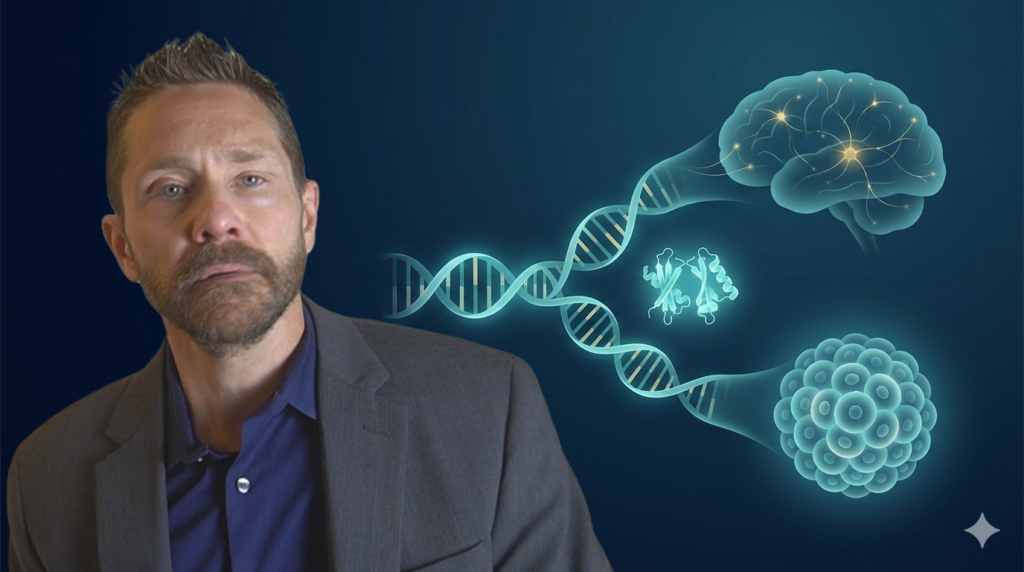
New research from Houston Methodist suggests that these two “opposites” — dementia and cancer — may share a common root.
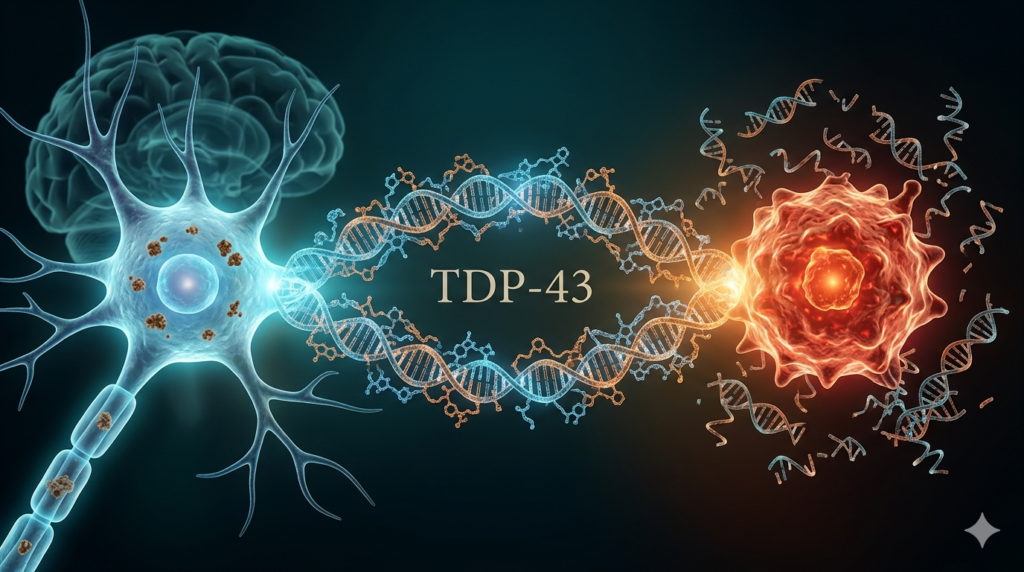
The factor being singled out is a protein called “TDP-43.”
For years, researchers have recognized abnormal TDP‑43 accumulation as a major pathological feature in ALS and frontotemporal dementia —
…though its exact role in disease progression has remained unclear.
Suffice it to say that, if doctors find it clumped up in the wrong place in the brain, it’s interpreted as a sign of impending trouble.
But we didn’t have a clear picture of why it was there or what it was actually doing.
As it turns out, this protein appears to play an important supervisory role in how our bodies repair DNA damage.
Today, we’re going to look at how a “glitch” with this one protein “supervisor” can contribute to the breakdown of the brain on one hand, or to the growth of a tumor on the other.
[Video placeholder]
To understand this TDP business, we need to talk about how your body handles its “instruction manual” — your DNA.
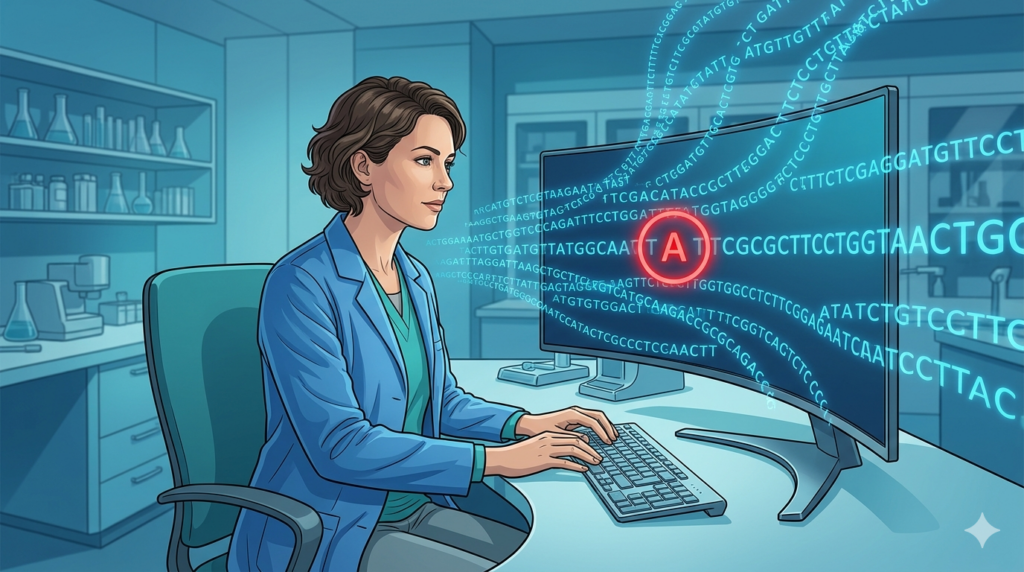
Every time your cells divide, they have to copy billions of lines of genetic code. It’s like a clerk typing out a massive book by hand. Inevitably, the clerk is going to make typos. You might get an “A” where there should be a “T.”
Healthy bodies have a “Proofreading System” (scientifically called Mismatch Repair).
Technically, “proofreading” happens during replication in real-time; whereas, mismatch repair is a sort of after-the-fact damage control.
But, in general, this system scans the code, finds the typos, and swaps them out for the right DNA “letters.”
TDP-43 appears to help regulate parts of that proofreading system.
It doesn’t just do the proofreading; it helps coordinate when repair processes activate and how they function. When this system is balanced, your DNA stays more stable.
But the Houston Methodist study found that when TDP-43 becomes dysregulated, the whole system can begin to break down.
Let’s look at this a little more closely.
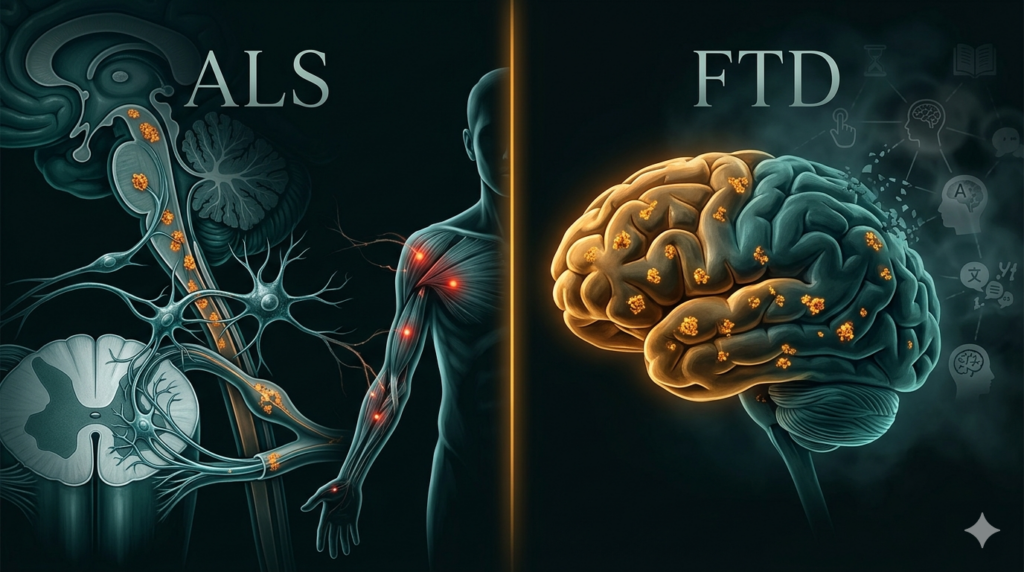
ALS and FTD
What actually happens in the brain?
Scientists have discussed two cases. The fits concerns the neurodegenerative motor-neuron disease known as amyotrophic lateral sclerosis, “ALS,” or — as I grew up hearing about it — “Lou Gehrig’s disease.” The second case study is frontotemporal dementia, or “FTD” — the latter has been in the news over the last few years due to the tragic diagnosis of famed Hollywood actor Bruce Willis, as we have discussed in other material. [Insert appropriate link(s).]
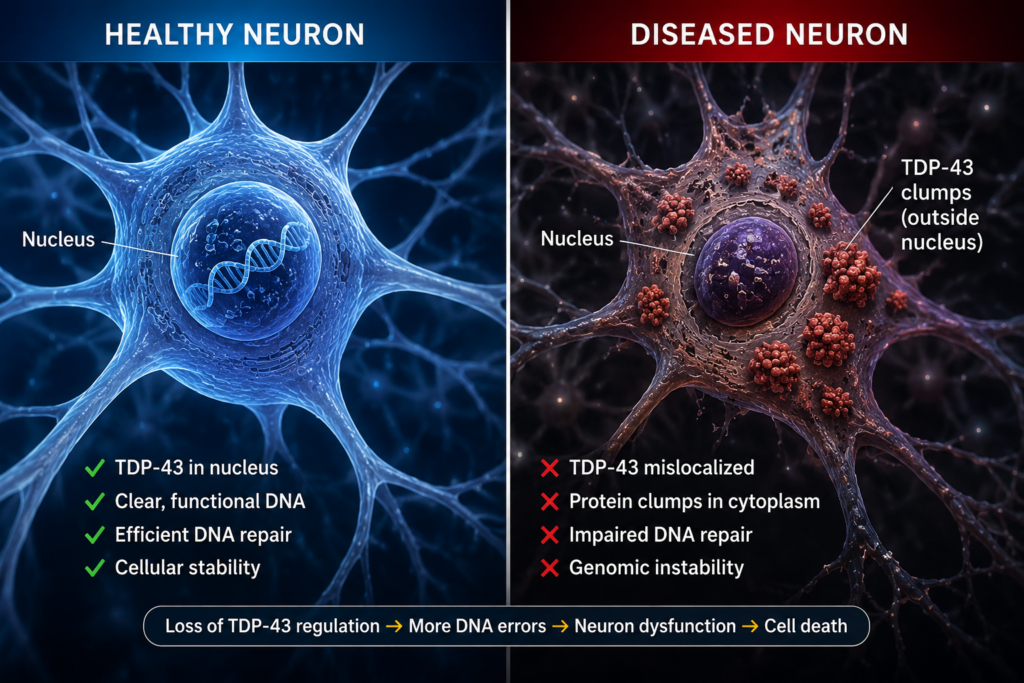
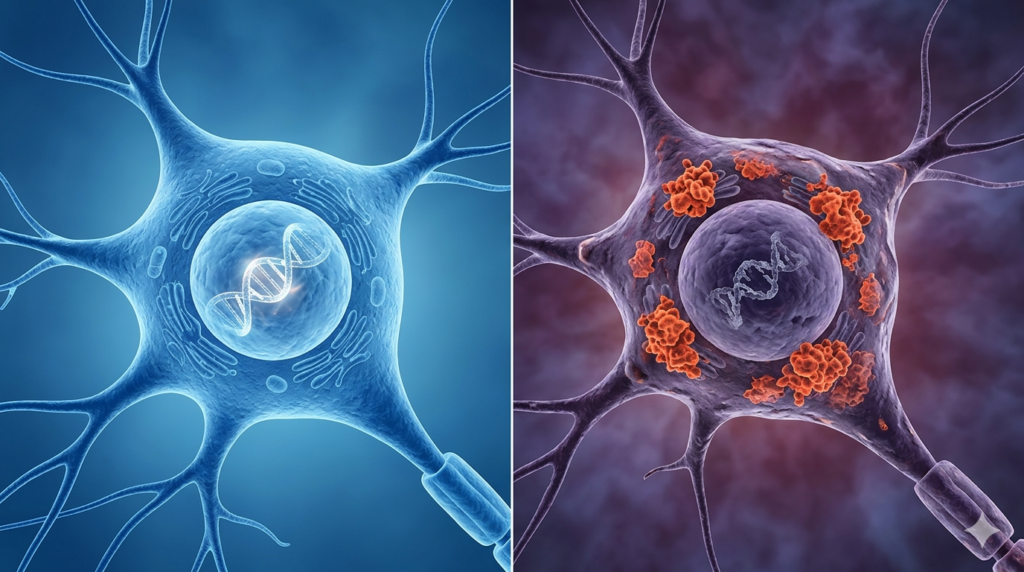
TDP-43 functions as a kind of DNA “Manager.” But, in ALS and FTD this Manager malfunctions.
It stops being where it’s supposed to be (namely, within the nucleus) and it starts clumping together in the “hallways” of the cell. This is the “Missing-Manager” scenario.
When the “manager” is missing or displaced, the repair system can become less coordinated and less reliable. This may allow more errors than usual to creep in, and for instability to build up over time — which, in turn, renders the neuron’s DNA volatile.
Over time, the cell can’t function because its “instructions” are full of errors.
Eventually, the cell gives up and dies. This mass “cell death” is what causes the symptoms of dementia — memory loss, loss of motor skills, and overall cognitive decline.
Now, let’s look at another side of the TDP-43 problem.
Cancer
Cancer is, at its core, a disease of corrupted instructions. Mutations can push cells to keep dividing, to ignore normal limits, and to survive when they shouldn’t.
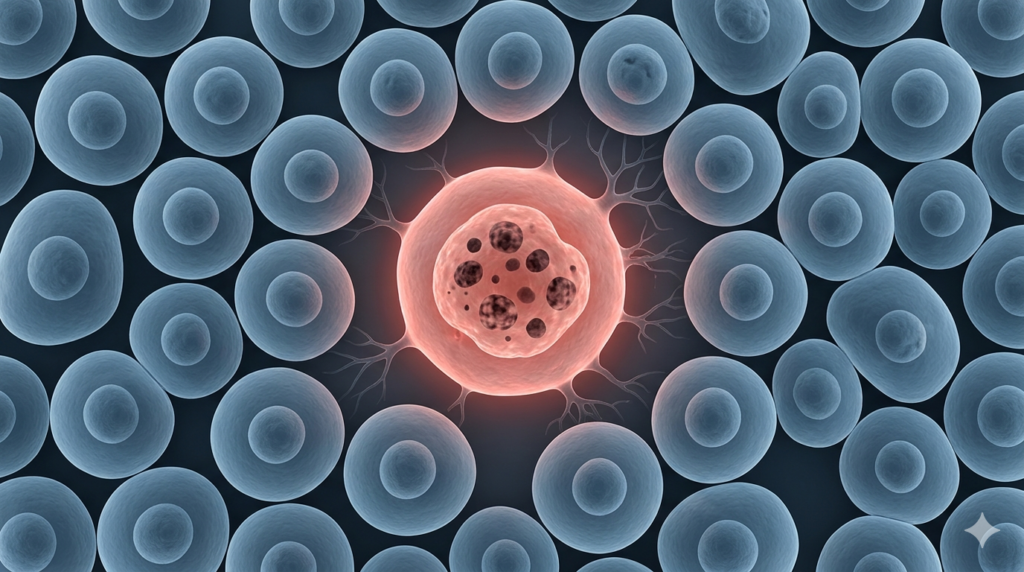
The Houston Methodist team looked at large databases of cancer patients and found something striking: in many tumors, there is an over-abundance of TDP-43.
Call this the “Manager-in-Overdrive” scenario.
When there is too much TDP-43, the proofreading department may become imbalanced. This loss of equilibrium can — once again — allow genetic errors to accumulate more rapidly.
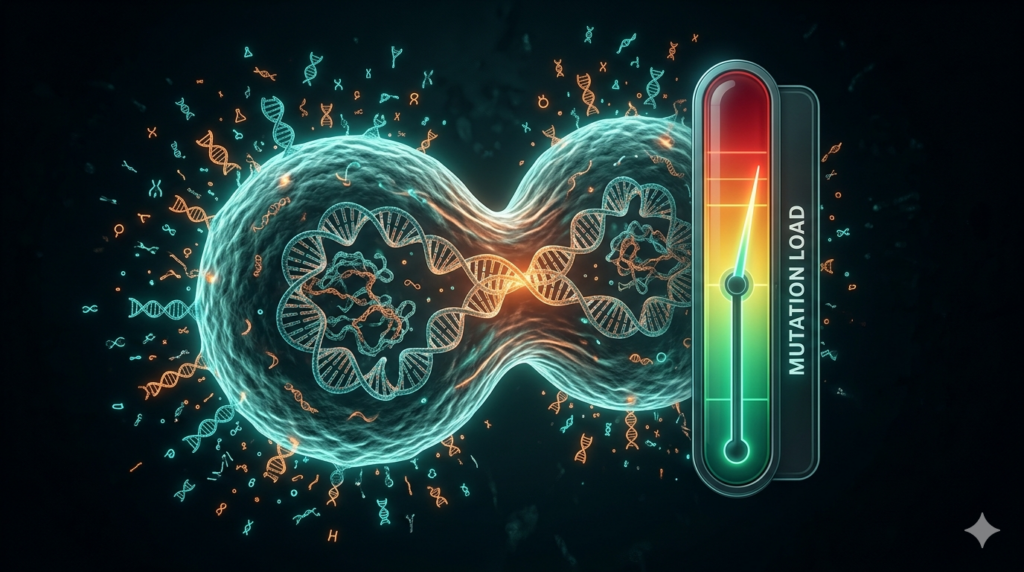
By looking at these tumors, researchers found that high levels of TDP-43 were associated with a higher “mutational burden” in multiple cancer types.
This basically means that a particular cancer is changing and evolving quickly.
Tumors with high mutation rates can become harder to treat because they may evolve in such a way as to develop resistance to chemotherapy or to evade the body’s immune responses.
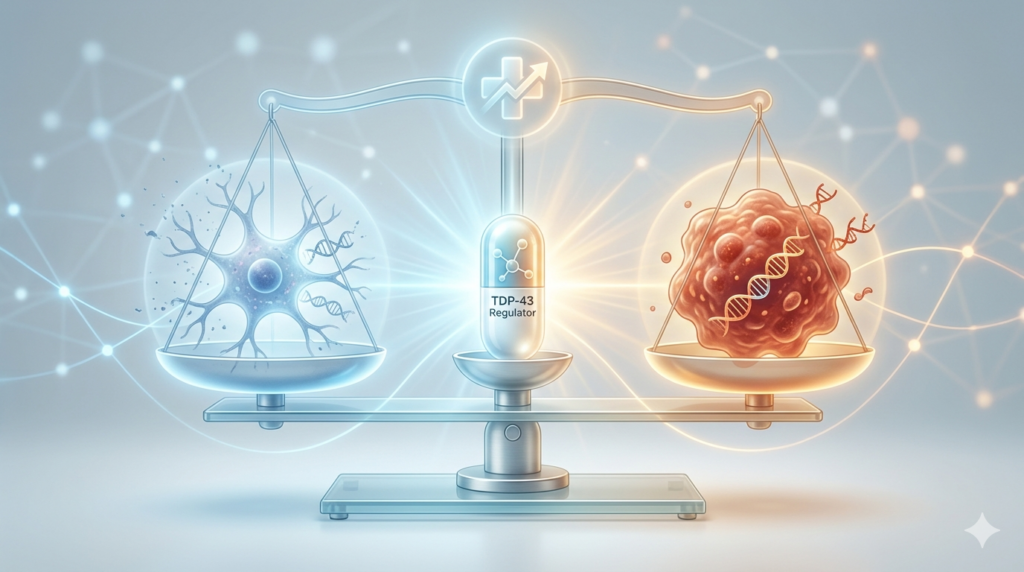
So, while too little TDP-43 may contribute to the death of brain cells, abnormally high TDP-43 activity may contribute to tumors growing faster and becoming harder to treat.
This might sound like a “lose-lose” situation, but for scientists, this is actually an incredible opportunity. Before this discovery, we were trying to fix dementia and cancer using completely different tools.
Now that we know (or, at least, highly suspect) that TDP-43 and DNA repair may sit near the center of both processes, we have a potentially unified experimental target.
The findings suggest that restoring balance to these repair pathways could become a future therapeutic strategy. The aim would be to maintain TDP-43 in a sort of “Goldilocks zone”: not too much, not too little.
In the brain, this could mean protecting neurons by helping keep their DNA stable.
In cancer, this could mean slowing down the tumor’s ability to mutate, potentially making it easier to treat or more susceptible to a range of traditional therapies.
Caveats and Disclaimers
It’s important to note that this research is still in an early stage, and it’s focused primarily on understanding the underlying biology rather than testing new treatments in patients.
Additionally, both “cancer” and “dementia” are generic terms. This is to say that they range over an assortment of discrete — and, often, highly varied — conditions.
To put it another way, neither “cancer” nor “dementia” is just one, single condition.
Therefore, even if this TDP‑43 mechanism does prove important in — say — ALS and FTD, it does not automatically follow that it explains other dementias, including Alzheimer’s disease.
That said, we are starting to see the beginning of “cross-over” medicine.
Scientists are now looking at whether certain drugs used in cancer research could eventually be modified to help dementia patients — or vice versa.
The big takeaway here is that our bodies are incredibly interconnected.
A protein that we thought only mattered for brain health turns out to be deeply involved in protecting the integrity of our genetic code.
By understanding how TDP‑43 helps regulate DNA repair, researchers may eventually develop treatments that target deeper cellular mechanisms rather than addressing symptoms alone.
Eventually, we may learn how to restore balance to the dysfunctional systems that could be at the center of both cancer and dementia.
The lesson may not be that TDP-43 is “good” or “bad.” Rather, it’s that our biology appears to require a very narrow balance.
Too little may destabilize DNA repair in one direction. Too much may destabilize it in another.
It’s a reminder that in biology — as with a lot of other things in life — balance can be key.
Now, there are plenty of details that I have ignored. And, frankly, many of them may be beyond my ken. But if you want to dive deeper into the technical specifics of the study — I’ve linked the full article from the journal Nucleic Acids Research in the description below.
As a reminder, this channel is mainly focused on the health and science topics relevant for Alzheimer’s Proofing your diet, lifestyle, and — for caregivers — your home environment.
And on that note, I wish you all the best in whatever scenario you find yourself.
Thanks for reading! Don’t forget to check out the YouTube version!
Sources
Vincent E Provasek, Albino Bacolla, Suganya Rangaswamy, Manohar Kodavati, Joy Mitra, Issa O Yusuf, Vikas H Malojirao, Velmarini Vasquez, Gavin W Britz, Guo-Min Li, Zuoshang Xu, Sankar Mitra, Ralph M Garruto, John A Tainer and Muralidhar L Hegde, “RNA/DNA-Binding Protein TDP-43 Regulates DNA-Mismatch-Repair-Genes With Implications for Genome Stability,” Nucleic Acids Research, vol. 53, no. 18, Sept. 23, 2025 [online], Oct 2025 [print], <https://academic.oup.com/nar/article/53/18/gkaf920/8262242> and <https://pubmed.ncbi.nlm.nih.gov/40985771/>.
Given the research we do for this channel, I am no stranger to surprising, sometimes controversial—and occasionally disgusting—claims regarding Alzheimer’s disease.
In a previous video, we explored how something as mundane as earwax buildup—or, more technically, cerumen impaction—could lead to hearing loss and, by extension, cognitive decline.
Today, we’re looking at a physical habit.
It’s often dismissed as a minor social faux pas—and was even the subject of jokes in an old Seinfeld episode. But recent research suggests this common behavior might create a pathway for certain pathogens to reach the brain.
We’re talking about nose-picking—and its potential link to late-onset dementia.
For the companion video, see here:
The Griffith University Study
A team of researchers at Griffith University in Australia published a 2022 study in the journal Scientific Reports. They focused on a bacterium called Chlamydia pneumoniae.
This common airborne bacterium—sometimes called the Taiwan Acute Respiratory Agent—is primarily known for causing bronchitis and pneumonia. However, it has also been detected in a significant number of human brains affected by late-onset dementia.
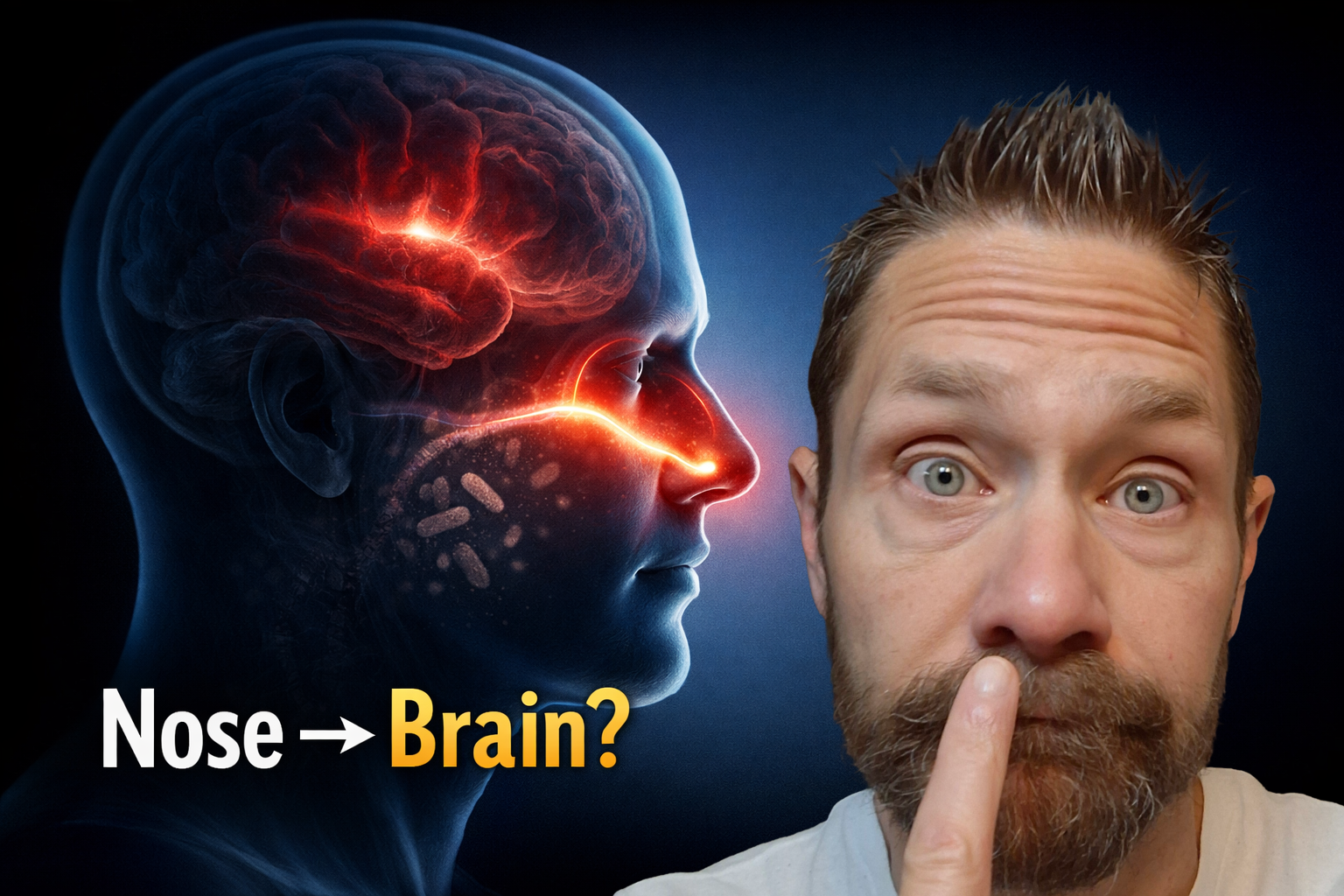
Using mouse models, the researchers tracked how this bacterium travels. What they found was striking: it can move along the olfactory nerve—from the nasal cavity directly into the brain.
In these models, infection reached the central nervous system within 24 to 72 hours. Once inside, it triggered amyloid-beta deposition—the same protein associated with Alzheimer’s plaques.
One interpretation is that amyloid-beta may function as part of the brain’s immune response to infection. However, if that infection becomes chronic or repeatedly facilitated—potentially through damage to the nasal lining—this process could contribute to neurodegeneration.
In short: this research suggests that certain behaviors might make it easier for pathogens to access the brain.
Connection: The Earwax Analogy
You may remember from our earwax discussion that conductive hearing loss involves a physical obstruction—something like earwax blocking sound transmission.
In a similar way, the nasal epithelium acts as both a physical and immunological barrier.
The Griffith University study found that when this barrier was damaged, infections in the mice became significantly more severe.
Think of the nasal lining as a security checkpoint: if it’s intact, most threats are stopped. If it’s compromised, things can slip through.
Just as we cautioned against inserting objects into the ear canal, scientists now warn that picking—or plucking nose hairs—can damage this delicate lining. That damage may give pathogens a clearer route to the brain.
Why This Matters
As geriatrician Maria Carney noted in our earwax discussion, “most people don’t even realize that they have an issue.”
That lack of awareness is a recurring theme in both Alzheimer’s prevention and detection.
While nose-picking is often associated with children, it remains common in adults. In fact, one study found that about 91% of people admit to it.
I’m curious how that compares with this audience—so I’ve put up an anonymous poll if you’d like to weigh in.
As many viewers know, age alone—especially over 65—significantly increases Alzheimer’s risk.
If we add environmental exposures, such as introducing pathogens through repeated nasal damage, this could represent an additional, potentially modifiable risk factor.
Caveats and Disclaimers
To be clear: this is early-stage research conducted in mice. We do not yet have direct evidence that this pathway operates the same way in humans.
Human trials would be needed to confirm whether a similar mechanism is at work.
And of course, Alzheimer’s disease likely involves multiple contributing factors—including acetylcholine loss, plaque formation through other mechanisms, neurofibrillary tangles, and nutritional or metabolic influences.
So yes—this hypothesis may sound farfetched.
But it is being seriously explored, and it may be worth paying attention to.
Practical Advice and Conclusion
One of the core goals of the Alzheimer’s Proof project is prevention. And unfortunately, there is no single solution—no magic bullet.
What we can do is try to stack the odds in our favor.
Protect the Barrier
Avoid plucking nose hairs and minimize behaviors that could damage the nasal lining. Chronic irritation may increase vulnerability.
Use Safer Alternatives
If needed, consider electric trimmers for grooming. For congestion, saline sprays or nasal irrigation may help. If using a neti pot, always use distilled or properly purified water.
Keep It Clean
If you must manually clear your nose, ensure your hands are clean—before and after. Also keep fingernails trimmed and smooth to reduce the risk of micro-injury.
Stay Aware
Consult a healthcare provider if you experience persistent irritation, bleeding, or signs of infection.
The key takeaway here isn’t panic—it’s awareness.
Small habits, repeated over time, can shape long-term brain health.
And if reducing Alzheimer’s risk comes down—even in part—to eliminating preventable factors, then even small changes may be worth considering.
Anu Chacko, Ali Delbaz, Heidi Walkden, Souptik Basu, Charles W. Armitage, Tanja Eindorf, Logan K. Trim, Edith Miller, Nicholas P. West, James A. St John, Kenneth W. Beagley, and Jenny A. K. Ekberg, “Chlamydia pneumoniae can infect the central nervous system via the olfactory and trigeminal nerves and contributes to Alzheimer’s disease risk,” Scientific Reports, vol. 12, no. 2759, February 17, 2022, <https://www.nature.com/articles/s41598-022-06749-9>.
For decades, Alzheimer’s research has chased the same target — plaques and tangles.
And despite billions of dollars… results have been limited and often disappointing.
But… what if we’ve been aiming at the wrong problem entirely?
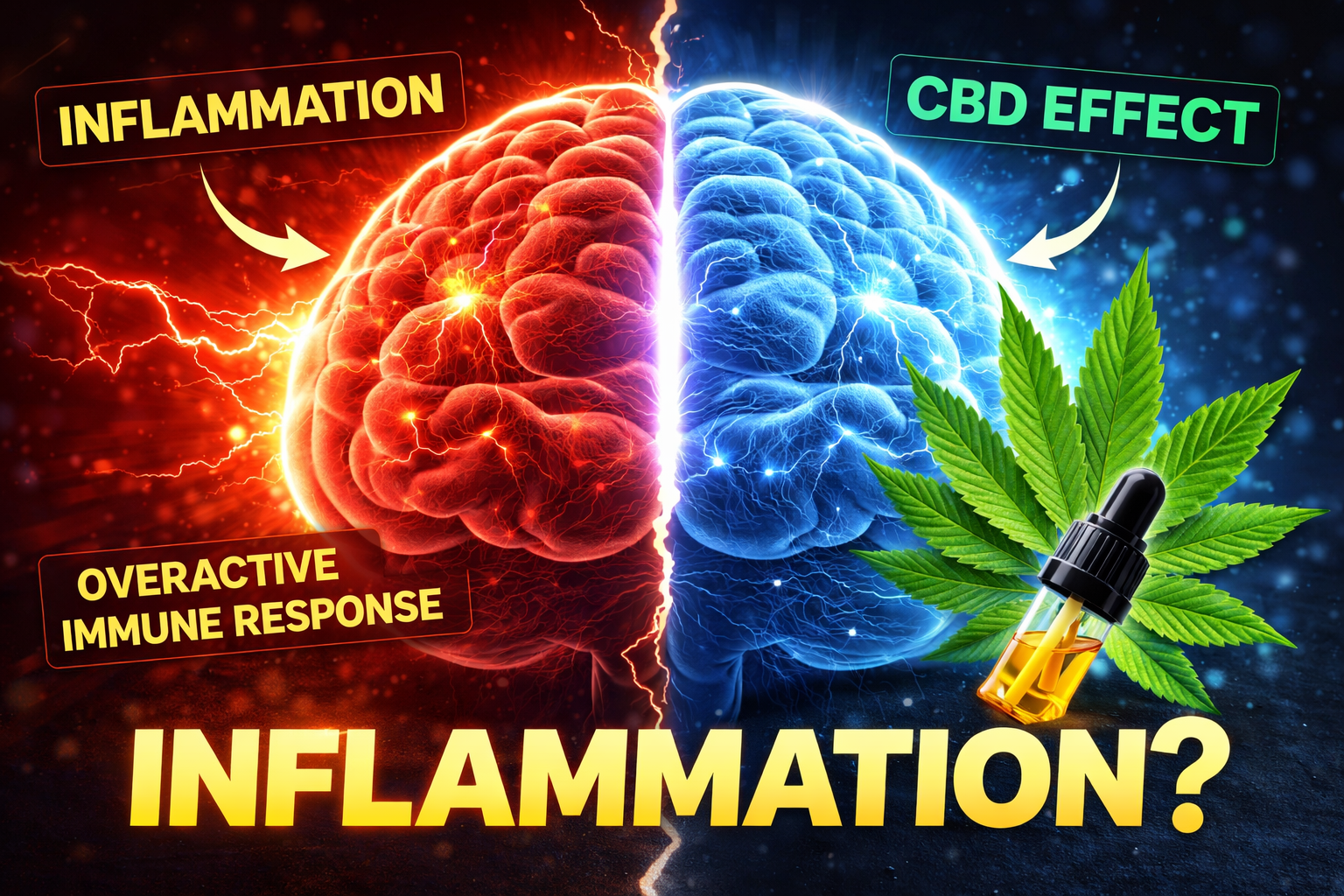
A new study suggests the real driver may be something more fundamental: inflammation.
And a compound called CBD might be able to dial it down.
Context: ‘Autoinflammatory’ Theory
To understand this breakthrough, we have to look at the “autoinflammatory” view of Alzheimer’s.
Traditionally, inflammation has been looked at as if it were a symptom of Alzheimer’s. But… researchers at Augusta University are arguing that chronic neuroinflammation is actually a core driver of the disease (along with other factors).
Translating that into dicey but everyday language, they’re starting to come around to the idea that inflammation is more of a contributing cause, not an effect.
Recall that, in general, “inflammation” is one of the body’s responses to illness or injury. In parts of our bodies we can see – an elbow, for instance (or…almost see!) – inflammation is what causes the hurt area to feel hot and painful, look red, swell in size, and so on.
Inflammation is often associated with loss of function. If your elbow is injured or inflamed, you can’t expect to be playing racquetball anytime soon.
Well… In Alzheimer’s disease, inflammation has to do with the brain’s immune system becoming chronically overactive. The brain gets stuck in a state of chronic immune activation. Yes, your brain can get inflamed, too.
This can also start a chemical chain reaction where usually functional neuronal “signals” begin to cause damage to nerve cells, instead of protecting them.
As a technical point, though, we don’t want to confuse inflammation (in the sense of haywire immune signaling and cellular activation) with what doctors call edema (i.e., large-scale fluid accumulation that increases pressure within the skull).
Think of it like this.
Your brain has a specialized immune system.
When it senses trouble, it sends out “first responders” like microglia and astrocytes.
In a healthy brain, these get to the scene of the accident, bandage the wounded, clean up, and go home.
But in Alzheimer’s, these cells get stuck in the “on” position. The emergency situation just goes on and on.
They stay “agitated,” and end up releasing toxic chemicals that (accidentally) kill the very neurons they were summoned to protect.
And this is where CBD enters the picture.
Science: IDO and cGAS
The study in question was led by Dr. Babak Baban. He and his team set out to see if cannabidiol, abbreviated “CBD,” could (so to speak) step into this mess as a peacekeeper.
CBD is already well known for its anti-inflammatory properties.
The researchers used a mouse model specially designed to mimic Alzheimer’s in humans.
They had these mice inhale CBD daily for four weeks. What they found wasn’t just “general” improvement. They identified two specific molecular “switches” that CBD was able to flip.
Two Molecular Switches
The first is an enzyme called IDO. It’s involved in how the brain processes tryptophan. You know, the essential amino acid that’s found in poultry – like your Thanksgiving turkey – which, by the way, has a largely undeserved “bad rep” for supposedly causing the “turkey coma” after you indulge. But that’s another story.
When overactive, IDO can shift tryptophan metabolism toward compounds that promote inflammation and neurotoxicity.
The second switch is a sensor called cGAS. This is basically a DNA-sensing pathway that can trigger powerful innate immune responses when activated.
In the Alzheimer’s-affected brains, both of these pathways were screaming at full volume.
But after the CBD treatment, the expression of IDO and cGAS dropped significantly.
Specifically, it quiets down the brain inflammation including in regions like the entorhinal cortex — a region critical for memory formation, and one of the first areas affected in Alzheimer’s.
By calming these two pathways, the CBD essentially told the brain’s immune system to “stand down.”
Results: Memory and Behavior
So, the biology changed, but did the behavior change? The symptoms?
Those are the “big” questions.
And the answer was… yes.
Remember, this is so far only demonstrated in animal studies. But…
The mice treated with CBD performed significantly better on recognition memory tests. And they showed more “exploratory behavior” than the untreated group. They weren’t just neurologically “calmer”; which researchers interpreted as improved cognitive function.
But here’s why this study is particularly exciting for the future of human medicine.
CBD appears to be a “multi-target” intervention.
While this specific study focused on inflammation, Dr. Baban’s team noted that their earlier work showed CBD may also influence plaque and tangle pathology through different mechanisms.
This is to say that, instead of a drug that only does one thing, we’re looking at a compound that might clear the trash, quiet the alarms, and protect the neurons all at the same time.
And notably, it’s derived from a plant.
Conclusion: The Road Ahead
Now. We have to be realistic.
This was only one study.
On mice.
While mouse models are essential for understanding these brain “switches” in a generic sense, humans — and our brains — are much more complex.
We still need rigorous human clinical trials to see if these results translate, what the right dosage is, and if long-term use is safe for seniors.
But…
If this line of research holds up, it changes the entire strategy.
Not just clearing damage — but preventing it at the source.
Not a single target — but an entire system reset.
And that raises a bigger question: Have we been looking for a silver bullet… when Alzheimer’s is really a systems-level failure?
If so, the future of treatment may not look like a drug that does one thing — but a therapy that brings the brain back into balance.
The question is: are we ready to rethink everything?
Including that an answer to one of our most complex diseases might be found in the chemistry of one of our most misunderstood plants.
What are your thoughts? Do you think the future of Alzheimer’s treatment lies in CBD, or are you still skeptical of cannabis-based medicine? Or are you more skeptical of pharmaceutical treatments? I’d love to read your comments.
By the way, if you’re interested in this idea of multi-target therapies, we’ve explored it before. In one video, we break down how CBD and THC interact with the brain.
And in another, we look at the controversial research into Lysergic acid diethylamide (or “LSD” and dementia — where, interestingly, a similar “systems-level” approach has been proposed. So if this direction intrigues you, those are worth watching next.
AT A GLANCE: Amyloid‑β plaques = a hallmark of Alzheimer’s disease; Most drugs target plaques directly
Alzheimer’s may involve a failure of brain “cleanup,” not just toxic buildup.
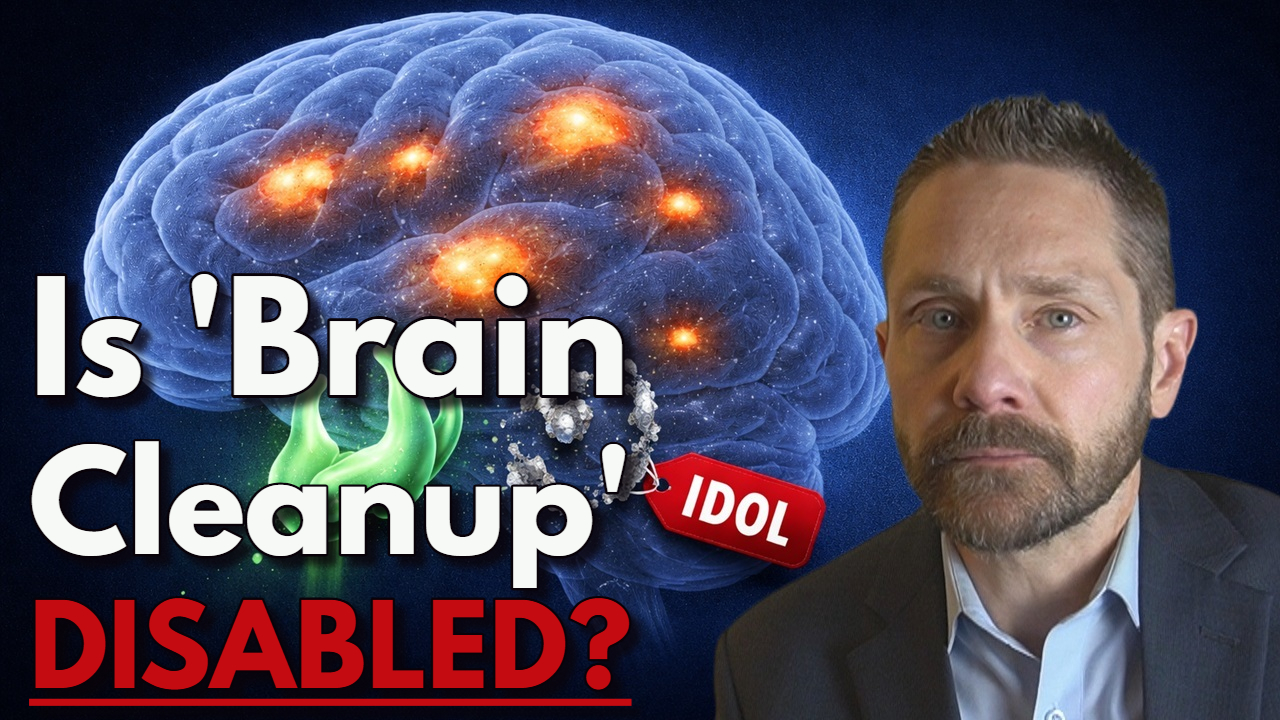
What if Alzheimer’s isn’t just caused by toxic buildup in the brain — but by the brain’s own cleanup crews being quietly dismantled from the inside?
If you’ve been around the block, when it comes to Alzheimer’s, you probably realize that a primary “pathological hallmark” is the accumulation of – what are called – “amyloid-beta plaques” within the brain.
AT A GLANCE: What if the problem is impaired clearance—not just plaque formation?
For over a century — since Alzheimer’s was first described in 1906 — drug development has largely focused on stopping plaque formation or clearing plaques after they appear.
And a critical area of this investigation involves taking a close look at the brain’s innate ability to clear these toxic proteins.
Recent research from the Indiana University School of Medicine has identified a specific enzyme that, when it is present, appears to be a factor when someone’s brain-clearing mechanisms go haywire.
And, in this video, we’ll look at a CliffsNotes’ version of the results.
AT A GLANCE: IDOL = Inducible Degrader of the LDL receptor controls how many LDL receptors remain on brain cells
The enzyme is abbreviated I‑D‑O‑L, or “IDOL,” short for “Inducible Degrader of the LDL receptor.” That expression (a mouthful, for sure) designates a protein that controls how many LDL receptors survive on the surface of brain cells.
But… what the heck is it? And, more importantly, how would its inhibition (quote, unquote) represent a promising shift in doctors might approach Alzheimer’s treatments?
The Molecular Rôle of “IDOL”
AT A GLANCE: Receptors = cellular “locks” that trigger actions
To even begin to understand this discovery — and to be perfectly honest, that’s about the most ambitious goal I can realistically aim for — we need to talk about something called a low‑density lipoprotein, or “LDL,” receptor.
First, in the relevant context, a “receptor” is a protein on a cell — or in a cell — that acts like a lock. When the right chemical “key” comes along, that lock opens and tells the cell to do… something.
AT A GLANCE: LDL receptors pull material into cells for use or disposal
An LDL receptor is one of these locks. Its job is to grab so‑called “bad” cholesterol — LDL — and pull it into cells so it can be used or gotten-rid-of.
Think of it like a trash‑pickup claw that grabs garbage from the streets of the body and pulls it inside for disposal.
AT A GLANCE: In the brain, LDL receptors help manage APOE and amyloid‑β
In the central nervous system, LDL receptors also play a crucial role in regulating APOE, a protein involved in the transport and clearance of amyloid‑beta.
So far, so good?
AT A GLANCE: IDOL tags LDL receptors for destruction
Now for this IDOL business.
IDOL is not a receptor itself. It’s a protein that comes along and “tags” LDL receptors for destruction — that’s the “inducible degrader” part of its full name.
AT A GLANCE: Overactive IDOL à fewer LDL receptors; (-) Amyloid clearance à (+) plaque buildup
It’s like removing the trash‑pickup claws and throwing them away instead of the “bad” cholesterol. Reducing the number of LDL receptors on cell surfaces is a bit like getting rid of trash trucks in the heart of a crowded city. It’s not good.
When IDOL becomes overactive, too many LDL receptors are destroyed, weakening the brain’s ability to clear APOE and toxic amyloid‑beta proteins. This allows plaques to accumulate and neurodegeneration to accelerate.
In effect, an overactive cellular “shutdown switch” disables the brain’s cleanup crews at precisely the moment they’re needed most.
Receptor Inhibitors — and Why IDOL Is Different
AT A GLANCE: IDOL inhibitors protect receptors; They stop destruction — not signaling
At this point, it helps to understand what scientists mean by a “receptor inhibitor.” Usually, a receptor inhibitor blocks a lock so that even when the correct key shows up, the cell can’t respond. But that’s not quite what’s happening here.
An IDOL inhibitor doesn’t block the lock — it stops the demolition crew from tearing the lock off the door. In other words, inhibiting IDOL prevents LDL receptors from being destroyed, allowing the brain’s cleanup machinery to stay in place and keep doing its job.
IDOL Proteins Aren’t the Problem in and of Themselves
Let’s register a couple caveats.
Number one, it’s important to understand that IDOL proteins aren’t “bad” in and of themselves. They’re normal control mechanisms within the complex anatomy-biology of the body.
And they don’t come from “outside.” Your own cells make IDOL proteins automatically.
AT A GLANCE: IDOL is a normal control mechanism; Problems arise when it shuts things down too aggressively
Think of their part in in the trash-removal process as akin to that of a “thermostat” that off the air conditioner or furnace when the desired temperature is reached. When a cell thinks it’s cleaned up enough LDL cholesterol, these IDOL proteins shut down the whole process.
In the context of Alzheimer’s Disease, overactive IDOL proteins lead to a depletion of these trash-removal receptors. In turn, this loss diminishes the brain’s capacity to clear amyloid-beta. And that, researchers, suspect, leads to – or makes worse – the formation of the plaques that lead to neurodegeneration.
Whew!
AT A GLANCE: Evidence so far: animal + cellular studies
It’s also important to note that this entire IDOL–LDL receptor mechanism has been demonstrated primarily in animal and cellular studies. While the evidence strongly implicates IDOL in Alzheimer’s pathology, human treatments are still in-process.
Research Findings
Neuronal vs. Microglial IDOL
AT A GLANCE: Microglial IDOL removal à little effect; Neuronal IDOL removal à major plaque reduction]
The study in question was led by Dr. Hande Karahan and Dr. Jungsu Kim, who sought to determine which cell types were most responsible for IDOL-mediated damage. Historically, the scientific community focused on microglia — the brain’s immune cells — as the primary drivers of plaque-clearance.
However, using a series of “knockout models,” the Indiana University team found that removing IDOL from microglia had a negligible effect on plaque levels.
AT A GLANCE: “Knockout” = a gene deliberately switched off to study its function
A “knockout model” is a genetically engineered animal — usually a mouse — in which a gene like IDOL is “switched off” so scientists can see how the brain behaves without it.
They take out a gene to see what breaks — or improves — when it’s gone.
When IDOL was “deleted” specifically from neurons, the results were deemed significant. The researchers observed a substantial reduction in amyloid-beta deposition.
AT A GLANCE: Lower APOE4 levels observed; APOE4 = strongest genetic risk factor for late‑onset Alzheimer’s
Additionally, the deletion of neuronal IDOL led to a decrease in APOE4 levels. As APOE4 is the most significant genetic risk factor for late-onset Alzheimer’s, this suggests that targeting IDOL could directly mitigate the risks associated with this specific genotype.
Clinical Implications and Synaptic Health
AT A GLANCE: IDOL inhibition linked to improved ‘synaptic plasticity’; Healthier connections = better learning & memory support
What distinguishes this research from current treatments — such as antibodies that target existing plaques — is its focus on enhancing the brain’s internal environment.
The researchers also observed a second effect – beyond reducing toxic amyloid-beta. This is to say that inhibiting IDOL was also associated with improvements in synaptic plasticity — the brain’s ability to adjust and strengthen connections involved in learning and memory.
It refers to how the brain “rewires” itself.
Conclusion: The Path to Small-Molecule Therapeutics
AT A GLANCE: Targeting IDOL may improve the brain’s internal environment
From a pharmaceutical perspective, the IDOL enzyme is a highly viable (read: commercially promising) target.
So, the upshot is that drug-researchers believe they may be able to engineer an oral medication capable of inhibiting the trash-removal inhibition!
AT A GLANCE: Goal: oral drugs that cross the blood‑brain barrier; Less invasive than antibody infusions
From a cost-per-treatment standpoint, this would an advancement over the current method, which requires expensive – and invasive – intravenous infusions required to deliver antibody treatments to try to dissolve plaques.
The Indiana University School of Medicine team is still a “preclinical” phase. Its focus is on screening for “small molecules” that can effectively cross the blood-brain barrier to inhibit IDOL. While further trials are obviously necessary, this research provides a roadmap for a new generation of Alzheimer’s therapies.
For those you still here, thank you for sticking with it! I know it was heavy-going.
If you’d like to dig deeper, here’s a link to the original study — because this is one of those cases where the data itself really is the story.
When I was a kid, and I heard “adults” saying: “Oh, they grow up so fast,” I probably rolled my eyes. I mean, how obvious can you get, right?!
Now I have two sons – both in their early 20s. Now I know what “they grow up so fast” means.
Similarly, I didn’t need my dad and grandma to get Alzheimer’s Disease to know that “dementia is bad.”
But it’s a bit like “they grow up so fast.” Sometimes, the things you’ll nod your head (in agreement) to, don’t really sink in until you’ve had a certain amount or type of experience.
So, here’s what I’ll do in this video. I’d like to list five (5) things that probably seem so obvious that I don’t think I ever would have denied them.
At the same time, from where I sit now, I realize that I didn’t actually appreciate the full significance of any of the five until I became the daily caregiver for my dad around 2008.
(The video version of this presentation is available on our YouTube channel.)
My dad died in 2016 from complications related to his Alzheimer’s. I have had several years to decompress and reflect on my family’s experiences with that dreaded disease.
So, I don’t say that just being my dad’s caretaker illuminated my mind. And I won’t pretend that merely listing these things for you will illuminate yours.
At the same time, I feel like encouraging you to slow down and maybe meditate on these things might be worthwhile. So, okay…
Dementia can change your loved one’s entire personality.
If, pre-2008, you’d have asked me: “Can Alzheimer’s alter personality?” I’m sure I’d have said, “You bet.” Nevertheless… Here’s what I thought when I started caretaking.
I thought my dad would continue to be the same extroverted, happy-go-lucky, laid-back person I had always believed him to be. – just with increasing memory problems. It took months – and countless frustrating, tearful, and sometimes (frankly) scary interactions – to learn that Alzheimer’s had flipped his personality. Almost all my dad’s traits that I just listed literally turned into their opposites. He was withdrawn and isolated, combative, agitated, etc.
Now… a case can be made that all these “negatives” had always been there, deep down. Everyone has a “dark side,” kind of thing.
So, maybe, for most of his life he was just really good at hiding or restraining those parts. And, maybe, when he got Alzheimer’s, he just couldn’t or wouldn’t hold back any more. Regardless…
What you “get” – when caring for a dementia-afflicted loved one – is often quite different from what you’re used to, what you expect, and especially what you hope for. So, be prepared for anything! Or, to put it another way, realize that the person you’re dealing with – while they may resemble the one you’ve known and loved your entire life – might act like a complete stranger.
Being a caretaker can make you feel really depressed.
Again, is this a surprise? Even people with no experience with Alzheimer’s probably know that it’s a horrible – and terminal – disease. Watching a loved one deteriorate is depressing.
But I thought that I’d at least feel as if I were doing something worthwhile by helping my dad.
And, don’t get me wrong, it was worthwhile, objectively speaking. In hindsight, I do cherish the fact that I was present for and with my dad.
Subjectively, though, when everything was going on, I felt miserable. Caretaking frequently felt futile and useless. And I felt physically sick much of the time. Maybe it’s just me.
It wasn’t just the understandable fact that my dad didn’t appreciate what I was doing. It was that he resented and actively resisted me. The whole thing was a fight practically from day one.
I locked the doors from the inside. I hid his tools. I disabled the car and – ultimately – pushed his long-time doctor to petition the state to get his driver’s license revoked. I was the enemy.
I knew that the steps I took had to be taken. But it was also painfully obvious my dad was being systematically cut off from all the things that gave him freedom and that he always loved to do.
I tried to remind myself that his disease was really to blame – not me. But that didn’t stop me from being overcome with guilt and regret. I’ve gotten more into all this in a dedicated video.
So: If being a caregiver makes you feel awful, you’re not alone. I felt horrible.
And, on the wavelength of things I didn’t fully know: Know that your life – and the life of your loved one – may be permanently changed. Relatedly…
You will need to take breaks.
Not taking a break can lead to serious consequences – not least is your own emotional or physical breakdown and burnout. Who would deny it?
By the same token, you can’t exactly leave an Alzheimer’s sufferer by themselves for any length of time. It may be difficult for you to prepare and eat meals in peace or to get an uninterrupted night’s sleep, let alone to take a mini-vacation. And this can go on for years.
In our case, my dad would live nearly eight (8) years after his diagnosis. That’s a long time to be someone’s 24/7 caretaker all by yourself.
So… how are you going to take those needed breaks?
As I’ve mentioned in other presentations, if you have no able or willing family members to relieve you from time to time, or in an emergency, then you may have to turn to professionals. Adult daycare, home-care providers, and (what are called) respite-care specialists can all play rôles, here. But, however you get help, you need to make sure that you take care of yourself.
Ultimately, a nursing home or other long-term care facility may be the only game in town. And on that note, try to more fully appreciate that…
Your loved one may end up in a nursing home.
And when I say “end up,” I don’t mean to suggest that it’s inevitable. I don’t believe that.
And, in my case, I don’t mean to refuse responsibility for the decision to get him admitted. It was my choice.
But, honestly, early on, I did a lot of “ostriching.” If I had seriously faced the fact that a nursing home was a possible – or eventual – outcome, I’d like to think that I would’ve planned for it.
I’d say: “I would have planned better.” Except, to be frank, I didn’t do any real planning at all.
No one in my family wanted to think about dad being in a nursing home. – including me.
And I put off any serious thought about that option until I was totally exhausted with caretaking. By that time, our options were severely limited. Even among homes we could “afford” (quote, unquote), our top two (2) choices were unavailable. They both had year-long waiting lists.
And because I was emotionally broken when I started to look into various homes, it’s likely that I didn’t investigate as thoroughly as I might have. – or, quite possibly, as I should have.
Since you can’t reason well when you’re under duress, my evaluation of the options – and my decision – were probably compromised also. It would have been healthier for me to admit, from the get go, that I couldn’t really rule out nursing homes.
If I’d have done only that, our decision-making process would have gone much better – and, possibly, yielded a better outcome. To top it off, I didn’t fully appreciate that…
A nursing home isn’t a perfect solution.
Again, who would say otherwise? For one thing, it’s obvious – at a general level – that when we’re deciding between two or more options, each choice will have positives and negatives.
Duh. Right? In hindsight, it seems pitifully naïve of me to have ever hoped that a nursing home would be “the answer to all my prayers.” Of course, nursing homes have their own drawbacks.
Some of these disadvantages are both major and pretty obvious – like the fact that they have a staggering, current average cost in the vicinity of $8,000 per month.
Another serious downside – one that I intend to make the focus of its own video – is the arguable tendency of nursing homes to over-medicate their patient-residents. I don’t want to go too far down this rabbit trail right now. Let’s just say that – in my opinion – my dad’s nursing home medicated him just to make him docile.
But it was hard for me to understand all this when I was at the end of my rope with homecare. The situation became seriously unmanageable. And I became desperate for an escape route.
So, at the risk of concluding with another one of those aphorisms that’s easy to say, but hard to appreciate or do… Try to stay as clear-headed as possible.
From a practical standpoint, try to have open and honest conversations with every interested person in your circle: from family and friends to doctors, lawyers, and so on.
Solicit advice from as many reputable sources as possible. And run your options past your family “think tank.” Try not to exclude any possibilities.
In two (2), planned, follow-up videos, I’ll expand on some of these ideas and explore related topics like “things I wish I’d known when I started off caretaking.” In the very next installment, already written, I’ll suggest three (3) things that I would do immediately, if I had to be a caregiver all over again.
But if you found something of interest or of use in this video, I invite you to click “Like.” It helps YouTube know that you appreciated the presentation.
If you’d be interested in hearing some of my tips, then please Subscribe to the channel (if you haven’t already) and don’t forget to make sure your notifications are turned on – the “bell” icon.
And if you think someone else might get something out of the video, kindly share the original link on your social media pages.
Either way, though, I thank you for watching.
And I wish you all the best for your caretaking efforts.
So far, most of my content has dealt with Alzheimer’s proofing in home-modification scenarios and other long-term-care conversations.
But, today, I thought I would venture off the beaten path just a little bit.
Alzheimer’s also has a number of interesting theoretical implications as well. My academic background is partly in philosophy and so these theoretical questions are also of interest to me personally.
There are a great number of these cognitive impairments and dementia might surface in a number of different contexts. Ethics is going to be one. Metaphysics is another. Philosophy of mind has obvious relevance. So, I thought I would just pick one of those issues and I decided upon the question of the existence of the soul; that this is an issue that has been debated for thousands of years, so I am under no illusions about trying to resolve the issue in the space of a short web article.
In fact, I am not even going to take sides on the issue, what I want to do instead is just trying to present an accessible introduction to the range of issues, or if you are already familiar with these then call it a refresher course.
The question that is going to be somewhat in focus here is:
Does Alzheimer’s disease disprove the existence of the soul?
What I am going to do is assume the role of the person who says that Alzheimer’s does disprove the soul and then, on the other side of the fence, I’ll play the person who says it does not. I’ll go back and forth like this through five (5) considerations.
But, without further ado, let me present both sides!
Pro and Con Arguments
Against Soul #1: Alzheimer’s is a brain disease that can destroy someone’s personality. That’s the key point.
Alzheimer’s destroys personality by destroying the brain. So, take away the brain, and you take away the personality. A soul simply does not fit into that picture anywhere.
The brain is necessary for personality.
For Soul #1: The brain is necessary for personality. There is no real question about that. So yeah, if you take away the brain, you take away the personality.
But think of a Philly-Cheese-Steak sandwich. If you take away the cheese, you take away the Philly cheese steak sandwich. That does not show that there is nothing to a Philly cheese steak sandwich other than cheese.
The cheese is necessary, just like the brain is necessary. But arguing that the necessity of the brain shows the nonexistence of the soul is like arguing that the necessity of the cheese shows the nonexistence of …bread rolls.
Against Soul #2: Not really, because we already know that bread rolls exist, and we know the full recipe for a Philly cheese steak. It is part of our background information.
But, here, we’re trying to figure out what the full recipe for personality is, based on empirical evidence.
Personality is made up of brain states. Think of it as like how a team is made up of players and coaches. There is nothing more to a team than the people who make it up, and there is nothing more to a personality than the brain states that make it up.
For Soul #2: Well, wait a minute!
The evidence shows dependence. Personality depends on the brain. But dependence is not the same thing as identity.
A team may be identical to the people that make it up. But, then, a team is not a good analogy.
A better analogy would be to think of a musician. A musician depends on a working, well-tuned instrument in order to make music. If the instrument is broken, or out of tune, then the quality of the music is either dramatically lowered, or the musician may not be able to make any music at all. But this dependence of the musician on a working instrument certainly does not imply that music is identical to a good instrument.
Similarly, the fact that personality is dependent on the brain does not mean the two are identical. The brain is an instrument of the soul.
Against Soul #3: But we can experience both musicians and musical instruments. We know they are two separate things because we can have dealings with both of them.
Again, in this case, were trying to figure out how many things there are.
Just because there could be something more than the physical brain does not mean that there is.
Number one, it’s not clear how a nonphysical thing like a soul could use a physical brain as a tool.
And, number two, the principal known as “Occam’s Razor” tells us not to multiply causes, and to prefer simpler explanations.
So, in this case, saying that personality is due to onething – a physical brain – is simpler than saying that it is due to two things – a physical brain plus some mysterious “soul.”
For Soul #3: There’s a saying, sometimes attributed to the famed physicist Albert Einstein: “Make everything as simple as possible, but not simpler.”
Simplicity is great, but it is not always a matter of just counting proposed causes.
Suppose someone is investigating a house fire, and they notice that the wiring is faulty, and that there were oily rags strewn about the entire place.
Now, it would, of course, be simpler to explain the house fire only by talking about the faulty wiring, and not mentioning the oily rags at all. But, if the house fire was in fact caused by faulty wiring and the rags together, then any explanation that leaves one of those factors out is not a good explanation.
Occam’s Razor says we should not multiply causes beyond necessity. Sometimes multiplying causes is necessary.
Against Soul #4: In the case of your fire example, the multiplication of causes is necessary because the scientist, or in that case, the fire investigator, concludes from the evidence that having more than one cause is necessary to give a full explanation.
In the case of personality, the investigators, for example, neuroscientists, have not concluded that we need to appeal to more than the physical brain in order to have an adequate explanation.
So, appealing to anything else simply goes beyond what is needed.
For Soul #4: Fire investigators and neuroscientists are both scientists of nature.
Natural science deals with what is physically measurable and physically detectable.
So, natural scientists can tell you all about the physical causes of physical things, but they cannot tell you about nonphysical things. For example, the fire investigator can tell you about faulty wiring and oily rags but cannot tell you that the fire was a tragedy.
Things like tragedies, or indeed souls, are nonphysical things. But, being nonphysical does not mean that they are not real parts of human experience. They are; they just go beyond what natural science can talk about.
Against Soul #4: We do not need the fire investigator to tell us that the fire was a tragedy. That’s obvious. But having a soul is not obvious.
For Soul #4: Here is what’s obvious: I have a rich inner experience – a private mental life – that goes beyond what neuroscientists can image, or test, or quantify in physical experiments.
Against Soul #5: We are getting off track. Here is the bottom line.
My dad got Alzheimer’s disease and progressively forgot more and more, and got worse and worse until, eventually, somebody could have looked at him and said he was a completely different person.
And that horrible decline was due to a brain disease.
So, at the end of the day, who my dad was, and who we all are, is dependent on, caused by, or explained in terms of the brain.
If something like Alzheimer’s disease comes along and damages our brains enough, it can literally change who we are.
And this is not at all what we would expect if we had, or if we were, something other than, a physical brain.
Therefore, Alzheimer’s disease shows: Probably, there is no such thing as a nonphysical soul.
For Soul #5: Well, my dad went through Alzheimer’s disease, too.
Notice how we both said that.
“Mydad developed Alzheimer’s disease.” “Mydad got progressively worse.” “My dad forgot who he was.”
But all that happened to the same person: My dad.
Yes, his personality was dramatically and tragically changed, because we know – from science – that you have to have a working brain in order to be a healthy and recognizable version of yourself.
But my dad never literally became someone else. If he had, why would the family have continued to care about him at all?
See, that is really the point. If, as I think, he was still numerically one and the same person, even after his brain and his personality were destroyed, then the question is: What was it about them that stayed the same the whole time? What continuous, existing thing explains that identity over time?
It wasn’t his brain, or his memories, or his personality. All those things were destroyed by the Alzheimer’s!
Therefore, I say that the thing that stayed the same was something the Alzheimer’s could not destroy: It was his soul.
Conclusion
These are heavy, theoretical topics! Bear in mind that I have left out quite a lot!
Philosophical reflections on questions regarding the soul may spill over into discussions of personal identity, memory, and so on – each of which on their own fill countless pages and extend back hundreds and even thousands of years.
Conversations of this kind often invoke obscure words and forbidding terminology. You may hear talk of “aboutness” and “intentionality.” You may be exposed to ponderous phrases like “mind-body dualism” and “reductive versus non-reductive physicalism.” You might hear great-big words like “supervenience.”
In the above presentation (and accompanying video!), what I have tried to do is to give a presentation of the issues without any of that jargon.
I have, however, bumped up against some of the deeper concepts. For example, there is an underlying discussion of necessary and sufficient conditions. I touched on this a little bit, without naming it specifically.
But, there are other important issues that I simply haven’t gotten into at all. For instance, there are questions about identity and what is sometimes called “Leibniz’s Law.” I did not really get into those at all.
And the conversation can easily turn into a subset of philosophy called “modality,” where the discussion is about concepts like contingency, possibility, and necessity.
Suffice it to say that there is plenty of room to expand a conversation like this!
So… if you feel like I have left out your favorite argument or your favorite consideration, please understand that I have not done it to purposely weaken one side of the argument or another, or to play favorites. I have simply done it because I felt that introducing another concept might have made the article a little bit less accessible.
And bear in mind that all of that is simply keeping the conversation in the realm of what you might call “philosophy.” The conversation could easily be further expanded to include religious doctrines, theological opinions, etc., and that could be an entire presentation all on its own.
What I did present was simply designed to be an introduction to the issues.
Although I may certainly get into further theoretical issues in the future, understand that this website is mostly about some very practical concerns about how to Alzheimer’s Proof your care environment. Or, indeed, I get into how to Alzheimer’s Proof your own diet and lifestyle to reduce your own risk of developing diseases like Alzheimer’s and other forms of dementia.
Of course, I have further content along those lines planned. So, I invite you to bookmark the page and check back!
Thank you for reading or watching!
Feel free to leave your thoughts in the comments, below.
Researchers have not yet been able to say definitively what the cause of Alzheimer’s disease is. But, among the candidate causes discussed is oxidation in the body – also called “oxidative stress.”
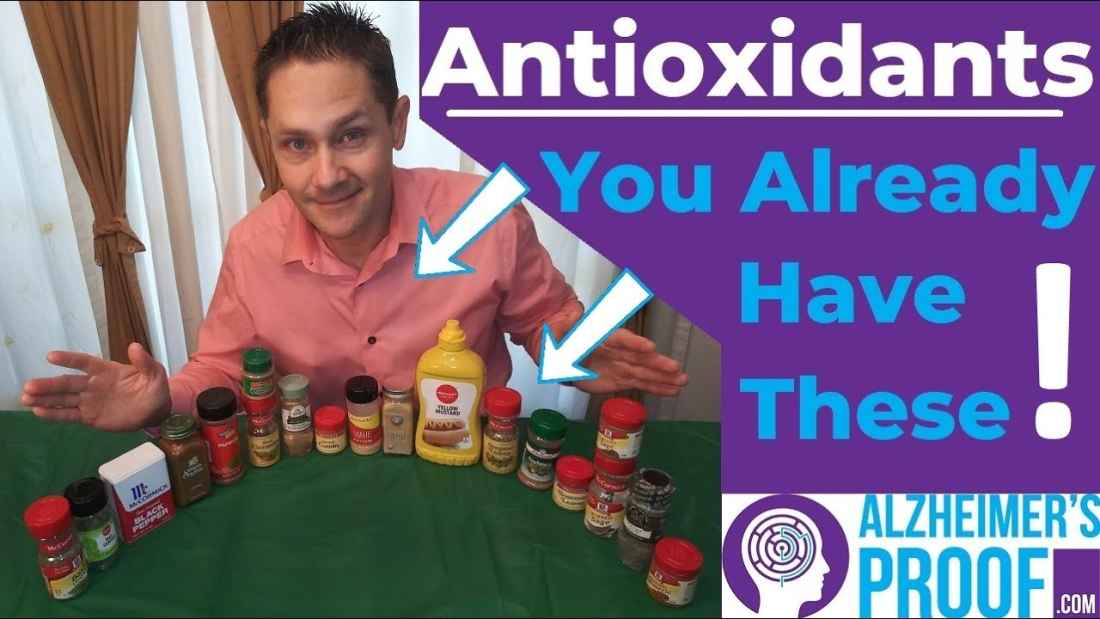
I want to survey the antioxidant potential of sixteen (16) herbs that you might have on your spice rack at home.
The Relevance of Oxidation
Oxidative stress dovetails with Alzheimer’s disease in several respects.
Firstly, patients who already have Alzheimer’s disease have problems with accelerated oxidation. They have more oxidative stress in their brains.
Secondly, many readers may also be aware that one of the primary characteristics of Alzheimer’s disease is that there is an abnormal accumulation of beta-amyloid and tau protein deposits, which aggregate between – and inside of – nerve cells, gumming up the neural “works.” Well, this abnormal deposition of protein has been speculated either to be the result of an increase in “free radicals” or a decrease in antioxidant defenses inside of some people’s bodies. In other words, it’s the result of oxidation.
But that raises the question: Are antioxidant therapies for Alzheimer’s disease viable?
In attempting to answer this question, we should be mindful of the fact that herbs can be excellent sources for antioxidant. And, as I mentioned at the outset, many of these versatile plants can be found in your kitchen.
In this article, I’ll list sixteen of the most common. (In a follow-up post, I’ll provide a further sixteen that, while less common, are still available.)
Caveats
Obviously, I’m not guaranteeing that you will have all – or even any of – these on your spice rack. Various starter sets will likely include some elements that I don’t write about. Contrariwise, your set may fail to have some component that I do discuss.
Additionally, these profiles are not exhaustive. Moreover, not every example of these herbs will have exactly the same chemical constituents or in the same amounts. It often depends on how the plants are grown, what weather conditions were like, how they were harvested, how the extract was harvested, how was stored, etc. Numerous peer-reviewed scientific journals contain more detailed information on herbs, in general, and on their antioxidant constituents, specifically.
16 Common Antioxidant Herbs You Have on Your Kitchen Spice Rack
Like most of the herbs surveyed here, basil is a good source of vitamins – many of which actually are antioxidants, themselves. But what I’m going to be concerned with is some of the other antioxidant chemicals that are found in these plants.
Basil’s Antioxidant Profile
I have come up with these little graphics with a list of antioxidants. I’m calling these the “antioxidant profile.”
In some cases, an herb’s antioxidant activity can’t be explained solely by the presence of any single compound on the list. In other words, following this line of thinking, it’s not just eugenol, but it’s eugenol in conjunction with all of the other chemicals contained in basil.
(Note: eugenol is more abundantly present in oil of clove. See Part 2.)
This propensity of antioxidants to complement and mutually amplify one another is referred to as “synergism.”
In addition to basil’s significant antioxidants, the herb has also been shown to increase both “memory retention” and “memory retrieval” in experiments on mice.[2]
Spice #2: Bay Laurel Leaves (Laurus nobilis)
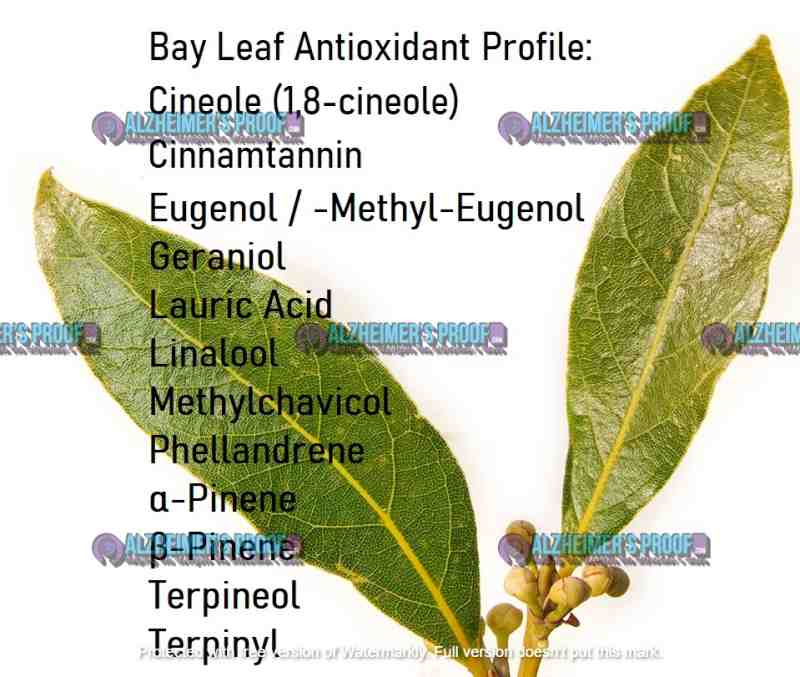
Bay Laurel’s Antioxidant Profile
You can see that my list for bay leaves is a little bit less expansive than it was for basil. sale being the primary one.
Nevertheless, bay laurel essential oil is a rich source of natural antioxidants. In fact, the anti-inflammatory and antioxidant potential of “laurel extracts is very significant,” particularly in relation to pathologies such as “Parkinson’s disease, Alzheimer’s disease, and atherosclerosis.”[3]
Spice #3: Black Pepper (Piper nigrum)
Black Pepper’s Antioxidant Profile
This one is really interesting to me. I’m fascinated that this is on the list because even people who don’t have a “collection” of herbs and spices probably have a salt and pepper shaker!
So, it’s amazing that pepper – regular pepper – may have many health-promoting qualities. And it may be highly relevant to Alzheimer’s prevention and treatment.[4]
For example, it’s full of antioxidants.
Piper nigrum’s signature component is something termed “piperine.” You don’t have to go further than the title of one Food-and-Chemical-Toxicology article to get a sense of why this is constituent is so exciting. “Piperine, the main alkaloid of …black pepper, protects against neurodegeneration and cognitive impairment in animal model[s] of cognitive deficit[s] like …Alzheimer’s disease.”[5]
It might be worthwhile to develop a taste for black pepper – if you don’t have one already! Sprinkle a little on your food next dinnertime.
Not only is a good antioxidant, in general, but it actually helps reduce high-fat-intake-induced oxidative stress, specifically.[6] Obesity, and consumption of high-fat diets are both known to be risk factors – that is, increase risk – for Alzheimer’s.
I get into this further in Part 1 of my YouTube-video series on sugar and dementia. (Watch Part 1, HERE.)
But, since black pepper is also purported to have acetylcholinesterase activity,[7]Piper nigrum is also an excellent and promising candidate for multi-target Alzheimer’s-disease therapies.
(And… if you want to get more into acetylcholinesterase inhibitors, I have separate YouTube videos on that subject. For a rudimentary explanation of how acetylcholinesterase inhibitors are supposed to work, see HERE. On the perhaps far-fetched and – as far as I know – merely theoretical possibility that a natural “acetylcholinesterase deficiency” might be beneficial in avoiding Alzheimer’s, see HERE. Finally, on the six, Food-and-Drug-Administration-approved Alzheimer’s drugs – five of which have acetylcholinesterase-inhibiting functions – see HERE.)
It’s worth observing that it’s not just black pepper that is reported to deliver positive health effects. The Piper genus has some 2,000 species of plants.[8] It is plausible to think that at least some of these will have effects similar to those of black pepper just rehearsed.
Spice #4: Cayenne / Paprika (Capsicum annuum)
Cayenne / Paprika’s Antioxidant Profile
Speaking of varieties of pepper, cayenne is another one commonly locatable on kitchen spice racks.
Rich in antioxidants, Cayenne’s main constituents include ascorbic acid, which is (of course) the more “sciency” name for Vitamin C. (By the way, for more on Vitamin C, glance see further down in this article.)
Vitamin C isn’t this pepper’s only arrow in its nutritional quiver. Cayenne also contains a healthy quantity of calciferol, that is, Vitamin D.[9]
Cayenne is known, in part, for is its antidiabetic effect.[10] Of course, diabetes may increase a person’s risk of Alzheimer’s.[11]
I’ll add that some people might have a cannister labeled paprika in their herbal starter packs. Now, I am not a chef, so this is not a culinary observation, but… cayenne and paprika are very similar. In fact, they’re similar enough that, from our standpoint, they can be considered readily interchangeable.[12]
So, for example, paprika is an antioxidant. It contains a variety of compounds, including Vitamin A – or “retinol” – and some other carotenoids, similarly to cayenne. It’s rich in antioxidants.[13]
You can see some validation of this in the article with the somewhat forbidding title, “Binding Antioxidant and Antiproliferative Properties of Sweet Paprika.”[14]
I’ll presently toss in a little caveat. Weather conditions as well as the various, possible ripening stages of individual peppers are going to impact the chemical constituents of these herbs. In the article cited in my footnote, you can see this point in reference to paprika.[15] However, as hinted at in my “disclaimers,” similar statements considerations apply to any of the herbs surveyed.
Cinnamon is loaded with antioxidants, according to the commonly cited website Healthline.[17]
In some ways, cinnamon’s antioxidant effects are similar to those of black cardamom (Amomum subulatum),[18] which I’ll get into in Part 2. (Again, to see this presentation in a YouTube-video format, see HERE.)
Coriander seeds have potential as natural antioxidants.[20] In fact, in addition to coriander’s ability to counteract oxidative stress, the seeds also show antihyperglycemic activity.[21] This makes Coriandrum sativum yet another potential herbal prophylaxis against diabetes. (And this, in turn, may help to reduce a person’s risk of dementia.[22])
Beyond these properties, “Coriandrum sativum seed extract” appears directly relevant to Alzheimer’s and other forms of dementia (for example, Multi-Infarct Dementia, also called “Vascular Dementia”) in virtue of its observed “ameliorative effects on memory impairment in… mice.”[23]
To put it slightly differently, it can possibly “[repair] memory deficits”[24] – which is cause for excitement!
Its constituents include beta-carotene, cineole, and limonene.
According to an article in the peer-reviewed journal Pharmaceutical Biology, cumin also has antistress potential. But, interestingly, especially for the focus of this website, the authors enthuse that cumin also has “memory-enhancing activity.”[26]
They wrote: “This study provides scientific support for the antistress, antioxidant, and memory-enhancing activities of cumin extract and substantiates that its traditional use as a culinary spice in foods is beneficial and scientific in combating stress and related disorders.”[27]
It happens to be an excellent stand-in for coriander. So, if you don’t have coriander seeds, but you do have cumin, you’re in luck. Not only can you expect that cumin is substitutable from a culinary standpoint, but – as alluded to – it also can be used as a stand-in from the standpoint of antioxidant profiles.
Spice #8: Garlic (Allium sativum)
Garlic’s Antioxidant Profile
Speaking of those antioxidant profiles, garlic has a unique one.
Among its noteworthy chemical parts, garlic’s “signature” antioxidant is something called allicin.
Firstly, allicin is being investigated for its possible dual ability to “reduce neuronal death and ameliorate …spatial memory impairment in Alzheimer’s disease models.”[28]
Additionally, allicin also holds promise as an acetylcholinesterase inhibitor[29] – which is the main therapeutic action of the majority of Alzheimer’s drugs – including the preeminent donepezil (sold as Aricept) – currently prescribed.
We already touched on this a bit with black pepper (see above). And we’ll get into it again when we talk about sage (see below), which is also reported to have exceptional acetylcholinesterase-inhibiting activity.[30]
(For my YouTube video on how acetylcholinesterase-inhibiting pharmaceuticals work, click HERE. For my presentation on the six FDA-approved for Alzheimer’s, see HERE.)
In addition to its own antioxidant constituents, Aged Garlic Extract (AGE) has “the ability …to increase the levels of some antioxidant enzymes.”[31]
Among other things, garlic also has a storied history as an antibacterial agent. For more on the herb that, before Alexander Fleming arrived on the scene, was referred to “Russian Penicillin,” see, for example, the article “Extracts From the History and Medical Properties of Garlic.”[32]
Recalling from our discussions of cayenne and cinnamon that diabetes is an Alzheimer’s risk factor, it’s also notable that “[g]inger has been shown to possess anti-diabetic activity in a variety of studies.”[34]
It also turns out that ginger has health-giving properties that are particularly relevant to females of the species. According to the peer-reviewed journal Evidence-Based Complementary and Alternative Medicine: “[G]inger is a potential cognitive enhancer for middle-aged women.”[35]
Finally, for Alzheimer’s, in particular, “Z. officinale may be a promising source of AChE [i.e., acetylcholinesterase – editor] inhibitors for Alzheimer’s disease.”[36] Indeed, some researchers think ginger may spark new insights into multi-targeted pharmaceutical approaches.[37]
Spice #10: Mustard (Brassica nigra)
Mustard’s Antioxidant Profile
It’s easy to dismiss mustard as a mere condiment. But, in fact, “Brassica nigra” is a remarkable “natural food source for antioxidants.”[38]
Healthline elaborates, stating: “Mustard contains antioxidants and other beneficial plant compounds thought to help protect your body against damage and disease. [i]t’s a great source of glucosinolates, a group of sulfur-containing compounds found in all cruciferous vegetables, including broccoli, cabbage, Brussels sprouts, and mustard.”[39]
Its antioxidant profile includes carotenes and kaempferol.
In the article titled “Kaempferol Attenuates Cognitive Deficit Via Regulating Oxidative Stress and Neuroinflammation…,”[40] appearing in the scientific journal Neural Regeneration Research, investigators report “that [kaempferol] may be a potential neuroprotective agent against cognitive deficit in [Alzheimer’s Disease].
As one of the most popular and widely used spices in the world, mustard is readily incorporated into a wide variety of dishes, recipes, and other culinary applications.
That said, however, bear in mind that various mustard-based preparations may include other ingredients besides the bare mustard seeds. Though, admittedly, some of these – for example, turmeric (see my YouTube videos HERE and HERE) and vinegar – may have salubrious properties of their own.
Spice #11: Nutmeg (Myristica fragrans)
Nutmeg’s Antioxidant Profile
Nutmeg is an interesting entrant to this list. First, let’s look at its “pluses.”
Predictably, the stuff “[c]ontains powerful antioxidants.”[41] As Healthline puts it: “Nutmeg contains an abundance of antioxidants, including plant pigments like cyanidins, essential oils, such as phenylpropanoids and terpenes, and phenolic compounds, including protocatechuic, ferulic, and caffeic acids.”[42]
Among its various “catechins,” and other assorted constituents – which together give it a free-radical-scavenging efficiency – is a unique chemical called “myristic acid.”
In one experiment, which involved feeding mice a “ketogenic diet …rich in myristic acid,” the studied diet “…significantly reduced total brain Aβ levels by approximately 25%.”[43]
Of course, the phrase “brain Aβ levels” refers to the pathological accumulation of junk, known as “beta-amyloid protein,” in the brains of Alzheimer’s suffers. These protein deposits are believed by some researchers to be the at-bottom cause of the dread disease. But, the jury is still out.
(For my own discussions of candidate Alzheimer’s-Disease causes, I invite you to see my WRITTEN ARTICLE elsewhere on this website or, if you’d prefer, view one of my early YOUTUBE-VIDEO efforts.)
Now… onto a few significant “minuses.”
In a New York Times article titled “A Warning on Nutmeg,” the author points us to the historical fact that, “[i]n the Middle Ages, it was used to end unwanted pregnancies.”[44]
This past employment as an herbal abortifacient would probably be little more than a footnote, were it not for the fact, reported by the Journal of Medical Toxicology, that there is such a thing as “nutmeg poisoning.”[45]
And this leads us to the somewhat darker side of nutmeg’s properties: myristicin’s potentially toxic effects.[46]
The concern shouldn’t be overstated, however. These poisoning cases are rare. They tend to involve teenagers horsing around. So, you don’t necessarily have to worry – for example, if you’re following quantity information in a tried-and-true recipe.
Still, interested persons should proceed with caution, since there’s little to go on in terms of precise information regarding how much nutmeg may be needed to cause some of the nastier effects (like hallucinations, nausea, and vomiting).
The New York Times says: “It takes a fair amount of nutmeg — two tablespoons or more — before people start exhibiting symptoms.”[47] That quantities of this sort (two tablespoons or more) are required is underscored by some of the poisoning reports available.[48]
Healthline suggests that doses can be less and still result in adverse events. In the article “High on Nutmeg,” writer Eleesha Lockett tell us: “According to the case studies from the Illinois Poison Center, even 10 grams (approximately 2 teaspoons) of nutmeg is enough to cause symptoms of toxicity. At doses of 50 grams or more, those symptoms become more severe. Like any other drugs, the dangers of nutmeg overdose can occur no matter the method of delivery.”[49]
Just handle nutmeg with care. For example, use only as directed by trusted recipes, and keep it out of reach of kids, teenagers, and the cognitively impaired.[50]
A glance at my “profile” for oregano reveals a plethora of powerful, constituent antioxidants, including rosmarinic acid – a compound also found in lemon balm (Melissa officinalis), peppermint (Mentha × piperita), rosemary (Rosmarinus officinalis), sage (Salvia officinalis), and thyme (Thymus vulgaris) – and which, in addition to its antioxidant capabilities, “…possesses many biological activities including …anti-inflammatory, anticancer, antiviral, antibacterial, and neuroprotective effects.”[52]
“Dietary intake of oregano oil has been reported to significantly delay lipid oxidation in animal models…”.[53]
One Science Daily post humorously puts things this way: “In what may be good news for pizza lovers and Italian-food connoisseurs everywhere, the herbs with the highest antioxidant activity belonged to the oregano family. In general, oregano had 3 to 20 times higher antioxidant activity than the other herbs studied,” according to at least one American-Chemical-Society investigation.[54]
Rosemary has “potent antioxidant properties” which “have been mainly attributed to its major diterpenes, carnosol and carnosic acid, as well as to the essential oil components”[55] – names for some of which you can read on the “dossier” that I have prepared.
We looked at another, characteristic antioxidant component – namely, rosmarinic acid – when we covered oregano, above.
Rosemary is quite noteworthy. In fact, I have two video presentations dedicated to it (viewable HERE and HERE), including one (ßthe second link!) where I (unofficially!) name it my pick for the second-best “Alzheimer’s herb” – just behind Gingko biloba.
Suffice it to say that rosemary is one of those “powerhouse” herbs that appears to be capable of attacking Alzheimer’s from multiple angles, including: providing “…general antioxidant-mediated neuronal protection,” guarding against “brain inflammation,” and even possibly hindering “amyloid-beta (Aβ) formation.”[56]
(Recall that nutmeg was alleged to have a similar, Aβ-inhibiting action. For a review, see the relevant section, above. And, for similar remarks about sage, continue, below!)
Spice #14: Sage (Salvia officinalis)
Sage’s Antioxidant Profile
As Healthline puts it: Sage is “Loaded With Antioxidants”![57] In fact, the herb reportedly “…contains over 160 distinct polyphenols, which are plant-based …antioxidants…”.[58]
Like oregano and rosemary before it, sage also contains nonnegligible quantities of rosmarinic acid (see the writeup on oregano for details). But it also has salvianolic acid, a chemical that is somewhat unique to Salvia plants.
The widely studied Red-Sage species, Salvia miltiorrhiza, for example, has “Salvianolic acid B (Sal B),” a “major and …active anti-oxidant …[that] protects diverse kinds of cells from damage caused by a variety of toxic stimuli.”[59]
Though, I hasten to add that “…salvianolic acid” shows up as one of the “major components” in “…analyzed samples of S. officinalis…,” or garden-variety sage, as well.
The remarks made in one scientific article are worth quoting at length.
“Amongst many herbal extracts, Salvia species are known for the beneficial effects on memory disorders… S. officinalis (common sage), Salvia lavandulaefolia (Spanish sage), and Salvia miltiorrhiza (Chinese sage) have been used for centuries as restoratives of lost or declining mental functions such as in Alzheimer’s disease (AD).
“…In AD, the enzyme acetyl cholinesterase (AChE) is responsible for degrading and inactivating acetylcholine, which is a neurotransmitter substance involved in the signal transferring between the synapses. AChE inhibitor drugs act by counteracting the acetylcholine deficit and enhancing the acetylcholine in the brain. …Essential oil of S. officinalis has been shown to inhibit 46% of AChE activity at a concentration of 0.5 mg/ml.
“…A study shows that S. officinalis improves the memory and cognition… A randomized, double-blind clinical study has shown that an ethanolic extract from common sage (S. officinalis) as well as Spanish sage (S. lavandulaefolia) is effective in the management of mild to moderate AD…”
“…The cytoprotective effect of sage against Aβ (amyloid-beta plaques) toxicity in neuronal cells has also been proven by …a study which provides the pharmacological basis for the traditional use of sage in the treatment of AD.”[60]
Therefore, sage – along with other plants like gingko, rosemary, and saffron – belongs high on any list of possible herbal Alzheimer’s interventions.
Let me interject, at this point, that if you want more detailed information on or about any of these herbs, then I would invite you to do a little bit of research yourself on PubMed.
First of all, many articles specify more of the antioxidant constituents than I do.
Secondly, as just illustrated by the previous, long quotation, numerous scholarly articles excavate the therapeutic potential of these spices much more completely – and expertly – than I can do in this space.
(However, for a nontechnical introduction, I invite you to check out my own treatment of sage on YouTube, HERE.)
(For a refresher regarding the significance of this activity for Alzheimer’s Disease, see the entries for black pepper and garlic, above. See also: my YouTube presentations on the function of acetylcholinesterase inhibitors, HERE; hypothetical “acetylcholinesterase deficiency,” HERE; and FDA-approved Alzheimer’s drugs which have acetylcholinesterase-inhibiting functions, HERE.)
Spice #15: Thyme (Thymus vulgaris)
Thyme’s Antioxidant Profile
Regarding thyme, one website reports: “It turns out that this useful kitchen herb is also a high-antioxidant food.”[61]
In fact, thyme – or, at least, its essential oil – is arguably one of the most potent herbal antioxidants. One set of authors reports: “The best antioxidant[62] was T. vulgaris oil.”[63]
And among thyme’s most important constituents – a summary of which you can see in the “profile” that I prepared – is thymol, itself one candidate (on a short list) for the title most powerful antioxidant.
One journal states: “Thymol, carvacrol, and eugenol are the most powerful antioxidants…”.[64]
Thymol is so potent that even “waste thyme extract can… be used as an antioxidant either in food or pharmaceutical emulsions…”.[65]
In terms of Alzheimer’s-Disease relevance, I note that “…thymol decreased the effects of Aβ on memory and could be considered as neuroprotective.”[66]
On top of all this, thyme also displays antimicrobial properties.[67]
(For more on thyme, including a segment on borneol (a constituent that is able to improve the transportation of other therapeutic compounds into the brain) see the YouTube version of this presentation, HERE.)
Spice #16: Turmeric (Curcuma longa)
Turmeric’s Antioxidant Profile
This herb is more widely known – and regarded – for its potent anti-inflammatory properties.[68]
But, make no mistake, “[t]urmeric is a powerful antioxidant,” also.[69]
The key component is something called “curcumin.” Now, the relationship between curcumin and turmeric is a bit tricky, especially when it comes to supplements. Curcumin has been thoroughly studied for its health benefits – which are numerous.
But, by itself, curcumin does not have the same health benefits from a practical standpoint, because it doesn’t get absorbed well in the digestive tract.
An article in USA Today makes the point.
“Curcumin is a nutritional compound located within the rhizome, or rootstalk, of the turmeric plant. An average turmeric rhizome is about 2% to 5% curcumin. …[I]t’s the curcumin …that has the powerful health benefits. …You would have to take hundreds of [turmeric] capsules to get a clinically studied amount of curcumin. …[But p]lain curcumin extracts are poorly absorbed in the intestinal tract.”[70]
Synergy
One possible workaround arguably depends upon the concept of synergism – mentioned earlier. Recall that this has to do with the idea of “combining” or “pooling” potencies.
So, for example, curcumin can be taken with another of turmeric’s constituents, namely, aromatic turmerone, sometimes abbreviated as “ar-turmerone.”[71]
Another possibility is a combination of curcumin and black pepper, the common spice discussed earlier in this article. “[P]iperine is the major active component of black pepper and, when combined in a complex with curcumin, has been shown to increase bioavailability by 2000%.”[72]
A further illustration of the power of synergy is offered by the Journal of Agricultural Food Chemistry, where we read the following. When sage and thyme are combined, antioxidant constituents, including “[c]arnosol, rosmanol, epirosmanol, isorosmanol, galdosol, and carnosic acid” together “exhibited remarkably strong activity, which was comparable to that of alpha-tocopherol.”[73]
“Alpha-tocopherol is the most active form of vitamin E in humans.[74] It is also a powerful biological antioxidant. Vitamin E supplements are usually sold as alpha-tocopheryl acetate, a form that protects its ability to function as an antioxidant.”[75]
Blends
And… don’t forget about spice blends! Many blends provide you with these common herbs in combination.
For instance, curry powder frequently includes ingredients such as coriander, fenugreek, ginger, and – of course – turmeric.
Chili powder might have garlic in addition to cayenne or paprika.
Italian-seasoning blends are typically going to include basil, garlic powder, oregano, Rosemary, thyme, and so on. Sometimes there’s an assist from things like marjoram or parsley – both of which I get into in part 2. (See HERE.)
There are a number of other blends, of course. For example, there’s poultry seasoning, which can have oregano, sage, and rosemary, but also secondary constituents like black pepper and marjoram.
My point in mentioning blends in these cursory comments is simply this.
Even if you look at your spice rack see discover that you don’t have most – or any – of the sixteen herbs expressly named on my list, if you have a few blends, you might find that you have more than you think you do.
Vitamin C
As a coda, I’ll add that many – in fact, nearly all – of these herbs also include vitamins. In conversations about antioxidants, one of the most significant vitamins is Vitamin C, or ascorbic acid.
Take thyme, for example. Thyme is frequently touted as a significant source of vitamin C. In its article “20 Foods That Are High in Vitamin C,” Healthline reports that “[o]ne ounce (28 grams) of fresh thyme provides 45 mg of vitamin C, which is 50% of the D[aily]V[alue].”[76]
Of course, you’re probably unlikely to consume that much thyme at one sitting.
Moreover, note that the article in question specifically mentions fresh thyme – as opposed to the dried stuff. It’s arguable that fresh herbs are often higher than their dried counterparts in terms of vitamin content, but lower in terms of other antioxidants – or, at least, in terms of measured, overall antioxidant potency.[77]
(I plan on tackling the vexed topic of “ORAC values” in another place.)
Bottom line: just be aware that many of these herbs can deliver some vitamin content. In fact, every one of the herbs that I survey, here, is reported to have some Vitamin-C content.
For More Information
Where can you go for more?
PubMed is a publicly searchable database of scholarly articles, many of which (though, not all) are posted in full-text format. Just use search strings such as <“antioxidant” + [your favorite herb]>. PubMed is accessible, HERE.
Among the numerous, informative articles that you may find is an offering like this: “Antioxidant Activity of Spices and Their Impact on Human Health: A Review.”[78]
That article is actually published by the international, peer-reviewed, academic journal Antioxidants – located HERE – which, as its name suggests, focuses on the topic that has occupied us in this post.
Additionally, though, my website and YouTube channel are sources for basic introductions to many topics in the vicinity. Some of the titles that readers may find interesting include:
All 25 of the herbs in the three installments just mentioned appear in a written article on my website, available HERE.
Finally, I’ll mention my YouTube presentation on “Rosemary” (a dedicated, early video I made on this spice)
[By Matthew Bell]
Notes:
[1] Basil is sometimes referred to as “Sweet Basil.”
[2] Shadi Sarahroodi, Somayyeh Esmaeili, Peyman Mikaili, Zahra Hemmati, and Yousof Saberi, “The effects of green Ocimum basilicum hydroalcoholic extract on retention and retrieval of memory in mice,” Ancient Science of Life, vol. 31, no. 4, Apr.-Jun. 2012, pp. 185-189, <https://www.ncbi.nlm.nih.gov/pmc/articles/PMC3644756/>.
[3] According to: Biljana Kaurinovic, Mira Popovic, and Sanja Vlaisavljevic, “In Vitro and in Vivo Effects of Laurus nobilis L. Leaf Extracts,” Molecules, vol. 15, no. 5, May 2010, pp. 3,378-3,390, <https://www.ncbi.nlm.nih.gov/pmc/articles/PMC6263372/>.
[4] For just one hint of this, see: Lokraj Subedee, R. Suresh, M. Jayanthi, H. Kalabharathi, A. Satish, and V. Pushpa, “Preventive Role of Indian Black Pepper in Animal Models of Alzheimer’s Disease,” Journal of Clinical and Diagnostic Research, vol. 9, no. 4, Apr. 2015, pp. FF01-FF04, <https://www.ncbi.nlm.nih.gov/pmc/articles/PMC4437082/>.
[5] Pennapa Chonpathompikunlert, Jintanaporn Wattanathorn, and Supaporn Muchimapura, “Piperine, the main alkaloid of Thai black pepper, protects against neurodegeneration and cognitive impairment in animal model of cognitive deficit like condition of Alzheimer’s disease [sic],” Food Chem. Toxicol., vol. 48, no. 3, Mar. 2010, pp. 798-802, < https://pubmed.ncbi.nlm.nih.gov/20034530/>.
[6] BrahmaNaidu Parim, Nemani Harishankar, Meriga Balaji, Sailaja Pothana, and Ramgopal Rao Sajjalaguddam, “Effects of Piper nigrum extracts: Restorative perspectives of high-fat diet-induced changes on lipid profile, body composition, and hormones in Sprague-Dawley rats,” Pharmaceutical Biology, vol. 53, no. 9, Apr. 9, 2015, pp. 1,318-1,328, <https://pubmed.ncbi.nlm.nih.gov/25856709/>.
[7] Kazuya Murata, Shinichi Matsumura, Yuri Yoshioka, Yoshihiro Ueno, and Hideaki Matsuda, “Screening of β-secretase and acetylcholinesterase inhibitors from plant resources,” Journal of Natural Medicines, vol. 69, no. 1, Aug. 15, 2014, pp. 123-129, <https://pubmed.ncbi.nlm.nih.gov/25119528/>.
[8] J.D.D. Tamokou, et al., “Antimicrobial Activities of African Medicinal Spices and Vegetables,” Victor Kuete, ed., Medicinal Spices and Vegetables from Africa: Therapeutic Potential against Metabolic, Inflammatory, Infectious and Systemic Diseases, London: Academic Press; Elsevier, 2017, p. 223, <https://books.google.com/books?id=SHjUDAAAQBAJ&pg=223>.
[9] Cholecalciferol, also known as Vitamin D3, is a particularly highly regarded variety.
[10] Setareh Sanati, et al., “A Review of the Effects of Capsicum annuum L. and Its Constituent, Capsaicin, in Metabolic Syndrome,” Iranian Journal of Basic Medical Sciences, vol. 21, no. 5, May 2018, pp. 439-448, <https://pubmed.ncbi.nlm.nih.gov/29922422/>.
[12] Arguably, they’re literally identical. At least, in some preparations, they seem to be the same herb. But, since I am not experienced enough to know whether this is the usual state of affairs, I’ll stick to the more reserved word, and simply say that they’re similar.
[14] Hong-Gi Kim, et al., “Binding, Antioxidant and Anti-proliferative Properties of Bioactive Compounds of Sweet Paprika (Capsicum annuum L.),” Plant Foods for Human Nutrition, vol 71, no. 2, Jun. 2016, pp. 129-136, <https://pubmed.ncbi.nlm.nih.gov/27184000/>.
[15] F. Márkus, H. Daood, J. Kapitány, and P. Biacs, “Change in the carotenoid and antioxidant content of spice red pepper (paprika) as a function of ripening and some technological factors,” Journal of Agricultural Food Chemistry, vol. 47, no. 1, Jan. 1999, pp. 100-107, <https://pubmed.ncbi.nlm.nih.gov/10563856/>.
[16]Cinnamomum verum is sometimes designated “Ceylon Cinnamon.” It is a close cousin to the Chinese variety, Cinnamomum cassia, which is more commonly found on grocery-store shelves. According to an article in the Wall Street Journal, C. verum is considered safer than C. cassia – at least in high doses. Additionally, C. verum is assumed to share many of the same salubrious properties of C. cassia, which latter has (admittedly) been more thoroughly studied in scientific experiments. See Laura Johannes, “Little Bit of Spice for Health, but Which One? While Ceylon Cinnamon Is Milder Than Grocery-Store Variety, There Are Few Studies on Its Benefits,” Wall Street Journal, Oct. 14, 2013, <https://www.wsj.com/articles/little-bit-of-spice-for-health-but-which-one-1381786452>.
[18] J. Dhuley, “Anti-Oxidant Effects of Cinnamon (Cinnamomum verum) Bark and Greater Cardamom (Amomum subulatum) Seeds in Rats Fed High-Fat Diet,” Indian Journal of Experimental Biology, vol. 37, no. 3, Mar. 1999, pp. 238-242, <https://pubmed.ncbi.nlm.nih.gov/10641152/>.
[19] Just a terminological note: Coriander and cilantro are the same plant, Coriandrum sativum. Some people, in some contexts, probably use the words “coriander” and “cilantro” as synonyms. But the way I’m using these words is this. “Coriander” refers to the seeds of the plant, whereas, “cilantro” refers to the aerial parts (leaves, etc.).
[21] B. Deepa, C. Anuradha, “Antioxidant potential of Coriandrum sativum L. seed extract,” Indian Journal of Experimental Biology, vol. 49, no. 1, Jan. 2011, pp. 30-38, <https://pubmed.ncbi.nlm.nih.gov/21365993/>.
[22] For just one report on this, see: Ramit Ravona-Springer and Michal Schnaider-Beeri, “The association of diabetes and dementia and possible implications for nondiabetic populations,” Expert Review of Neurotherapeutics, vol. 11, no. 11, Nov. 2011, pp. 1,609-1,617, <https://www.ncbi.nlm.nih.gov/pmc/articles/PMC3240939/>.
[23] Yurina Mima, Nobuo Izumo, Jiun-Rong Chen, Suh-Ching Yang, Megumi Furukawa, and Yasuo Watanabe, “Effects of Coriandrum sativum Seed Extract on Aging-Induced Memory Impairment in Samp8 Mice,” Nutrients, vol. 12, no. 2, Feb. 11, 2020, pp. 455ff, <https://pubmed.ncbi.nlm.nih.gov/20848667/>.
[25] N. Thippeswamy and K. Naidu, “Antioxidant potency of cumin varieties—cumin, black cumin and bitter cumin—on antioxidant systems,” European Food Research and Technology, Jan. 12, 2005, vol. 220, pp. 472-476, <https://link.springer.com/article/10.1007/s00217-004-1087-y>.
[26] Sushruta Koppula and Dong Kug Choi, “Cuminum cyminum extract attenuates scopolamine-induced memory loss and stress-induced urinary biochemical changes in rats: a noninvasive biochemical approach,” Pharm. Biol., vol. 49, no. 7, Jul. 2011, pp. 702-708, <https://pubmed.ncbi.nlm.nih.gov/21639683/>.
[28] Xian-Hui Li, Chun-Yan Li, Zhi-Gang Xiang, Fei Zhong, Zheng-Ying Chen, and Jiang-Ming Lu, “Allicin can reduce neuronal death and ameliorate the spatial memory impairment in Alzheimer’s disease models,” Neurosciences (Riyadh, Saudi Arabia), vol. 15, no. 4, Oct. 2010, pp. 237-243, <https://pubmed.ncbi.nlm.nih.gov/20956919/>.
[29] Suresh Kumar, “Dual inhibition of acetylcholinesterase and butyrylcholinesterase enzymes by allicin,” Indian Journal of Pharmacology, vol. 47, no. 4, Jul.-Aug. 2015, pp. 444-446, <https://pubmed.ncbi.nlm.nih.gov/26288480/>.
[31] Ana L. Colín-González, Ricardo Santana, Carlos Silva-Islas, Maria Chánez-Cárdenas, Abel Santamaría, and Perla Maldonado, “The Antioxidant Mechanisms Underlying the Aged Garlic Extract- and S-Allylcysteine-Induced Protection,” Oxidative Medicine and Cellular Longevity, vol. 2012, 2012, p. 907,162, <https://www.ncbi.nlm.nih.gov/pmc/articles/PMC3363007/>.
[32] Biljana Petrovska and Svetlana Cekovska, “Extracts from the history and medical properties of garlic,” Pharmacognosy Review, vol. 4, no. 7, Jan.-Jun. 2010, pp. 106-110, <https://www.ncbi.nlm.nih.gov/pmc/articles/PMC3249897/>.
[34] Nafiseh Khandouzi, Farzad Shidfar, Asadollah Rajab, Tayebeh Rahideh, Payam Hosseini, and Mohsen Mir Taherif, “The Effects of Ginger on Fasting Blood Sugar, Hemoglobin A1c, Apolipoprotein B, Apolipoprotein A-I and Malondialdehyde in Type 2 Diabetic Patients,” Iranian Journal of Pharmaceutical Research, vol. 14, no. 1, Winter 2015, pp. 131–140, <https://www.ncbi.nlm.nih.gov/pmc/articles/PMC4277626/>.
[35] Naritsara Saenghong, et al., “Zingiber officinale Improves Cognitive Function of the Middle-Aged Healthy Women,” Evid. Based Complement Alternat. Med., vol. 2012, Dec. 22, 2011, <https://www.ncbi.nlm.nih.gov/pmc/articles/PMC3253463/>.
[36] Bui Thanh Tung, Dang Kim Thu, Nguyen Thi Kim Thu, and Nguyen Thanh Hai, “Antioxidant and acetylcholinesterase inhibitory activities of ginger root (Zingiber officinale Roscoe) extract,” Journal Complementary and Integrative Medicine, vol. 14, no. 4, May 4, 2017, <https://pubmed.ncbi.nlm.nih.gov/29345437/>.
[37] See: Faizul Azam, Abdualrahman Amer, Abdullah Abulifa, and Mustafa Elzwawi, “Ginger components as new leads for the design and development of novel multi-targeted anti-Alzheimer’s drugs: a computational investigation,” Drug Design, Development and Therapy, vol. 8, 2014, pp. 2,045-2,059, <https://www.ncbi.nlm.nih.gov/pmc/articles/PMC4211852/>.
[40] Somayeh Kouhestani, Adele Jafari, and Parvin Babaei, “Kaempferol attenuates cognitive deficit via regulating oxidative stress and neuroinflammation in an ovariectomized rat model of sporadic dementia,” Neural. Regen. Res., vol. 13, no. 10, Oct. 2018, pp. 1,827-1,832, <https://www.ncbi.nlm.nih.gov/pmc/articles/PMC6128063/>.
[43] Milad Iranshahy and Behjat Javadi, “Diet therapy for the treatment of Alzheimer’s disease in view of traditional Persian medicine: A review,” Iranian Journal of Basic Medical Sciences, vol. 22, no. 10, Oct. 2019, pp. 1,102-1,117, <https://www.ncbi.nlm.nih.gov/pmc/articles/PMC6885391/>.
[45] See: Jamie Ehrenpreis, Carol DesLauriers, Patrick Lank, P. Keelan Armstrong, and Jerrold Leikin, “Nutmeg Poisonings: A Retrospective Review of 10-Years Experience from the Illinois Poison Center, 2001–2011,” J. Med. Toxicol., vol. 10, no. 2, Jun. 2014, pp. 148-151, <https://www.ncbi.nlm.nih.gov/pmc/articles/PMC4057546/>.
[46] Note: Beside the fact that “[m]yristicin is present in nutmeg” – and the related “mace” – it’s also present in “…black pepper, parsley, celery, dill, and carrots.” This is according to the chapter titled “Toxins in Food: Naturally Occurring,” by D. Hwang and T. Chen, contributors to the academic volume Encyclopedia of Food and Health (Oxford and Waltham, Mass: Academic Press; Elsevier, 2016), edited by Benjamin Caballero, Paul Finglas, and Fidel Toldrá (text excerpted at <https://www.sciencedirect.com/topics/pharmacology-toxicology-and-pharmaceutical-science/myristicin>). However, I am reporting on myristicin in relation to nutmeg – and not in relation to other of the named plants – because the quantities are orders of magnitude higher in nutmeg, resulting in the fact that “…nutmeg and mace induce greater narcotic and psychotomimetic activity than” some other herbs, or even of “…an equivalent amount of myristicin or elemicin, also a component of nutmeg” separately. Ibid.
[48] Ehrenpreis, et al., op. cit. In fact, one report involved “…ten tablespoons of nutmeg.” Ibid.
[49] Eleesha Lockett, “Can You Get High on Nutmeg? Why This Isn’t a Good Idea,” Gerhard Whitworth, reviewer, Healthline, Aug. 31, 2018, <https://www.healthline.com/health/high-on-nutmeg>. Note that in a Google snippet, the article’s title displays as “High on Nutmeg: The Effects of Too Much and the Dangers”; whereas, on the actual Healthline website, the title reads “Can You Get High on Nutmeg? Why This Isn’t a Good Idea.” Presumably, the difference has to do with Search-Engine-Optimization (SEO) settings, which is an esoteric conversation that would implicate technical terms like “metadata” and “metatags,” and lies far afield from anything I’ll be delving into, presently.
[50] Of course, the focus of my work is on people with Alzheimer’s Disease and other forms of dementia. These conditions negatively affect memory and reasoning. Confused sufferers can sometimes expose themselves (or others) to dangers – whether advertently or inadvertently. For instance, one journal article reports on the case of one woman whose cognitively afflicted “…husband put nutmeg on his steak instead of pepper.” Els van Wijngaarden, et al., “Entangled in uncertainty: The experience of living with dementia from the perspective of family caregivers,” PLoS One (Public Library of Science), vol. 13, no. 6, Jun. 13, 2018, p. e0198034, <https://www.ncbi.nlm.nih.gov/pmc/articles/PMC5999274/>.
[52] Niloufar Ansari and Fariba Khodagholi, “Natural Products as Promising Drug Candidates for the Treatment of Alzheimer’s Disease: Molecular Mechanism Aspect,” Current Neuropharmacology, vol. 11, no. 4, Jul. 2013, pp. 414-429, <https://www.ncbi.nlm.nih.gov/pmc/articles/PMC3744904/>.
[53] Muhammad Ayaz, Abdul Sadiq, Muhammad Junaid, Farhat Ullah, Fazal Subhan, and Jawad Ahmed, “Neuroprotective and Anti-Aging Potentials of Essential Oils from Aromatic and Medicinal Plants,” Frontiers in Aging Neuroscience, vol. 9, May 30, 2017, p. 168, <https://www.ncbi.nlm.nih.gov/pmc/articles/PMC5447774/>.
[54] “Researchers Call Herbs Rich Source of Healthy Antioxidants; Oregano Ranks Highest,” Science Daily, Jan. 8, 2002, <https://www.sciencedaily.com/releases/2002/01/020108075158.htm>; citing: American Chemical Society. On oregano outperforming other herbals in terms of its antioxidant abilities, see also: Snezana Agatonovic-Kustrin, Ella Kustrin, and David Morton, “Essential oils and functional herbs for healthy aging,” Neural Regeneration Research, vol. 14, no. 3, Mar. 2019, pp. 441-445, <https://www.ncbi.nlm.nih.gov/pmc/articles/PMC6334595/>.
[55] Aleksandar Rašković, Isidora Milanović, Nebojša Pavlović, Tatjana Ćebović, Saša Vukmirović, and Momir Mikov, “Antioxidant activity of rosemary (Rosmarinus officinalis L.) essential oil and its hepatoprotective potential,” BMC Complementary and Alternative Medicines (alternatively titled BMC Complementary Medicine and Therapies), vol. 14, Jul. 7, 2014, p. 225, <https://www.ncbi.nlm.nih.gov/pmc/articles/PMC4227022/>.
[56] As discussed in: Solomon Habtemariam, “The Therapeutic Potential of Rosemary (Rosmarinus officinalis) Diterpenes for Alzheimer’s Disease,” Evidence Based Complementary and Alternative Medicine, vol. 2016; Jan. 28, 2016, <https://www.ncbi.nlm.nih.gov/pmc/articles/PMC4749867/>.
[59] Yan-Hua Lin, Ai-Hua Liu, Hong-Li Wu, Christel Westenbroek, Qian-Liu Song, He-Ming Yu, Gert Horst, and Xue-Jun Li, “Salvianolic acid B, an antioxidant from Salvia miltiorrhiza, prevents Abeta(25-35)-induced reduction in BPRP in PC12 cells,” Biochemical and Biophysical Research Communications, vol. 348, no. 2, Jul. 28, 2006 [online], Sept. 22, 2006 [print], pp. 593-609, <https://pubmed.ncbi.nlm.nih.gov/16890202/>.
[60] Mohsen Hamidpour, Rafie Hamidpour, Soheila Hamidpour, and Mina Shahlari, “Chemistry, Pharmacology, and Medicinal Property of Sage (Salvia) to Prevent and Cure Illnesses such as Obesity, Diabetes, Depression, Dementia, Lupus, Autism, Heart Disease, and Cancer,” Journal of Traditional and Complementary Medicine, vol. 4, no. 2, Apr.-Jun. 2014, pp. 82-88, <https://www.ncbi.nlm.nih.gov/pmc/articles/PMC4003706/>.
[62] At least, it was the best among the five explicitly tested: bitter orange (Citrus aurantium), Fennel (Foeniculum vulgare), Mediterranean cypress (Cupressus sempervirens), Tasmanian blue gum (Eucalyptus globulus), and Thyme (Thymus vulgaris).
[63] Smail Aazza, Badiâ Lyoussi, and Maria Miguel, “Antioxidant and antiacetylcholinesterase activities of some commercial essential oils and their major compounds,” Molecules, vol. 16, no. 9, Sept. 7, 2011, pp. 7,672-7,690, <https://pubmed.ncbi.nlm.nih.gov/21900869/>.
[64] Yasiel Crespo, Luis Sánchez, Yudel Quintana, Andrea Cabrera, Abdel del Sol, and Dorys Mayanchaa, “Evaluation of the synergistic effects of antioxidant activity on mixtures of the essential oil from Apium graveolens L., Thymus vulgaris L. and Coriandrum sativum L. using simplex-lattice design,” Heliyon, Jun. 15, 2019, vol. 5, no. 6, p. e01942, <https://pubmed.ncbi.nlm.nih.gov/31245650/>.
[65] Soukaïna El-Guendouz, Smail Aazza, Susana Dandlen, Nessrine Majdoub, Badiaa Lyoussi, Sara Raposo, Maria Antunes, Vera Gomes, and Maria Miguel, “Antioxidant Activity of Thyme Waste Extract in O/W Emulsions,” Antioxidants (Basel, Switzerland), vol. 8, no. 8, Jul. 25, 2019[online], Aug. 2019 [print], pp. 243, <https://www.ncbi.nlm.nih.gov/pmc/articles/PMC6719112/>.
[66] Masoumeh Asadbegi, Parichehreh Yaghmaei, Iraj Salehi, Alireza Komaki, Azadeh Ebrahim-Habibi, “Investigation of thymol effect on learning and memory impairment induced by intrahippocampal injection of amyloid beta peptide in high fat diet- fed rats,” Metabolic Brain Disorder, vol. 32, no. 3, Mar. 2, 2017 [online], Jun. 2017, [print], pp. 827-839, <https://pubmed.ncbi.nlm.nih.gov/28255862/>.
[67] Monika Sienkiewicz, Monika Łysakowska, Paweł Denys, and Edward Kowalczyk, “The antimicrobial activity of thyme essential oil against multidrug resistant clinical bacterial strains,” Microbial Drug Resistance, vol. 18, no. 2, Nov. 21, 2011 [online], Apr. 2012 [print], pp. 137-148, <https://pubmed.ncbi.nlm.nih.gov/22103288/>.
[68] Julie Jurenka, “Anti-inflammatory properties of curcumin, a major constituent of Curcuma longa: a review of preclinical and clinical research,” Alternative Medicine Review, vol. 14, no. 2, Jun. 2009, pp. 141-153, <https://pubmed.ncbi.nlm.nih.gov/19594223/>.
[72] Susan Hewlings and Douglas Kalman, “Curcumin: A Review of Its’ Effects on Human Health,” Foods, vol. 6, no. 10, Oct. 22, 2017, p. 92, <https://www.ncbi.nlm.nih.gov/pmc/articles/PMC5664031/>. A similar extract is sometimes referred to as “bioperine.”
[73] Kayoko Miura, Hiroe Kikuzaki, and Nobuji Nakatani, “Antioxidant activity of chemical components from sage (Salvia officinalis L.) and thyme (Thymus vulgaris L.) measured by the oil stability index method,” J. Agric. Food Chem., vol. 50, no. 7, Mar. 27, 2002, pp. 1,845-1851, <https://pubmed.ncbi.nlm.nih.gov/11902922/>.
[74] Though, see my YouTube-video presentation Antioxidants, Part 2 to discover gamma-tocopherol, a form of Vitamin E more commonly found in seeds – such as sesame seeds, which are on my list.
[77] Also, pasteurization or processing can cause the vitamin content (especially in the case of Vitamin C) to diminish.
[78] Alexander Yashin, Yakov Yashin, Xiaoyan Xia, and Boris Nemzer, Antioxidants (Basel, Switzerland), vol. 6, no. 3, Sept. 15, 2017, p. 70, <https://www.ncbi.nlm.nih.gov/pmc/articles/PMC5618098/>. Innumerable other articles could be given at this point, including many cited elsewhere in this post, or in any of the companion videos, but also: T. Alan Jiang, “Health Benefits of Culinary Herbs and Spices,” Journal of AOAC International, vol. 102, no. 2, Jan. 16, 2019 [online], Mar. 1, 2019 [print], pp. 395-411, <https://pubmed.ncbi.nlm.nih.gov/30651162/>.
People can end up in nursing-home and other long-term-care environments for any of several reasons. And residents may run the gamut in terms of their levels of awareness and disability.
When a resident retains his or her reason, then – in principle – he or she can “advocate” for themselves in the sense of communicating their desires and needs to facility administrators and staff. But what about cognitively impaired residents, such as those with Alzheimer’s Disease or some other form of dementia?
Such persons may require additional assistance. And this is where a Family Council can come in.
Long-Term-Care Resident Groups
Residents in long-term-care facilities, and families of people residing in such facilities, have the ability to form groups. These groups are often organized to facilitate discussions focused on resident needs and facility changes that may have to do with quality-of-care and quality-of-life issues.
As it happens, these groups, when formed, have tended to be referred to as “councils.” There are two main types of these councils that may be created: family councils and resident councils.
Resident Councils
The most basic variety of long-term-care group is going to be the resident council.
In general terms, a “resident council” is an association of individuals who live in a particular care facility and who wish to work together for the enhancement of their shared living experience.
When they exist, resident councils are independent of the care facility. To put it another way, the resident councils are not controlled or run by the facility administrators or staff.
I say that this sort of group is the “most basic” because it is natural for facility residents to provide feedback and input that pertains to their living conditions. They are interested in the facility, not simply in a psychological sense, but in an economic sense – that is, they have an interest in the policies and procedures of the relevant facility.
Family Councils
A related type of long-term-care group is the family council. As the name implies, “family councils” are groups organized and run by families (or close friends or representatives) of nursing home residents instead of the residents themselves. These family members then join with other families and speak for residents in advocating for policy and procedure changes that improve daily care and quality of life.
It should be said that nothing prevents residents from joining or participating in family councils.
Relatedly, I note that the point of the family council is not to compete with, replace, or supplant the resident council.
Rather, the point is to offer assistance to residents. And, the focus of this website being what it is – namely, Alzheimer’s Disease – it is important to observe that this assistance is especially necessary and valuable in cases where residents lack the ability to speak for themselves because of cognitive impairment, dementia, or similar conditions. (More on this, below.)
Brief Council-Related Questions and Answers (Q&A)
What Do Councils Do?
Both family and resident councils may bring to light issues surrounding care and living conditions. These may include, without limitation: the availability of food, medical equipment, silverware; the cleanliness of the facility; the functionality of things such as elevators; the reliability of internet access; and so on.
Essentially, any topic that impacts the quality of life of residents is fair game.
Once topics have been discussed, it is up to the individuals in the council as to how to proceed. Many facilities (see further on) are required to provide the council with a go-between or contact so that concerns can be delivered to the administration or staff without delay.
Councils may decide to bring their concerns to the facility orally or in writing – in a small group or via a designated council representative.
The first and preferable route would be to communicate with the facility.
However, if the facility is unreceptive for whatever reason, or if it somehow fails to satisfactorily address the expressed concerns, then councils may contemplate or undertake other actions.
Are Family Councils Only Allowed When Residents Have Dementia?
No. Family councils can be formed in order to support any person residing in a particular long-term-care facility, whether the resident is impaired or not.
However, it’s arguably even more important for a family council to be formed when resident loved ones do have cognitive impairments, since dementia sufferers may be unable to speak for themselves.
What Are Examples of Conditions That May Result in Cognitive Impairments?
What If a Resident Has No Living (Or Interested) Family Members?
Residents may give permission to non-family members to participate in family councils on their behalf.[1] If a resident has a cognitive impairment, then things can get a little dicey. If you would like a non-family member to represent your interests in a family council, you may wish to record your wishes in writings prior to the manifestation of any condition that might call in question your mental fitness.
Are Long-Term-Care Facilities (Such as Nursing Homes) Required to Recognize Family Councils?
I will address this question at greater length in a forthcoming post.
But, for now, suffice it to say that Federal regulation (in Title 42 CFR 483.10) states that Medicare/Medicaid-participating nursing homes must recognize family and resident groups when they form.
Further, these facilities have to provide resident and family groups with private meeting spaces, and they need to take reasonable steps (with the approval of the groups) to make residents and family members aware of upcoming meetings in a timely manner.
Additionally, the facility must provide a designated staff person to act as a liaison to the group. This person will be responsible for providing assistance to the group and with delivering (though not necessarily writing) responses to formal requests that result from the group meetings.
Does the Long-Term-Care Facility Have to Respond to Council Requests?
The facility cannot ignore the group or suppress its ability to form. So, in this sense, yes, the facility must provide some sort of reply to a group when it is asked to do so.
This does not mean, however, that the facility is compelled to do precisely what the council requests.
Things are tricky. I will try to explore some of these issues at greater length in a future installment.
Six Characteristics of a Family Council
It may be helpful if I briefly sketch some of the qualities that a family council will have.
Autonomy
Autonomy refers to the fact that the group is self-led. Neither a family council nor a resident council is created or led by facility administrators or staff members. If the facility has started and controls a group, then it is not a family or resident council in the relevant sense – regardless of what the facility calls it.
Facilities are of course free to form their own groups; and residents or families are free to join these facility-created groups if they choose to do so. But the formation of a facility-led group is not a replacement for an autonomous family council, and joining a facility group does not bar a person from joining an autonomous group.
Facility Specificity
There may be groups that support anyone living at any nursing home. However, a family council is relative to a specific facility. The ties that bind the members of a family council have to do with the fact that members all have relatives who live in the same long-term-care facility.
Independence
Independence is an extension of autonomy. The administration does not have claims over the family council. The councils are not dependent upon the facility. Moreover, the council is not considered to be a government program. It is an independent association of families of people living at a particular facility.
Interest
A family council must be made up of a group of people who have an interest in the facility. In this context, “interest” does not simply mean a curiosity. It means there has to be an interest in more of an economic sense. Member families have to have some “stake” in the facility and, going further, in the standards according to which the facility operates.
Openness/Inclusivity
There must be no barrier to entry into the family council other than having a close friend or relative involved in the facility. The council be must inclusive or open in terms of its membership.
Privacy
The group is owed a private space that should be provided by the administration of the facility on the facility grounds. The facility cannot appoint a staff member to “sit in” on the meetings.
Administrators or staff may be invited by the group to attend meetings. But, apart from such an invitation, presumably furnished by a council officer or spokesperson, the group should be allowed to meet privately.
Once again, the facility may endorse or sponsor other, staff-led groups. And these groups may also listen to complaints or solicit feedback from families and residents. But, the existence of such facility-controlled groups does not undermine the ability of residents and families to form their own councils to advance their own interests.
Notes:
[1] Presumably, if there is a conflict, a resident could also revoke a family member’s permissions or otherwise “block” one of his or her family members from participating in a council.
Within the United States and Canada there are laws that require a physician to report a patients with neurological or cognitive disorders to a licensing agency, as those patients may be a danger behind the wheel of a vehicle.
This type of reporting is not mandatory across the entire United States. Currently, there are only six (6) states that mandate a physician to report on a patient’s ability to operate a motor vehicle. These six states include:
California
Delaware
Nevada
New Jersey
Oregon
Pennsylvania
Not all mandatory states direct their reporting law toward those who are afflicted with Alzheimer’s Disease or, indeed, any sort of dementia whatsoever. Below are some specifics around each mandatory state and what is defined in their law.
If you want to see and hear me present the material, feel free to watch the YouTube video that I prepared, here:
California
The state of California is the first that I will discuss. It’s a prime example of a state in which (a.) there is mandatory reporting, and (b.) that reporting is at least partially concerned with Alzheimer’s Disease expressly.
The California Legislative Information website (leginfo.legislatures.ca.gov) references chapter 3 – Disorders Characterized by Lapses of Consciousness [103900-103990].
103900 states: “Every physician and surgeon shall report immediately to the local health officer in writing, the name, date of birth, and address of every patient at least 14 years of age or older whom the physician and surgeon has diagnosed as having a case of a disorder characterized by lapses of consciousness.”
This law specifically includes Alzheimer’s Disease as a disorder that involves the requisite “lapses of consciousness.”
In Delaware, the focus is on conditions that are characterized by “losses of consciousness.” In this respect, Delaware’s statutory language is similar to the “lapses of consciousness” verbiage present under California law.
Title 24 of the Delaware Code Online – Professions and Occupations Chapter 17, Medical Practice Act states: “Every physician attending or treating persons who are subject to losses of consciousness due to disease of the central nervous system shall report within 1 week to the Division of Motor Vehicles the names, ages and addresses of all such persons unless such person’s infirmity is under sufficient control to permit the person to operate a motor vehicle with safety to person and property.”
Again, for further reading, scroll down to “Delaware’s entry, HERE.
Nevada
Nevada is a good example of a state in which, while there is mandatory-physician reporting, it is not directed towards cognitive impairments such as dementia (of which, as we know, Alzheimer’s Disease is the most common variety). (On two ways of understanding the difference between Alzheimer’s Disease and dementia, see my YouTube video, HERE.)
According to the Bradley, Drendel & Jeanney law firm: “…Nevada laws can regulate the driving rights of individuals with epilepsy. In fact, doctors in our state are required to report epileptic seizures to the state’s Department of Motor Vehicles…”
You might be picking up on a recurring theme, here, but… for additional information, click down to “What does Nevada State Law say about Driving with Alzheimer’s?” in my 50-State Guide, HERE.
New Jersey
The New Jersey Academy of Ophthalmology, states, “NJ Law (N.J.S.A. 39:3-10.4) requires all physicians to report patients to the Motor Vehicle Commission within 24 hours after determining that a patient experiences any of the following: Recurrent convulsive seizures, recurrent period of unconsciousness or impairment, or loss of motor coordination due to conditions such as, but not limited to epilepsy in any of its forms which persist or recur despite medical treatment.”
Even so, New Jersey appears to be one of those states in which physicians could potentially be held liable, legally, if they don’t report potentially dangerous drivers.
While New Jersey law has established an elective reporting system for drivers with vision deficiencies and mandatory process for reporting specific neurological dysfunctions, there is no statute that protects a physician from liability if they have failed to report a patient that may cause injuries to a third party due to a condition known by the physician.
Given this, you might think that a New Jersey doctor will err on the side of reporting. And, I may be inclined to agree.
For more info, where do you think I’ll send you? My state guide, of course! Find it, HERE.
Oregon
The Oregon Driver & Motor Vehicle Services states: “Most medical professionals are required to report drivers who can no longer drive due to impairment.”
It is required of medical professionals to report on a patient’s impairment, even if that patient has agreed to give up driving.
The Oregon Secretary of State website similarly states: “…mandatory reporting by physicians and health care providers of those persons with severe and uncontrollable cognitive or functional impairments affecting a person’s ability to safely operate a motor vehicle.”
Cognitive impairments as specified in Oregon include: attention, judgement and problem solving, reaction time, planning and sequencing, impulsivity, visuospatial, memory and/or loss of consciousness or control.
Intuitively, this list is expansive enough to range over various cognitive impairments like dementia and Alzheimer’s Disease, even if they are not singled out for special or explicit attention.
See: “What does Oregon State Law say about Driving with Alzheimer’s?” which is a subsection of my longer, and more comprehensive (but certainly not exhaustive) reference, elsewhere on this website.
Pennsylvania
According to Schemery Zicolello Law Firm, the Pennsylvania Medical-Reporting Law requires health care personnel to report to the Pennsylvania Department of Transportation the full name, date of birth and address of every person over 15 years of age that is diagnosed as having a disorder or disability that could impair his/her ability to drive. In the list of reportable medical conditions, the attorneys specifically call out dementia.
That’s good enough for me.
If you want a bit more detail, scroll down to “Pennsylvania,” on my article, HERE.
Utah
Utah was mentioned in an article by National Center for Biotechnology Information (NCBI) as a reporting state. However, in the Fact Sheet for Patients and Families provided for Utah drivers, the indication for mandatory reporting by physicians is not present.
The document does state that the patient is expected to report and disclose their impairments to the department of motor vehicles.
So… I don’t find that Utah is actually a mandatory-reporting state.
Bear in mind that just because a state does not have mandatory-reporting laws, it should not be assumed that physicians won’t report anyway.
In the first place, a doctor might believe that it is his or her ethical duty to report a potentially dangerous driver – regardless of whether state law strictly requires that he or she do so.
Additionally, the physician’s other professional entanglements – for instance, his or her affiliation with a medical group or his or her professional-liability insurance – might have stricter requirements governing action steps in relevant cases.
Mandatory Medical Reporting Law States: In some states, physicians are required to report patients who have specific medical conditions (e.g., epilepsy, dementia) to their state Department of Motor Vehicles (DMV). These states generally provide specific guidelines and forms that can be obtained through the DMV.
Physician Reporting Law States: Other states require physicians to report ‘unsafe’ drivers to their state DMV, with varying guidelines for defining ‘unsafe.’ The physician may need to provide (a) the patient’s diagnosis and (b) any evidence of a functional impairment that can affect driving (e.g. Results of neurological testing) to prove that the patient is an unsafe driver.
Physician Liability States: Case law illustrates situations in which the physician was held liable for civil damages caused by his/her patient’s car crash when there was a clear failure to report an at-risk driver to the DMV prior to the incident.
On the NHTSA’s website, a survey of medical review practices can be found that indicate while all 51 jurisdictions accept reports of potentially unsafe drivers from physicians, only 6 jurisdictions require physicians to report drivers to the motor vehicle agency.
Another helpful article on NHTSA’s website is ‘Current Screening and Assessment Practices’. This article summarizes the legal requirements in each of the six mandatory reporting states.
Another helpful resource is the National Center for Biotechnology Information, the website for which can be found, here: https://www.ncbi.nlm.nih.gov.
National Library of Medicine, National Institutes of Health contains an article within the Journal of General Internal Medicine (abbreviated “J Gen Intern Med”). Of interest is an article titled “Reporting by Physicians of Impaired Drivers and Potentially Impaired Drivers,” which mentions that virtually all states have established policies for the identification of drivers with physical or mental impairments, however, the reporting is voluntary with the exception of specific states.[1]
Additional references on AlzheimersProof.com include:
This is a resource regarding the legalities of driving with Alzheimer’s or another cognitive disorder. This is not legal advice, simply research and research leads presented in a comprehensive article to assist in locating additional sources for further information. You can find additional information and important aspects specific to your state within my 50-State legal guide, HERE.
The above article, also on my website, goes into a discussion about a number of factors that may impact a person’s ability to drive, given their cognitive or mental state. This not only addresses that Alzheimer’s Disease occurs in stages (for more on which, see HERE), but also addresses some concerns around other cognitive impairments.
I also have an article – and a companion video (see my YouTube channel, HERE) – talking specifically about considerations of driving safety, apart from an explicit discussion on any legal requirements.
Now, if it gets to the point where you have to actually restrict your loved one’s access to the vehicle (and I sympathize with you if this happens), then you might find something of use in the above resource.
The final piece that I’ll note, here, is a general article that I did on the question of how to “Alzheimer’s Proof” a car. Recall that Alzheimer’s Proofing is akin, in this context, to baby proofing or childproofing. For more on this, see HERE.
Disclaimer
Please note – this article should not be treated as providing legal or medical advice, but purely as a reference that provides general information in regards to the laws that require a physician contact a licensing bureau in regards to a patient’s ability to operate a vehicle. This post is given as-is; I do not warrant that the information is accurate or complete. But I provide the information in good faith and I believe, to the best of my knowledge, that it is reliable.
Notes:
[1] As noted in the main text, the article’s list of states includes Utah, while in other references, Utah is not mentioned as a mandatory state.
Alzheimer’s Disease is a progressive, neuro-degenerative illness that presents itself in stages. While there is some debate over the precise number of stages (for more on which, see my ARTICLE or companion VIDEO), for present purposes, we can say that there are three: early, middle and late. Because cognitive degradation is just what it is to have some form of dementia, the fact is, at some point, an Alzheimer’s sufferer will become unsafe behind the wheel of a car.
In the early stage of Alzheimer’s, memory impairments may be mild affording a person the ability to safely drive. A larger concern occurs during the transition from the early to middle stage of the illness.
During the middle stage of Alzheimer’s, memory impairments may become more severe. You or your loved one may be doing fine one day, but have a lapse in memory or judgement, causing challenges the next day. These lapses, or deterioration in memory, can make a person with Alzheimer’s more of a danger to themselves or others, especially when driving.
By the time a person reaches the late stage of Alzheimer’s, he or she will have lost so many abilities (including language, mobility, responsiveness, etc.) that driving will be virtually inconceivable. Generally, by that time, the level of physical disability alone makes operating a motor vehicle practically impossible.
But before that threshold is reached, it may be somewhat difficult to identify the precise time at which a person becomes an unsafe (or at least unreliable) driver. Here is a breakdown of some early signs or symptoms that may indicate it is no longer safe for a person with this illness to operate a vehicle.
(These signs may be noticed by the person themselves, a loved one, vehicle caretaker or an outside party such as a neighbor, physician, police officer, etc. Additionally, it is important to assess behaviors and signs relative to a person’s “baseline.” In this context, a baseline is the starting point for comparison. It’s basically the way a person acted or the degree of functionality they possessed for most of their adult life – at a point when they were obviously not impaired in the relevant sense.[1])
Emotional Changes
A person with a mild demeanor may become more aggressive, hostile, or otherwise difficult. These changes in behavior could potentially be due to a mood disorder or other neurological problem. However, these behavioral changes can also occur in a person with Alzheimer’s Disease or some other form of dementia.
If you notice that you or a loved one becomes unable to control anger or depression, becoming so overcome with emotional fits or episodes, it may be an indicator of Alzheimer’s or some other serious condition. Whatever the cause, these emotional changes will increase the dangers and risks of being behind the wheel of a car.
Anger – Your loved one may become agitated or irate with little or no apparent provocation, or beyond what a normally functioning person would think of as justified or reasonable.
Anticipation – In this case, the pathological component may be another outgrowth of memory loss. If you loved one seems or professes to expect or hope for an imagined or past event, it may be a sign of worsening dementia.
Disgust – An Alzheimer’s patient may have difficulty masking emotions and might display naked aversion, distaste, loathing, revulsion, etc. even in inappropriate contexts or directed toward things that they previously felt fondly toward.
Fear – On a low level, this might result in an increasing level of anxiety. It could be apparent through spoken language, but it may only become apparent to people who notice subtler signs or body language (e.g., in facial expression or posture) or habit (such as hand wringing or nail biting). Alternatively, fear may manifest in more extreme ways, for instance, through indications of a pathologically paranoid or suspicious turn of mind.
Joy – We all like to see our loved ones content and happy. But, in some cases, the level of jubilation or excitement may exceed what is appropriate to or warranted for the occasion. For instance, your loved one may not exercise due restraint. Alternatively, it may appear strike you as inappropriate in the sense that he or she seems to be taking pleasure in something that ought to elicit a different emotional reaction.
Sadness – A dementia-afflicted people might suffer from apathy or depression, or from some other related sort of unrelenting melancholy. They may tend to brood or become removed or withdrawn from family or other social circles.
Surprise – Look for evidence or amazement or bewilderment that seem out of place. Astonishment or shock could be a result of affected judgment or reasoning. But it also could be a function of increasing forgetfulness and impaired memory.
Trust – This may be related to fear and paranoia in the sense that your loved one may begin to suspect family members of plotting against them. Contrariwise, it might be expressed in an inappropriate or unwise willingness to follow or receive instructions from strangers.
Memory Changes
Some Alzheimer’s-afflicted individuals may have issues with short-term memory loss but are able to remember things that occurred further back in time. Vehicle operations can be broken up into “before,” “during” and “after” categories to determine if memory changes impact or undercut safe driving. Here’s what I mean.
Before Getting Into the Vehicle, Ask…
Do you or your loved one have an issue finding the keys?
Is it consistently a challenge to remember where the vehicle is parked? Or…
Is it hard to recall which vehicle belongs to you?
Everyone misplaces things from time to time. Obviously, when it is sporadic, this is not necessarily an indicator of Alzheimer’s Disease or some other form of cognitive impairment or dementia. However, the issue occurs when this becomes more of a pathological condition where memory loss is more frequent than normal, or when its occurrence undermines safety.
While Inside of the Vehicle, Ask…
Do you or your loved one have trouble remembering which pedal is the accelerator and which is the brake?
Is there confusion on what traffic signs or signals are indicating?
Do you or your loved one regularly forget where you are going, or how to get there?
Beyond the perceptual diminishment that often accompanies normal aging, cognitive impairments may erode sensory faculties. Does the driver have reduced sensory-processing capabilities? (See further below.)
Do the A/C or radio controls confuse you or distract you from the road?
A person with this illness may not understand signs to where they inadvertently drive through a construction zone. They may also forget where they are going or how to get where they are going, even if the route is familiar.
After Exiting the Vehicle, Ask…
Are there dents or scratches that cannot be accounted for?
Is parking haphazard or erratic?
Are items forgotten inside the car inadvertently?
Are keys routinely left in the vehicle?
Is the car left running unintentionally?
Have you or your loved one begun to receive mailed traffic citations? Or…
Is the driver being pulled over more frequently than before?
A person afflicted with this some form of dementia or other cognitive difficulty may not remember how a particular dent or scrape appeared on the vehicle.
All these items are warning signs or indicators that something else may be going on beyond normal forgetfulness.
Motor-Skill Changes
Cognitive disabilities are only half of the picture, though. Driving also places physical demands on a person. Therefore, various physical impairments can also undermine safe-driving abilities.
Similarly to the previous category, these changes can also be evaluated by looking at requirements that impose themselves before, during, and after using a vehicle.
Before Getting Into the Vehicle, for Example…
Changes in motor skills or reductions in physical strength may hinder a person from doing something as simple as opening or closing a vehicle door.
You or your love done may struggle with opening or closing the hatch or trunk.
It may become difficult or practically impossible properly open or close the hood of a vehicle.
It is true that memory may come into play here as well. And there’s little question but that forgetting how to do these minor tasks may be an indicator of Alzheimer’s.
But diminished motor skills can be serious problems on their own. And, when determining a person’s driving fitness, physical abilities need to be assessed alongside cognitive ones.
While Inside of the Vehicle, for Example…
A person with diminished motor abilities may have difficulty turning the wheel.
He or she may have trouble physically depressing the pedals or shifting gears.
Someone might find it physically taxing to keep the car in the correct lane.
Parking the vehicle may begin challenging, especially if the individual has limited abilities to turn their body or head.
Sensory impairments such as hearing or vision loss can also undercut the ability to safely operate a car or truck.
After Exiting the Vehicle, for Example…
Do you or your loved one have difficulties just physically getting in and out of the house, opening entry or garage doors, carrying groceries, and so on?
Of course, people often drive in order to assist them with the functional activities of life – such as shopping. While general impairments may not specifically speak to the question of safety behind the wheel, they do speak to the issue of whether driving is beneficial or necessary. If you or your loved one can no longer perform or engage in other life activities – like shopping – then it may be that driving is no longer helpful. This suggests that it may pose a risk that outweighs any potential benefit.
Additionally, the loss of non-driving-specific abilities indicates a general physical decline any may suggest either that driving-related abilities may soon erode or that further cognitive impairment is on the horizon.[2]
Clearly, being unable to physically control a vehicle, while not an Alzheimer’s-specific problem, may be an indicator that you or your loved one can no longer reliably or safely operate a vehicle.
Perceptual Difficulties
The normal aging process can cause perceptual difficulties. However, Alzheimer’s can exacerbate these issues.
Perceptual difficulties may impact visual-spatial abilities such as being able to judge distance or peripheral vision. Being spooked by shadows or not noticing cars or pedestrians next to you may be a result of diminished perception.
There may also be an inability to see traffic signs, signals, or other drivers (for example, people braking in front of them or merging into the same lane).
Perceptual difficulties may also include a decreasing ability to hear sirens or horns. This poses an obvious danger – especially, though not exclusively, if it is coupled with memory impairments. Forgetting what emergency-vehicle sounds indicate or require in terms of courses of action can lead to accident, injury, or death.
Reasoning Changes
A deviation from a normal route may cause confusion for a person with Alzheimer’s, as they may not be able to react or think through an alternate route. They may also have issues navigating around accidents or construction sites.
A person with this disease, or some other form of cognitive impairment or dementia, may have a reduced reaction time that, in turn, undermines their ability to react to unexpected changes within their route. These include such things as closed roads and bridges, etc., which could potentially lead to accident, and certainly engender confusion.
Deviations and detours can also result in you or your loved one becoming lost.
Concluding Remarks
As difficult as this can be for the afflicted individual, there will come a point where having them behind the wheel of a car or truck will become more of a danger than a benefit.
For more information, please see my companion YouTube video, HERE.
Postscript
In addition to these safety considerations, there may also be legal implications and potential liabilities in regards to a person driving with Alzheimer’s Disease.
While I am not a lawyer or legal expert, I do have several, relevant resources available on AlzheimersProof.com.
[1] Of course, some persons may have lifelong afflictions or disabilities. These will have to be factored in as well. Doing so is beyond the scope of this article. Consult a healthcare or medical professional for personal evaluations or recommendations.